

It’s check-in Friday, midsummer, and the line of 40-foot rigs is backing onto the county road. The premium pads you just poured are half-shaded at noon, the splash-pad crowds the bathhouse, and maintenance is rerouting golf carts around a surprise drainage puddle. Sound familiar?
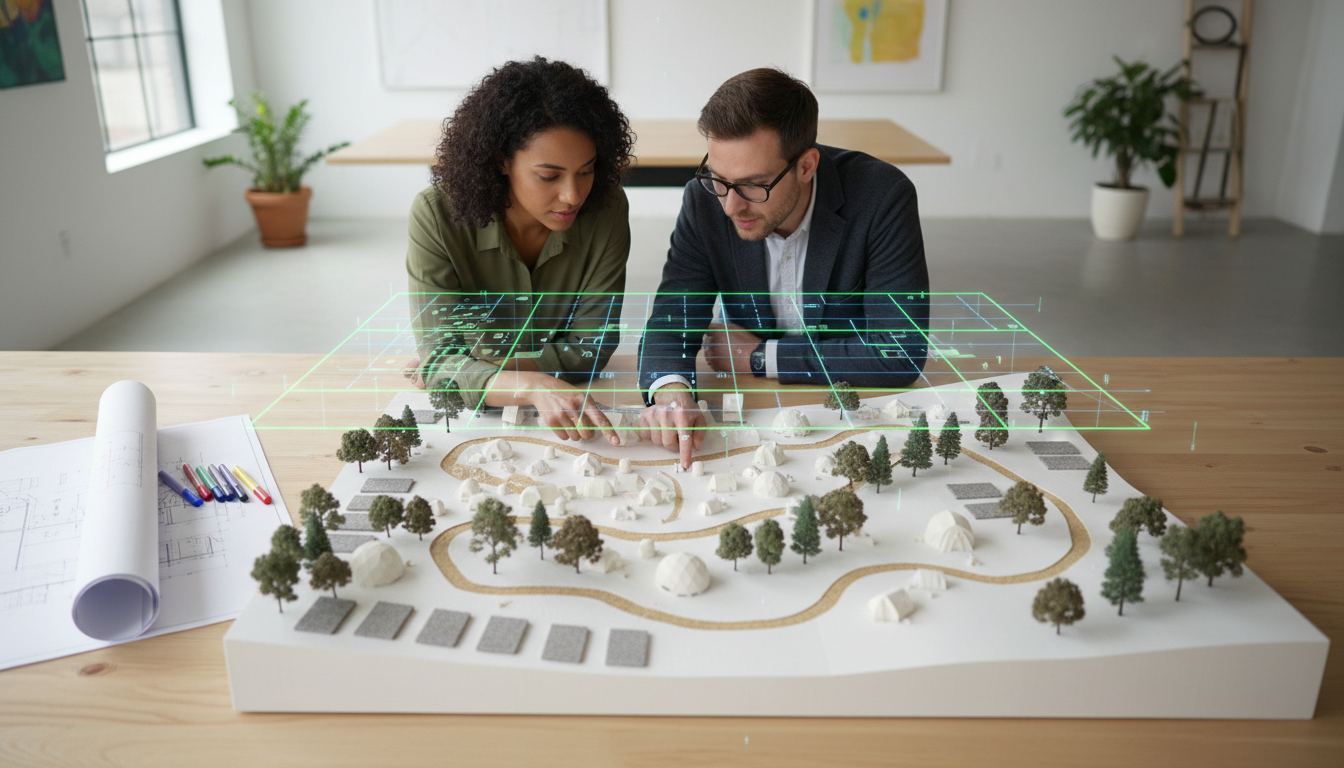
Now imagine opening a laptop in February, dragging those pads five feet east, flipping the bathhouse door, and watching a live heat map prove—before a shovel ever hits dirt—that the traffic jam, shade problem, and drainage issue are gone. That’s the promise of a digital twin: a living 3-D replica of your park that stress-tests every layout idea against real-time data while you sip coffee in the office.
Want to see how early adopters are squeezing extra nights, add-on sales, and kilowatts out of the same acreage—often within one peak season? Keep reading; the campsite of the future starts with a clone.
Key Takeaways
• A digital twin is a live 3-D computer copy of your campground.
• You can test new pad spots, doors, and paths on the screen before digging.
• Tiny sensors send real-time info on crowds, shade, water, and power to the twin.
• Fixing problems in the twin first saves money, time, and guest headaches.
• Start with one busy loop, watch four numbers (stay length, add-on sales, work hours, utilities), then grow.
• Long-range radios (LoRa), Wi-Fi, and solar power keep sensors talking in woods, sand, or snow.
• The twin links to your booking and sales tools, opening clean sites and suggesting upsells on its own.
• Zone-level data keeps guest privacy safe—no personal tracking needed.
• Parks that try a twin often earn back the cost in one peak season..
How a Living Replica Powers Better Decisions
A digital twin is more than a pretty 3-D map. It updates continuously, pulling in sensor feeds and guest-flow data so operators can observe, simulate, and refine in an endless loop. Researchers call this the monitor–analyse–optimise–revalidate cycle, and they’ve documented major comfort and energy gains in heritage sites that follow it heritage study. Campgrounds share the same pain points—bottlenecks, shade, drainage, emergency access—minus the luxury of ballroom ceilings and carpet.
Cloud services such as AWS IoT TwinMaker now package the heavy lifting with a hospitality spin, letting outdoor operators drag and drop pads, tents, bathhouses, and food trucks while heat maps and utility meters update second-by-second. The result is a sandbox where bad ideas die cheaply and good ideas get green-lit with proof. The twin becomes a decision engine that keeps learning, ensuring every future adjustment is rooted in data rather than guesswork.
The Road to Payback: Mapping Dollars, Not Just Dots
Financial clarity starts with choosing a profit-critical pilot zone—think your busiest premium RV loop. Scan or import that slice, sprinkle a handful of utility meters and foot-traffic counters, and run live for one peak season. Early adopters who followed this approach saved $1,800 in water leaks and added $2,200 in upsells from repositioned fire-pit bundles on just 12 sites.
Treat the LiDAR scan and core modeling as capital expenses, but bill the sensors and software as operating costs. That split keeps cash demands light and tax treatment friendly. Track a simple, board-ready quartet: average length of stay, add-on sales per site, maintenance hours per pad, and utilities per occupied night. When the dashboard shows gains, plow the winnings into the next expansion—no new capital call required and investors already primed by transparent KPI emails.
Turning Paper Maps into a Breathing Canvas
Most parks already own some geometry: a CAD file from the grading contractor or a GIS layer from the county. Drop that into a twin platform, and gaps show up in neon—missing elevations, tree canopies, slope. A one-day LiDAR sweep fills the blanks, capturing grade, canopy height, and even picnic-table coordinates.
Once geometry is solid, click “import” in the twin console and watch the campground pop into a browser. Now bind live data: electric smart meters, weather stations, Bluetooth occupancy beacons. In seconds the static drawing becomes a living environment that blinks and pulses as guests check in, AC units cycle, and storm clouds roll by. Every pixel is queryable, so the next shade experiment is a mouse drag, not a backhoe rental.
Connectivity That Shrugs Off Pines, Sand, and Snow
Forests and deserts laugh at hotel-style Ethernet. The workaround is a layered network: LoRaWAN handles low-rate sensors across miles, while Wi-Fi or cellular gateways sit in service buildings where power is reliable. Solar trickle charging and IP-67 enclosures keep devices humming for years, and mounting hardware above flood lines saves them from spring melt or monsoon runoff.
Before installing, run a radio-frequency survey with leaves on the trees and again after they’ve dropped; foliage shifts signal paths more than most owners expect. Build a mesh so if one gateway fails, packets hop to the next, avoiding the dreaded Saturday truck roll. Redundancy costs less than a single peak-season emergency service call and unlocks the 24/7 data stream a twin needs to stay alive.
Drag, Drop, Decide: Scenario Planning Without Excavators
Rotate pads 15 degrees and the model recalculates shade at 3 p.m., projecting lower AC usage and happier patio time. Shift a glamping tent cluster closer to the ridge view and pedestrian heat maps reflow instantly, showing shorter nighttime restroom walks. Researchers proved that a simple five-metre pathway nudge can double perceived comfort scores in heritage parks comfort study; campground pilots echo those gains.
Because the twin updates each second, you spot nonlinear surprises: moving the food truck 20 feet trims queue time but spikes noise near quiet-hour cabins. See it on screen, tweak again, and lock the plan only when every KPI—comfort, spend, utility load—sings in harmony. Risk stays virtual, wallets stay closed until certainty arrives.
From Incident Panic to Predictive Calm
On a July Saturday the twin’s dashboard lights up: restroom foot traffic in Loop B exceeds the hygiene threshold, and water flow spikes at site 42. Maintenance receives an auto-ticket, housekeeping a cleaning alert, and guest services a heads-up to nudge arrivals toward Loop C. What used to be a scramble is now a routine, data-driven choreography.
Tabletop drills during shoulder season cement adoption. Staff rehearse a storm evacuation virtually: rerouting golf carts, locking inventory, updating guest texts. Those who suggest data-backed tweaks—like reversing one-way lanes to halve exit time—earn recognition and coffee gift cards. Culture shifts from “another IT project” to “everyday superpower,” and ROI compounds as frontline improvements feed fresh ideas back into the model.
Plugging the Twin Into PMS, POS, and Revenue Streams
The richest data is worthless if it floats in its own silo. Pipe live occupancy from the twin into your reservation engine and let same-day inventory auto-open or close based on real-world capacity, smoothing power and water demand. Sync maintenance blocks so a site under repair disappears from online availability before a guest ever sees it.
Traffic patterns double as upsell cues. When a family books the site farthest from the pool, the system suggests a golf-cart rental. Add-on sales climb, and the twin tracks whether that extra vehicle congests the main loop. Weekly reviews merge revenue, operations, and guest-flow data so if the new communal kitchen boosts food-and-beverage spend but pinches pathways, you model an expansion before pouring concrete.
Sustainability That Shows Up on the Balance Sheet
A twin lets you test shade sails, deciduous tree lines, and prevailing wind angles long before nursery purchases or trenching. Fewer compressor cycles and natural runoff management translate to lower utility spend and less erosion repair. Studies confirm iterative digital-first design slashes resource waste across both temporary and permanent venues resource study.
Cloud dashboards expose kilowatt-hours and gallons per occupied night in real time. Eco-minded guests can see their own footprint via optional badges on the folio, turning operational discipline into marketing edge. Savings reinvested in solar rooflets or low-flow fixtures close the loop, letting sustainability and profitability reinforce each other season after season.
Respecting Guest Privacy While Counting Footsteps
Heat maps improve service, but guests deserve transparency. Collect only zone-level occupancy, not device IDs. Store operational sensor data separately from reservation PII, linking the two only when fulfilling a request—for example, routing a firewood delivery.
Simple signage—“Anonymous sensors keep facilities clean & safe”—paired with an opt-out at check-in covers most concerns. A tiny fraction decline, and their decision is logged without fuss. Rotating beacon addresses and following state privacy laws further insulate the operation from legal or reputational risk, keeping the twin an asset rather than a liability.
Ninety Days From Scan to Savings
The fast-track schedule below shows how quickly a pilot can move from idea to insight. Weeks 1–2: Capture geometry, pick four KPIs, and brief every department so they know what success looks like. Weeks 3–6: Install sensors in the pilot zone, stand up the LoRaWAN mesh, and customize role-based dashboards. By the end of week six, you should have a living model streaming real data to every screen that matters.
With the infrastructure humming, Weeks 7–10 focus on live operation: run during shoulder season, collect baselines, and hold two tabletop drills to rehearse incident response. Weeks 11–12: Crunch the numbers, share results with staff and investors, and green-light the next phase armed with evidence, enthusiasm, and momentum. By the close of the twelfth week, the twin should be driving measurable improvements that justify expansion across the rest of the property.
Some operators will spend the off-season guessing; others will spend it rehearsing success inside a living replica of their park. Insider Perks can get you there—combining campground-specific marketing savvy with AI-driven modeling and automation that plug directly into your PMS, POS, and revenue stack. Let our team scan, simulate, and fine-tune your layout so you roll into opening day with evidence on your side and competitors in your rear-view mirror. Ready to see the future of your property before the first reservation drops? Connect with Insider Perks today and start building the smartest site map you’ll never have to print.
Frequently Asked Questions
Q: What exactly is a digital twin and how is it different from a 3-D map?
A: A digital twin is a continuously updating virtual replica of your park that pulls live inputs—utility meters, weather feeds, occupancy beacons—so it can predict the impact of changes in real time, whereas a static 3-D map is just a drawing that never learns or reacts.
Q: How much does it really cost to get started and when should I expect payback?
A: A focused pilot on one premium loop typically runs $8–12 K for the initial scan, connectivity hardware, and first-year software, and operators who track four core KPIs usually see enough savings and upsell lift to break even within one peak season and turn cash-positive by the following shoulder.
Q: My park is only 75 sites—does a digital twin make sense at this scale?
A: Yes, smaller properties often see outsized benefits because a single bottleneck or drainage error can hurt a larger percentage of inventory, and the lighter footprint means fewer sensors and faster modeling, keeping both cost and complexity low.
Q: What kinds of sensors do I need and where do they go?
A: Most pilots rely on smart electric meters at pedestals, battery-powered people-counting beacons at restrooms and amenities, a weather station, and a few water-flow monitors on suspect lines, all of which can be zip-tied to existing posts or utility risers with no trenching.
Q: We have spotty Wi-Fi under the pines—will the system still work?
A: The platform uses a LoRaWAN backbone that reaches a mile or more through foliage for low-rate data, then backhauls through any building that already has DSL, cable, or even a data-capped cellular hotspot, so full-time fiber is helpful but not required.
Q: How do I make sure guest privacy isn’t compromised by all this tracking?
A: Occupancy beacons are set to collect anonymized zone-level counts without grabbing phone IDs, and operational data remains siloed from reservation PII, so posting notice at check-in and offering a simple opt-out keeps you compliant with state privacy rules and guest expectations.
Q: Can the twin integrate with my existing PMS and POS software?
A: Most commercial twin platforms expose standard APIs that let you push live occupancy, maintenance blocks, and add-on sales data directly to property-management and point-of-sale systems such as Campspot, Newbook, or Lightspeed without custom coding.
Q: How accurate are the simulations when it comes to shade, drainage, and foot traffic?
A: LiDAR scans capture grade within an inch and vegetation height within three inches, while real-time sensor feedback continually tunes the traffic and utility models, so each weekly data cycle tightens the correlation between what the model predicts and what happens on the ground.
Q: What kind of staff training is required to use the dashboards day-to-day?
A: Front-office and maintenance teams can usually master the role-specific dashboards in a two-hour session, after which most interactions are point-and-click tasks like approving a layout tweak, acknowledging an auto-generated work order, or pulling a weekly KPI snapshot for owners.
Q: What happens if a sensor fails during a holiday weekend?
A: The network is built with self-healing mesh routing that reroutes packets automatically, and the dashboard flags the missing device so you can swap a $40 sensor at your convenience instead of dispatching an emergency technician.
Q: How do I expand the twin once the pilot loop proves itself?
A: You simply scan the next block of sites, drop additional sensors as needed, and the platform stitches the new geometry and data feeds into the existing model so every future decision—whether it’s a new glamping zone or a solar array—benefits from the growing digital foundation.