

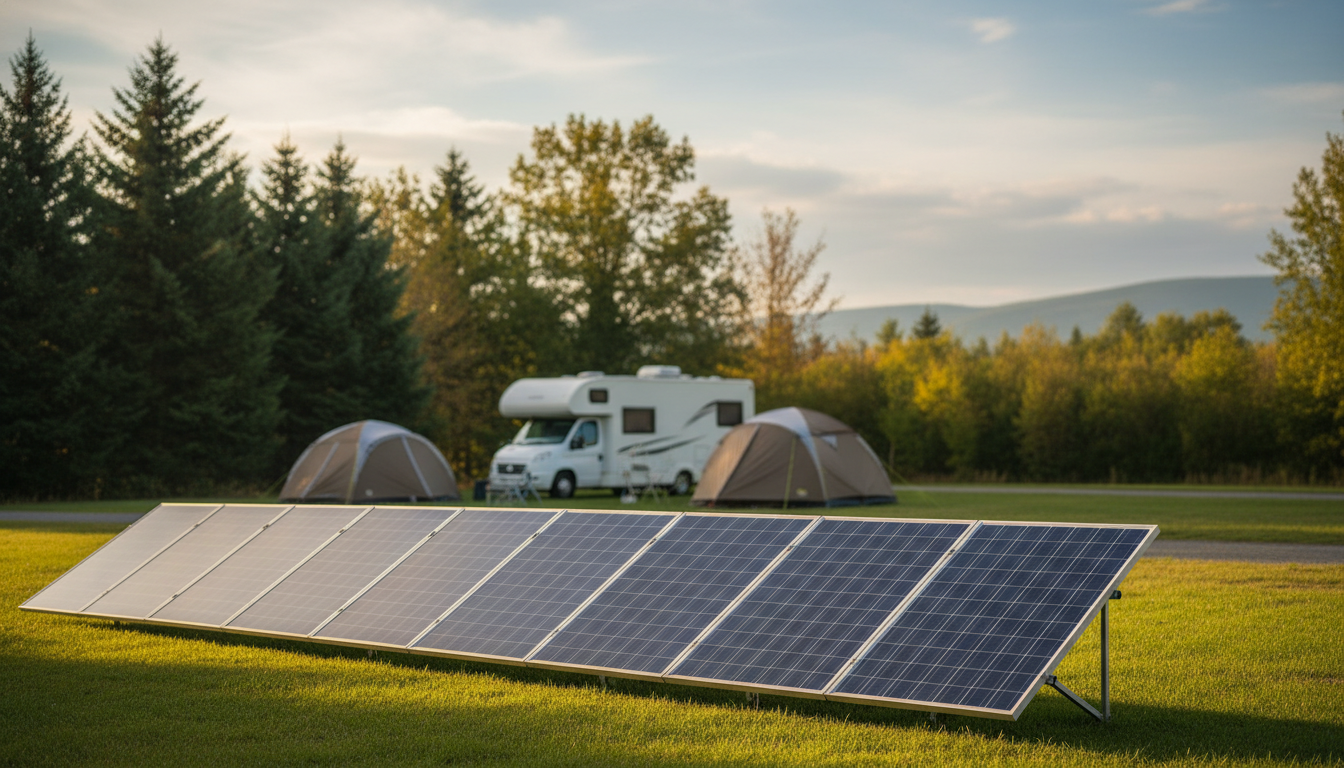
Right now, campground and resort owners are staring at a national 6-to-10-year payback—under three years in high-rate markets like Hawaii—but a looming 2025 tax-credit sunset could tack on 43 % overnight.
Want your panels to break even in “seven summers” instead of “two decades”? Curious how a carport canopy can shade rigs, slash bills, and still hit profit mode before the inverter warranty expires? Keep reading; the next few minutes could save you six figures and a whole lot of rate-hike headaches.
Key Takeaways
– Payback time means how long the panels need to earn back their cost; shoot for under 7 years.
– Most parks break even in 6–10 years; very high-rate places like Hawaii can do it in 2–3 years.
– The 30 % federal tax credit drops after 2025; waiting could make payback about 43 % longer.
– High power prices and lots of sun speed up payback; cheap power and shade slow it down.
– Use a full year of electric bills and size panels for average yearly use, not just summer peaks.
– Put panels where shade can’t hit them; carport canopies also give guests cool, covered spots.
– Wash and inspect panels twice a year; trim plants to keep sunlight flowing.
– Loans or power-purchase agreements can give positive cash flow right away.
– Sharing your solar story can draw eco-friendly guests and even new income streams.
Why Years-to-Breakeven Rules the Decision
Payback is the clean, single KPI that turns a complicated solar spreadsheet into an easy yes or no. If the array covers its own cost inside the average ownership horizon—roughly seven to ten years for many family-run parks—it stops being a risky capital outlay and becomes a line-item profit engine. Every month after breakeven sees utility savings drop straight to the bottom line, and that momentum builds resale value just as predictably as a new bathhouse does.
The number also gives you leverage with partners and lenders. Showing a five- to seven-year breakeven backed by federal tax credits, escalating utility rates, and real-world case studies quiets doubts faster than any green-branding argument. Conversely, a fifteen-year timeline flags hidden issues—cheap power, oversizing, or poor site layout—early enough to fix before you sign a contract.
National Baseline: 2025 Numbers and the ITC Clock
EnergySage pegs the average 2025 commercial payback at six to ten years, with most properties clustering around the lucky-seven mark. That projection assumes today’s 30 % Investment Tax Credit (ITC) and only modest utility inflation—an assumption that looks conservative when you consider recent double-digit summer rate hikes in several states. Arrays then run another 18–23 years at low cost, banking $30,000 to $100,000 + in lifetime savings depending on size and region.
The catch? If Congress lets the credit phase down after 2025, analysis shows payback balloons by roughly 43 %. Owners filing under Section 48E still lock in 30 % through 2026, but that buffer shrinks annually afterward. Translation: permitting now, instead of next year, could shave three to four years off breakeven—arguably the single easiest ROI lever available.
Rates and Sun: Geography Swings ROI
Utility rates and solar irradiance set the stage before you request a single proposal. A beachfront park on Kauai paying over 40 ¢/kWh can hit payback in 2.4 years. Meanwhile, a Wasatch-front glamp ground in Utah staring at 10 ¢/kWh might wait two decades for the same system to cross even. Neither operator can change the sun or the tariff, but both can stack incentives, optimize sizing, and fine-tune layout to pull their number toward the low end.
Most of the U.S. clusters in a comfortable middle. California, New Jersey, Massachusetts, and much of the Northeast usually see five- to seven-year paybacks thanks to state SRECs, property-tax abatements, and higher retail power. If you’re unsure where your park lands, grab twelve months of bills, plug the kWh rate into a free online break-even calculator, and you’ll have a reality check before the first installer walks the property.
Sizing the System for Seasonal Loads
A year’s worth of electric bills is more valuable than the slickest production model. July’s peak-season A/C surge might double—or triple—January’s draw on a partially shuttered park. Size the array for average annual consumption, not the single hottest afternoon, or you risk exporting pennies-on-the-dollar surplus that drags payback years into the future.
Monthly netting in many territories lets fat summer generation erase spring and fall bills, so the right sizing sweet spot often sits just below annual demand. Parks that close in winter can go smaller still and pair panels with a modest battery to cover security lights and gate motors. Thinking of adding a heated pool or mini-split-equipped glamping domes? Re-run the load model while you can still upsize wire gauges and trenching routes for a fraction of retrofit cost.
Layout Choices That Protect Production
Tree canopies and pull-through lanes look innocent until a single 4 p.m. shadow clips annual output by double digits. Mapping shade lines through all four seasons prevents that slow bleed. Many owners tuck ground mounts along a perimeter fence or over a low-use parking strip, preserving guest space and shortening conduit runs.
Rooftop arrays on bathhouses or clubhouses avoid guest interaction entirely, but only if the roof will last as long as the panels. Carport canopies over RV or EV spots often pull double duty—generating power while scoring five-star reviews for shaded parking. In snow country, a steeper tilt angle sheds drifts naturally, keeping maintenance passes to a minimum and winter production humming.
Maintenance Habits That Preserve Savings
Solar may be low maintenance, but it’s not no maintenance. A bi-annual walk-through each spring and fall catches loose wiring, cracked connectors, or that persistent robin nest trying to tuck twigs beneath the array. Light cleaning with de-ionized water and a soft brush once or twice a year keeps output on spec; desert parks battling dust devils might need quarterly rinses.
Vegetation is the stealth saboteur. Keep shrubs at least three feet below the lower panel edge, and you sidestep shade creep that can wipe out a year of savings before anyone notices. Assign an in-house “solar champion” to log inverter data monthly—five minutes of dashboards that can flag a blown fuse well before busy season. One $30 repair beats $1,000 in lost production every single time.
Financing Models and Cash Flow
Cash isn’t king if it handcuffs your next cabin build. Many parks hit positive year-one cash flow by stretching a solar-specific loan over 12–15 years while the nominal payback still lands inside eight. Interest is often offset by the 30 % ITC and year-one MACRS depreciation, letting you bank savings without draining reserves.
Power-purchase agreements shift the entire upfront cost and ongoing maintenance to a third party in exchange for a fixed per-kWh rate. That can be the perfect move for an owner eyeing a sale in five to seven years, though you’ll forfeit the tax credit upside. A hybrid—paying 20–30 % in cash and financing the rest—builds equity faster while keeping contingency capital free for trench surprises or main-panel upgrades. As these financing choices come together, the next logical step is learning how to turn the array itself into a guest-facing amenity.
Turning Panels into Guest Revenue
Solar isn’t only an expense reducer; it’s an amenity that books sites. Highlight the array in OTA listings and watch green-minded travelers click-through at higher rates. Carport canopies with Level-2 chargers let you charge a modest EV fee while converting electrons into Instagram stories about a “zero-emissions road-trip stop.”
On-site storytelling cements the brand. A simple sign showing annual CO₂ offsets turns a silent rooftop into a conversation piece. Host an Earth Day dry-camping giveaway or a behind-the-scenes solar tour, and suddenly your marketing team has authentic content instead of staged photo-ops. Transparency counts, too; sharing year-over-year utility savings with partners primes the pump for the next green upgrade.
Snapshot Case Profiles
A 20-site beach park on Kauai installed a 30 kW ground mount and reached breakeven in 2.5 years, thanks to sky-high retail rates and a sunnier-than-average sky. Utility savings now finance a battery bank that will take the office off-grid during hurricane season. The owner now uses the array’s performance data as a featured stat in marketing emails to eco-minded travelers.
A 150-site RV resort outside Boston opted for a 250 kW carport canopy and hits the six-year mark next spring, buoyed by SRECs and premium shaded parking fees. Meanwhile, a 60-site Utah glamp ranch paused its 40 kW rooftop proposal after modeling an 18-year payback; the owner plans to revisit the project if rates climb or the ITC narrows. Both parks illustrate how regional rate structures and incentive stacks can swing ROI just as much as sunshine hours.
12-Step Action Checklist
Even the clearest vision stalls without a roadmap. A concise, ordered checklist turns theory into traction, guiding owners from utility-bill download to ribbon-cutting without overlooking a single permit or shade study. By following the steps below in sequence, you minimize rework, capture every incentive deadline, and keep trench crews and marketing teams moving in lockstep.
Treat this checklist as a living document. Update it whenever state incentives change, when seasonal load profiles shift, or after you learn something new from your installer’s production monitoring. Sharing the refined list with neighboring park owners can even position you as the local authority on solar, turning collaborative knowledge into community clout.
1. Pull twelve months of utility bills, noting kWh and demand charges.
2. Gather current per-kWh rates and track their last five-year escalation.
3. Plug those numbers into an online calculator for an initial payback estimate.
4. Map shade patterns, future cabins, and trench paths on a site plan.
5. Request three installer quotes, each modeling production on average annual load.
6. Verify roof ages or designate a ground corridor.
7. Decide on cash, loan, or PPA, reserving 5–10 % for contingencies.
8. File for federal and state incentives early.
9. Train an in-house maintenance lead.
10. Plan guest-facing signage.
11. Earmark first-year savings for the eventual inverter swap.
12. Celebrate every utility bill that arrives smaller than the last.
The math says the sooner you flip the switch, the sooner every sunrise starts padding your P&L. The story you tell about that switch is what turns a smart utility decision into a guest-magnet brand advantage. When you’re ready to turn kilowatts into click-throughs—and automate the whole journey from Google search to gated check-in—tap the team at Insider Perks. Our marketing, advertising, AI, and automation tools were built for outdoor hospitality, so your solar ROI shines online just as brightly as it does on the meter. Let’s make your next seven summers unforgettable.
Frequently Asked Questions
Q: How do I calculate the payback period for my specific park rather than rely on national averages?
A: Pull a full year of electric bills, total the kilowatt-hours and demand charges, then plug those numbers—plus your proposed system size—into a reputable online solar calculator or an installer’s modeling software; the tool will combine your local utility tariff, available incentives, and solar irradiance data to project annual savings and show how many years it takes for those savings to equal the installed cost after tax credits.
Q: What happens to payback if the 30 percent Investment Tax Credit drops or expires?
A: If Congress lets the credit fall off, the upfront cost you must recover rises by roughly 43 percent overnight, which can stretch a seven-year payback to ten or more; starting design and permitting now locks in today’s 30 percent rate for projects placed in service before the phase-down schedule bites.
Q: My park shuts down in winter—will that ruin the economics?
A: Seasonal closures usually shorten, not lengthen, payback because you can size the array for annual—not peak—consumption, slash shoulder-season bills to near zero, and still earn net-metering credits from summer overproduction that roll through the months when the main meter barely spins.
Q: Should I oversize the system to cover future cabins, EV chargers, or a heated pool?
A: It’s cheaper to oversize conduit and breaker space now but size the array for today’s verified loads; you can add panels later under existing wiring capacity once expansion plans and utility rates are clearer, keeping initial payback tight and avoiding years of low-value surplus exports.
Q: Are carport canopies worth the premium compared to ground mounts or rooftops?
A: Although carports run 10–20 percent more per watt, they generate shaded parking revenue, protect rig finishes, and often produce better angles than flat roofs, so the incremental cost is usually recovered within the same payback window while boosting guest satisfaction scores.
Q: How does financing affect the payback calculation?
A: The technical payback period—years until cumulative savings equal total installed cost—stays the same, but a 12- to 15-year solar loan can put you in positive cash flow the first season by spreading payments below monthly utility savings, effectively turning breakeven math into an immediate operating surplus.
Q: What kind of maintenance budget should I expect after installation?
A: Most parks spend $0.01–$0.03 per watt annually—usually two visual inspections, a light cleaning, and minor vegetation control—which is baked into the payback models and is far less than even modest utility-rate hikes erase in a single year.
Q: Will hail, snow, or guest damage void warranties or slow payback?
A: Tier-1 panels are tested for one-inch hail at 50 mph, backed by 25-year power warranties, and covered by standard commercial property insurance riders, so weather-related downtime is rare; any isolated breakage is quickly swapped under warranty with negligible impact on cumulative savings.
Q: How does adding battery storage change the numbers?
A: Batteries rarely accelerate pure payback because they add cost, but they can flatten demand charges, provide backup during grid outages, and let you store midday overproduction for evening peaks, turning a marginal eight-year solar payback into a more resilient, still-acceptable ten-year solar-plus-storage package.
Q: Can solar increase the resale value of my campground or resort?
A: Yes—appraisers typically capitalize post-breakeven annual savings at market cap rates, so a system saving $20,000 a year can add $200,000–$300,000 to property value, often outstripping what you paid even before you finish depreciating the asset.
Q: Will installing solar complicate a future property sale or refinancing?
A: Lenders view owned solar as a fixed asset that reduces operating expenses, and PPAs can be assigned to a buyer with minimal paperwork, so as long as you keep copies of the interconnection agreement and service records, solar usually streamlines, not hinders, due diligence.
Q: How soon should I start the permitting and interconnection process?
A: Submit applications as soon as your preliminary design is in hand because utility and AHJ queues can stretch three to six months; early filing also establishes your eligibility for current incentives and secures grid capacity before neighboring developments soak up the remaining allotment.
Q: Can I market the array to guests to recoup costs faster?
A: Absolutely—highlighting solar in listings, offering shaded premium sites, or adding a modest EV charging fee converts electrons into new revenue streams that can shave several months off breakeven while differentiating your park in a crowded OTA search.