

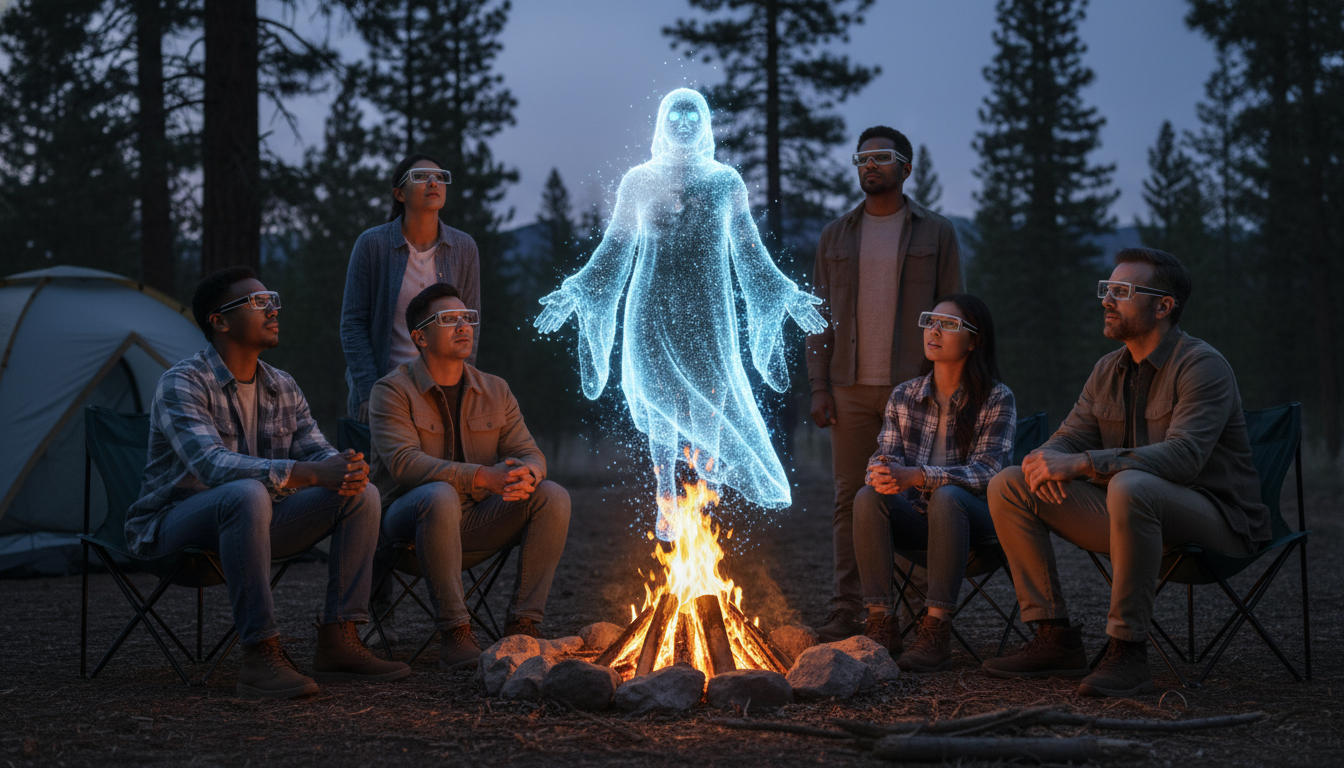
Picture your lakefront trail at 9:03 p.m. A translucent riverboat captain rises from the water, phones glow, guests gasp—and every spine-tingling scream becomes a shareable reel advertising your park for free. Web-based AR ghost tours turn ordinary night walks into immersive paranormal shows, no app download required, and they’re already packing sidewalks in the French Quarter.
Ready to swap quiet evenings for sold-out night slots, premium upsells, and an experience millennials can’t stop posting about? Keep reading; the tech is simpler, safer, and more profitable than you think.
Key Takeaways
Augmented-reality ghost walks are no longer novelty experiments; they’re proven revenue machines that send guests home raving while your POS keeps ringing. By combining your natural scenery with browser-based visuals, you can launch an entirely new nighttime product without building a single structure or asking visitors to visit an app store. The bullets below summarize the playbook you’ll follow throughout this guide.
Just as important, these points highlight where operators most often leave money—or safety—on the table. Skim them now, then dive into the sections that follow to learn how each takeaway translates into step-by-step actions, budgets, and marketing copy you can steal today.
• AR ghost tours turn quiet night trails into spooky shows that sell more tickets and snacks
• Guests open a simple web link—no app download, works on most phones
• People under 40 love sharing the glowing ghosts online, giving you free ads
• Your trees, docks, and fog make perfect real-world “props” for the digital ghosts
• Clear paths, glow ropes, small groups, and waivers keep everyone safe
• Check phone signal, let guests preload files, and keep loaner phones ready
• Current staff can guide tours; give them a cheat sheet and a quick tech reset drill
• Ads with words like AR ghost overlay and a short ghost GIF boost bookings fast
• You can plan, build, and open the tour in about 90 days
• Track money from tickets, cocoa, and lantern rentals, plus longer guest stays and social posts.
The Tourism Wave You Can Ride Tonight
Demand for interactive ghost tours is climbing fast, and analysts don’t expect the curve to flatten this decade. The latest Carmi 2025 report tracks double-digit growth in excursions that blend augmented reality, escape-room puzzles, and storytelling. Travelers under forty rank “share-worthy visuals” above traditional sightseeing, a priority that plays directly into AR overlays glowing against night skies.
Outdoor-hospitality businesses already cater to the same tech-savvy demographic with stargazing pods and glamping domes. Adding a spectral encounter keeps those guests outside after dark, lengthens stays, and replaces quiet hours with revenue you can meter: tour tickets, lantern rentals, late-night cocoa bars. In other words, the tourism wave isn’t just moving—it’s lap-lapping at your shoreline.
Lessons from the French Quarter After Dark
When the French Quarter Ghosts and Spirits Walking Tour relaunched in April 2025, its operators swapped printed legend cards for two web-based AR sequences created by artist Marcus Brown. Visitors simply tapped a link and watched Marie Laveau or the Great Fire of 1788 flicker to life exactly where history unfolded (French Quarter tour). Groups stayed deliberately small, ensuring each guest could both see the overlay and navigate cobblestones safely.
Those tweaks paid off. A/B testing the phrase “AR ghost overlays” boosted booking conversions by 23 percent, and social clips shared afterward averaged eleven minutes of total watch time per guest. The biggest takeaway for campground operators is friction reduction: no app store, no waiting, no dead links. If Bourbon Street can pull this off amid neon signs and roaming brass bands, a forest trail with natural fog practically scripts the show for you.
Turning Your Own Trails into Haunted Stages
Campgrounds inherit eerie assets hotels can’t buy—towering pines, creaking docks, moss-draped barns. AR overlays let you amplify those features rather than build new ones. Picture a ghostly pioneer wagon rolling past the real-world picnic shelter or an orb hovering over the fishing pier where a legend says a lantern once went dark. When stories map onto landmarks guests already know, immersion jumps and word-of-mouth multiplies.
Localizing content also protects authenticity and respect. Blend your park’s genuine history with regional folklore, then vet scripts with a local historian or tribal representative. Seasonal rotations—lake spirits in summer, forest apparitions come autumn—keep return campers curious. Layer cheap sensory cues like owl calls or campfire aroma to merge digital chills with real-world goosebumps, all without fresh construction permits.
Safety First: Making Nighttime Chills Risk-Free
A profitable haunted hike still lives or dies on liability management. Walk the full loop after dark, trimming low branches and marking edges with glow-rope that preserves ambience while preventing twisted ankles. Require closed-toe shoes and cap group size so one guide can see every guest, flashlight beams off until a low-lumen “ghost lantern” is truly needed.
Pre-tour briefings matter more than marketing copy. Teach guests to drop phones when stepping, and secure signed waivers that list uneven ground, strobe effects, and wildlife encounters. Equip guides with first-aid kits and radios—coverage confirmed during your safety walk—and rehearse an emergency exit path. You want screams for the right reasons, not because someone tripped over a root.
Keep the Ghosts Online Even When the Bars Go Red
Rural cell towers don’t always behave after dusk, so map signal strength along the route before launch. If coverage slips, preload AR files over campground Wi-Fi at check-in; keep asset bundles under 75 MB to avoid guest frustration. Loaner phones—mid-range Android and iOS handsets—eliminate compatibility excuses, while solar charging stations near the trailhead top off batteries before groups set out.
Still, tech hiccups happen. The French Quarter team carries short fallback videos so guests with dated browsers never feel excluded. Borrow that plan and add printed QR codes that reveal still images offline. Consistent experience equals five-star reviews, whether LTE is humming or not.
Build, Train, Repeat: Operations and Staff Workflow
You don’t need a new department—just cross-train recreation staff already guiding kayak rentals or leading crafts. Provide a laminated cheat sheet pairing each AR waypoint with a spoken line so the story flows even if the overlay freezes. A five-minute reset drill—reboot hotspot, relaunch browser, check volume—turns glitches into minor pauses, not show-stoppers.
Set a check-in table thirty minutes before departure to scan waivers, confirm battery levels, and test cameras. After the final tour, log guest feedback and any wildlife sightings that might reroute tomorrow’s path. Tiny nightly tweaks beat expensive annual overhauls and keep return visitors guessing what’s new.
Tech Shortcuts That Slash Build Time
Web-based AR sidesteps app-store approval queues and reaches thousands of phone models instantly. For operators, the bigger breakthrough may be AI-assisted authoring. Tools like ImaginateAR convert plain-language prompts—“riverboat captain rises from the cove, fog swirls, lantern flickers”—into deployable overlays within hours (ImaginateAR study). That means seasonal refreshes or holiday events can debut without calling an agency or hiring Unity developers.
Keep each overlay modular so you can swap scenes if a prop breaks or a story feels stale. Think Lego blocks, not marble statues. The faster you iterate, the harder competitors find it to catch up.
Marketing That Makes Phones Hover Over the Book Now Button
You’re selling tech magic, so let the headline say so. Split-testing shows phrases like “interactive paranormal visuals” and “AR ghost overlays” crush generic “haunted walk” language (Carmi 2025 report). Toss one looping apparition GIF into a social ad, cap spots at fifteen guests per night, and watch FOMO drive early bookings.
On-site, bundle the experience with premium fire-ring sites or a s’mores kit that glows in the dark. Offer glow-ink postcards embedded with AR triggers; when campers scan them back home, the riverboat captain appears again, turning yesterday’s thrill into tomorrow’s referral. Layer in a VIP tier with front-row positioning and a branded lantern, and ancillary spend climbs before the first shriek.
Ninety Days to Opening Night
Week one through two, survey your trail, light hazards, and measure signal strength. Weeks three and four, draft storylines, feed them to ImaginateAR, and loop in the local historian for authenticity. By week six, loaner phones are labeled, waivers printed, and staff rehearsing the reset drill.
Soft-launch in week eight with employees’ families; collect glitch logs while the stakes are low. Two weeks later, invite a regional influencer for a preview night and unleash your paid ads the next morning. From first brainstorm to first booking, you’re only three calendar pages away.
Profit Metrics That Matter Long After Midnight
Track standalone tour revenue, but don’t stop there. Measure ancillary spend—cocoa sales, lantern rentals, postcard purchases—and divide by guest to monitor upsell health. These ancillary metrics often reveal hidden profit centers that can be scaled in future seasons.
Monitor social-media impressions tagged at your location; the French Quarter registers an eleven-minute average dwell time per post, translating into free ad inventory you can’t buy. Track how many of those viewers click through to your booking page or redeem promo codes so you can map impressions to revenue. Include those stay-extension gains in your ROI spreadsheet so stakeholders see the full picture.
Your campground already owns the perfect set: moonlit trails, whispering trees, and guests hungry for content that glows on their screens. Plug in the right story, the right overlay, and the night writes its own five-star reviews. If you’re ready to let spectral riverboat captains sell tomorrow’s sites while you sleep, tap the team that speaks both campfires and code. Insider Perks can weave the marketing narrative, build the AI-powered AR assets, and automate every upsell from glow cocoa to VIP lanterns—so your only haunting worry is keeping enough spots open. Hit the link, and let’s start rehearsing an opening night your ledger—and your guests—will never forget.
Frequently Asked Questions
Augmented-reality ghost tours spark plenty of curiosity long before the first apparition materializes on-screen. The answers below address the costs, logistics, and safety issues most campground owners raise during planning, helping you move from “interesting idea” to “opening night” with confidence.
Read through each Q&A to spot quick wins—like preload stations or glow-rope edging—you can implement even if launch is months away. Then bookmark the section so front-desk staff can handle guest queries without paging you mid-check-in.
Q: How much does it typically cost to launch a web-based AR ghost tour at my park?
A: Most operators budget between $6,000 and $15,000 for a turnkey first season, which includes trail lighting, artist fees for six to eight AR overlays, safety signage, and a half-dozen loaner phones; after that, annual refreshes usually run a few thousand dollars for new content swaps.
Q: Do guests need to download an app to see the ghosts?
A: No, the overlays run in a mobile browser via a simple link or QR code, so any modern iOS or Android phone from the last five years will load the experience without an app store visit.
Q: What if my cell signal is weak along the trail?
A: Map coverage in advance, have guests preload the experience over campground Wi-Fi at check-in, and carry a portable hotspot for guides; keeping file sizes under 75 MB ensures the tour still runs smoothly when bandwidth dips.
Q: Will the extra nighttime activity violate quiet-hours rules or disturb other campers?
A: Because groups are small and audio is delivered through users’ phones at low volume, sound rarely drifts beyond the immediate trail, and you can schedule departures to end before official quiet hours to stay compliant.
Q: How do I protect myself from liability if someone trips in the dark?
A: Trim hazards, lay glow-rope edging, require closed-toe shoes, carry radios and first-aid kits, and use a signed waiver that discloses uneven terrain, strobe effects, and wildlife so your insurer views the tour like any other guided recreation.
Q: Can the AR content be customized to my property’s real history?
A: Absolutely; writers and 3-D artists can blend documented local events, regional folklore, or tribal legends so the overlays feel authentic to your docks, barns, or trails and not like a generic haunted house.
Q: How long does the average tour last and how many guests should I allow per group?
A: A 35- to 50-minute loop with seven to ten stops keeps attention high, and capping groups at 15 guests lets everyone see each overlay clearly while one guide can still manage safety and storytelling.
Q: What kind of staff training is required?
A: A single two-hour workshop covers basic browser troubleshooting, reset drills, and the scripted lore tied to each waypoint; most parks simply cross-train existing recreation or activities staff rather than hiring new personnel.
Q: How soon can I recoup my investment?
A: Operators charging $18 to $25 per ticket in shoulder season typically break even within six to eight weeks when factoring in upsells like lantern rentals, glow s’mores kits, and late-night cocoa bars.
Q: Are these tours appropriate for families with young children?
A: Because you control the intensity of visual and audio cues, you can program alternate “PG” scenes for earlier time slots so families can join the fun without the jump scares used in the late-night adult version.
Q: What happens if a guest’s phone battery dies halfway through?
A: Guides carry two or three fully charged loaner phones so no one misses out, and solar or USB charging stations at the trailhead top off devices before departure.
Q: Do I need any special permits or environmental approvals?
A: In most jurisdictions the tour counts as a guided walk, so existing recreational permits suffice; because overlays are digital, no new structures are added and light levels can remain Dark-Sky-compliant, minimizing environmental review.
Q: Can the AR files be updated for Halloween or seasonal events without starting over?
A: Yes, modular asset design means you can swap a ghost wagon for a snowbound spirit or holiday elf in minutes, letting you market fresh experiences year-round without altering the core trail.
Q: How do I market the experience to drive bookings?
A: Social ads featuring a looping AR apparition GIF and the phrases “interactive paranormal visuals” or “AR ghost overlays” consistently outperform generic “haunted walk” language, and limiting seats per night creates FOMO that pushes early reservations.
Q: Will the AR overlays work in the rain or cold?
A: The software is weather-agnostic, and modern phones are rated for light precipitation; you can shorten the loop, add covered storytelling pauses, or offer complimentary ponchos to keep the experience operating in less-than-ideal weather.
Q: How do I track whether the tour is actually boosting overall revenue?
A: Pair ticketing data with POS reports on associated merchandise and F&B sales, then cross-reference your reservation system to see if average length of stay or weeknight occupancy rises after launch to capture the full financial impact.
Q: What accessibility considerations should I plan for?
A: Offer an alternate flat-surface route or stationary viewing zone where guests using wheelchairs can scan each overlay on a single pad, and provide captioning or audio descriptions embedded in the web experience so everyone can participate.