

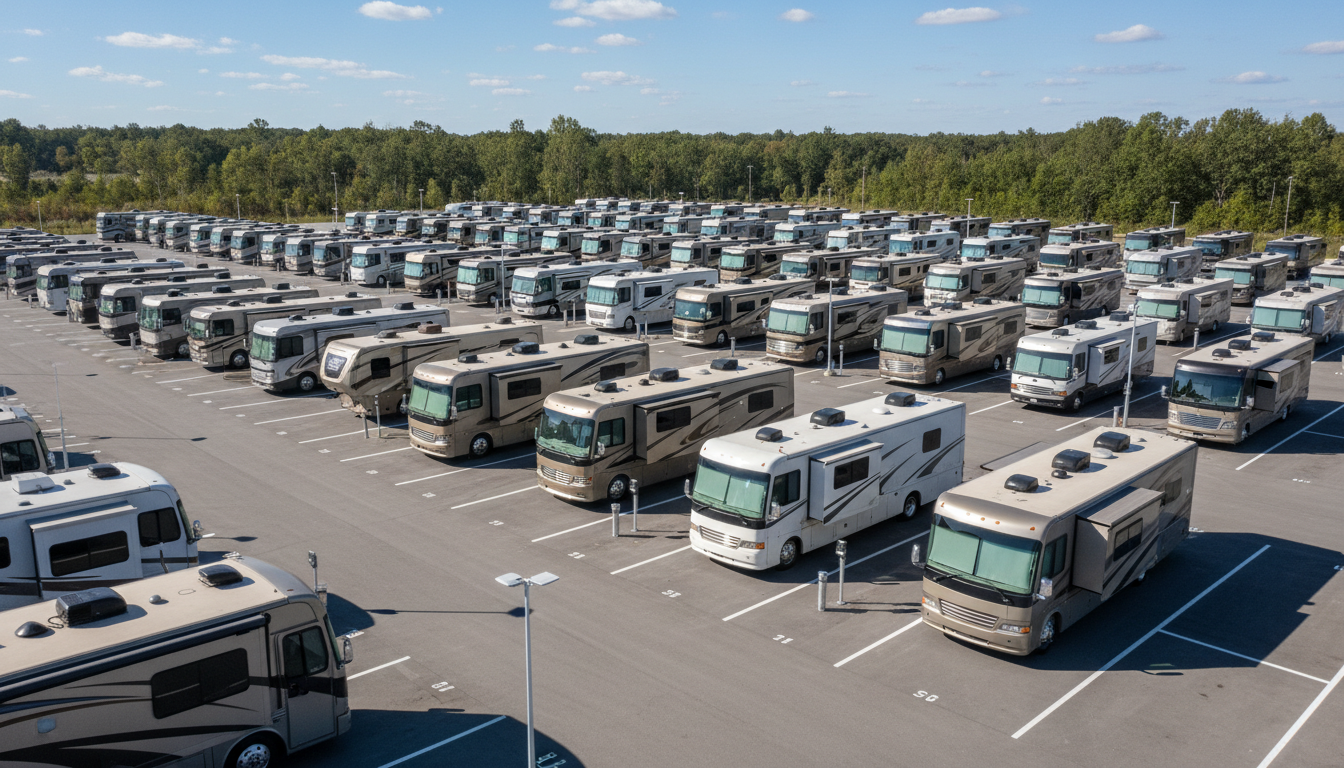
The next time a 45-foot diesel pusher lumbers toward your gate, imagine knowing—before the driver even shifts into park—exactly which site can swallow its slide-outs, how to route it down your widest lane, and what premium you can charge for the last available pull-through. That isn’t wishful thinking; it’s the new reality of AI-driven parking management.
From license-plate cameras that unlock gates only for rigs your system has pre-vetted, to dynamic maps that reroute guests in real time, artificial intelligence is quietly turning oversize-RV chaos into a high-margin amenity. Want to stop double-booking, shorten check-in lines, and sell late-checkout with one tap? Curious how a chatbot can upsell a 40-footer at 2 a.m. while your staff sleeps? Keep reading—your pavement could be printing money by the next busy weekend.
Quick Takeaways
• AI can match each big RV to the right site, guide it down the widest lane, and set smart prices
• Smooth, certain parking makes guests happier and spreads by word-of-mouth better than ads
• Fix basics first: wider roads, clear signs, trimmed trees, and staging space at the gate
• Collect four facts every time: rig length, height, slide-outs, and tow-vehicle length
• Choose a full package (like ParqEx) or build your own stack with sensors, cameras, and chatbots
• Run a short trial, show staff the wins, and give them a simple 3-tap override for backups
• Text links, QR codes, and in-app videos let guests check in, park, and add late checkout on their phones
• Protect networks: split guest Wi-Fi, use two-step logins, rotate codes, and auto-delete plate photos
• Results: up to 12 % more nightly revenue, 40 % less check-in labor, and big jumps in guest scores
• Roadmap: audit layout, start a 90-day pilot on big-rig spots, then scale park-wide.
The bullet list above distills the entire playbook into bite-size evidence you can pitch at the next owners’ meeting. It shows the progression—physical fixes, data discipline, tech choices, staff buy-in, guest touchpoints, security, and measurable ROI—so decision makers grasp the journey at a glance.
Keep this cheat sheet handy as you read on; each section below dives deeper into one or more of these points, giving you the context, examples, and step-by-step actions that turn quick takeaways into on-the-ground results.
Why Big-Rig Certainty Outperforms Bigger Marketing Budgets
The fastest-growing corner of the RV market is Class A and Super C coaches, yet nearly 40 percent of those owners say they bypass parks that “can’t guarantee an adequate site.” Every time a driver circles your loops hunting for space, review scores drop and referral traffic evaporates. Predictive parking—powered by AI—turns that liability into a differentiator visible in every star rating.
Because modern algorithms analyze historical arrival patterns, future reservations, and live occupancy, you can promise a spot with airline-level confidence. Operators leveraging these insights report immediate guest-satisfaction jumps and discover they can invest less in paid advertising, relying instead on word-of-mouth amplified by flawless arrivals. In crowded markets, certainty often beats a splashy ad campaign.
Eliminating Hidden Bottlenecks Before the Algorithm Goes Live
No amount of software can rescue a campground whose roads choke big rigs or whose signage sends them down dead ends. Oversize sites need to be at least 10–15 feet longer than the average Class A rig, laid out as pull-throughs or at wide 60-degree back-in angles so guests avoid multi-point turns. Internal lanes must measure a minimum of 24 feet, free of low branches, and splashed with reflective way-finding signs repeating site numbers and travel direction.
Painting high-contrast turn-radius lines or edging with pavers helps both human drivers and vision-based guidance systems align quickly, keeping traffic flowing. Reserve a staging zone near your entrance so an arriving behemoth can pause while the AI reassigns a space in real time. These physical tweaks erase bottlenecks that often get blamed on technology but really stem from asphalt and paint.
From Clean Data to Clean Turns: Feeding the Algorithm
Artificial intelligence loves structured information, so your reservation flow must collect the four inputs that matter most: overall rig length, height, number of slide-outs, and tow-vehicle length. Capture each via drop-down menus—“35 ft” instead of “thirty-five feet”—to keep the database uniform. Missing slide-out data is the number-one culprit when a 42-footer ends up shoehorned beside a tree.
Returning guests should confirm specs on every stay; yesterday’s roof rack becomes today’s clearance issue. Sync those profiles with your PMS so housekeeping, maintenance, and activity teams can prep the right way. Even if internet service falters, a simple paper backup sheet at check-in preserves data hygiene and lets the algorithm make good decisions later.
Choosing Tech That Scales With Your Ambition
Some parks want a turnkey solution that “just works.” For them, platforms such as ParqEx’s campground suite layer AI over remote monitoring, QR-code reservations, automated payments, and robust analytics, letting managers view live occupancy and reassign oversize spaces with minimal labor. Guests glide through contactless booking, and operators enforce rules without stationing staff at the gate.
Others prefer to build a modular stack. Precise ParkLink offers à-la-carte IoT sensors, mobile gateways, license-plate recognition, and dynamic pricing engines, so you can start with mobile payments and scale toward full AI enforcement. Whichever route you choose, integrate a conversational layer such as the Campspot × Insider Perks chatbot (proof here) to capture late-night bookings and upsell after hours.
Training Humans to Trust the Machines
Technology fails when staff treat it as an adversary. Run a two-week trial where employees use the AI but still note manual decisions, then compare outcomes every Friday. When the data shows faster check-ins and zero double bookings, even skeptics become advocates.
Provide a three-tap override guide so anyone—from the front desk to maintenance—can step in if a rare mismatch occurs. Cross-train multiple departments on the same dashboard, ensuring no arrival ever waits for the “one person who knows the system.” Daily 15-minute huddles during the first month surface glitches while memories are fresh and celebrate early wins like a holiday weekend without gate backups.
Guest Touchpoints That Feel Like First-Class Boarding
A pre-arrival SMS containing a dynamic map link lets drivers skip the office entirely, routing them down your widest lanes. Confirmation emails and entrance signs sporting QR codes allow late arrivals to pull up reservations, pay balances, and receive gate codes without waking your team. The end result is a seamless arrival sequence that feels as polished as a hotel valet lane.
Inside the guest app, a 60-second video demonstrates how to align with utilities, lowering anxiety and reducing torn-up sod. Real-time dashboards display open dump stations or propane lanes, automatically staggering traffic. On departure day, a smart notification invites guests to extend with one tap, applying dynamic pricing for late checkout and padding your margins.
Locking Down Data Before Hackers Knock
Every new sensor, camera, or payment gateway expands your attack surface, so segregate guest Wi-Fi from operational networks with a simple VLAN split. Require multi-factor authentication for any dashboard that can move money or reassign spaces. Rotate API keys and gate codes every 30, 60, or 90 days to limit exposure if credentials leak.
Store license-plate images only as long as needed for enforcement, then purge automatically to match privacy expectations and trim storage costs. Nightly cloud backups of configuration data ensure your AI engine can be rebuilt quickly after hardware failure or cyber incident, avoiding manual chaos on a holiday weekend. Those extra safeguards reassure guests that their personal data is guarded as carefully as their vacation memories.
Counting the Dollars Hiding in Plain Sight
Parks that implement dynamic oversize pricing routinely see an 8–12 percent bump in average daily rate for big-rig sites. Labor costs drop as platforms like ParqEx automate license-plate enforcement, giving back 40 percent of staff hours previously spent on check-ins.
Guest surveys show a 25-point Net Promoter Score jump once AI routing and contactless entry go live, driving repeat business that costs nothing to acquire. These gains ripple into secondary revenue streams as satisfied guests spend more on add-ons like propane refills and on-site activities. Combine revenue lift, labor savings, and higher loyalty, and the payback period for most systems lands comfortably under one season.
A Roadmap That Starts Small and Scales Fast
Begin with a quick audit of layout, signage, and data collection; patch physical blockers before flipping any digital switch. Next, decide between turnkey versus modular tech and bolt on a 24/7 chatbot to protect after-hours revenue.
Launch a 90-day pilot limited to oversize sites, tracking occupancy, revenue, and staff hours in a shared dashboard. When the metrics prove themselves, roll out dynamic pricing and automated enforcement property-wide, then iterate on guest experience features like real-time lane status. Scalability is built in—add more sensors, integrate loyalty programs, or deploy fleet discounts as your vision expands. Document each iteration so future managers can replicate the process without relearning the same lessons.
The takeaway is simple: the more effortlessly you park guests, the faster profits park themselves in your ledger. If you’d like expert guidance on fusing AI, automation, marketing, and advertising into a single revenue engine, the Insider Perks team is already clearing the way for parks just like yours. Click here to connect with us—then watch how quickly every oversize arrival turns into an oversize return on investment.
Frequently Asked Questions
Before you dive into the nuts and bolts below, remember that no two parks are identical, so treat these answers as a starting point rather than a finish line. They reflect averages gathered from operators who’ve already blended AI with real-world asphalt, giving you a realistic sense of costs, timelines, and guest reactions.
Read through the common queries, then jot down the three hurdles unique to your property. When you reach out for demos or quotes, you’ll be armed with targeted questions that move conversations from generic pitches to custom solutions in minutes.
Q: How much does an AI-driven parking system typically cost to install?
A: Most turnkey platforms charge an upfront hardware package starting around $8,000–$15,000 for cameras, sensors, and gateways, then a monthly SaaS fee of $4–$8 per site; modular stacks let you start for a few hundred dollars with license-plate recognition alone and add components as revenue grows, so total investment can be scaled to your cash flow.
Q: Can I layer AI on top of the reservation or PMS I already use?
A: Yes—providers like ParqEx, Precise ParkLink, and the Campspot × Insider Perks chatbot expose APIs or pre-built connectors that sync site maps, guest profiles, and payment data, so you rarely have to abandon your current PMS; you simply map site attributes and let the AI consume that data in real time.
Q: What physical upgrades are mandatory before the software will work well?
A: At minimum you need accurately measured oversize pads, 24-foot interior lanes, clear 13-foot vertical clearance, and reflective signage that matches your digital map; without that baseline, the algorithm can route perfectly on screen yet the coach will still scrape a branch or miss a turn in real life.
Q: How long will it take my team to learn and trust the new system?
A: Parks that run a two-week side-by-side trial—using the AI while still logging manual choices—find staff confidence builds in fewer than 10 operating days once they see faster check-ins, zero double bookings, and fewer radio calls for “site swaps.”
Q: Won’t guests resent paying higher dynamic rates for big-rig sites?
A: Surveys show Class A and Super C owners value guaranteed fit and friction-free arrival more than a small rate premium; when presented as a “Big-Rig Certified” option with instant gate access and concierge routing, guests accept 8–12 percent higher ADR without impacting satisfaction scores.
Q: What happens if power or internet drops during a busy arrival window?
A: The better platforms cache the last synced occupancy map on local hardware and can run in “offline mode” for several hours, printing or displaying a simple backup sheet that lets staff assign the next best site manually until connectivity returns, so service continuity is preserved.
Q: How is sensitive data like license-plate imagery kept private and compliant?
A: Images are encrypted at rest, stored on a separate VLAN from guest Wi-Fi, retained only for a user-defined window—often 30 days—then automatically purged, while dashboards require multi-factor authentication and audit logs to satisfy emerging privacy and cyber-insurance standards.
Q: Does AI eliminate the need for people at the gate or front desk?
A: It reduces repetitive tasks—scanning plates, collecting balances, handing out maps—but most parks keep at least one host for hospitality, retail upsells, and problem solving; labor hours shift from traffic control to revenue-generating guest engagement rather than disappearing entirely.
Q: Can the system accommodate walk-ins who show up unannounced?
A: Staff can create a “just-in-time” profile in under a minute, capture rig specs via drop-downs, and let the AI suggest open pads that fit; once the payment is processed, the guest receives the same QR or plate-based access as an online reservation.
Q: Is this technology practical for small, seasonal parks with 50 sites or fewer?
A: Because you can start with a single camera at the entrance and cloud-based mapping for under $2,000, small parks often achieve proportionally larger ROI by freeing the owner—who usually wears many hats—from gate duty and eliminating expensive peak-season temp hires.
Q: How fast will I see payback and what metrics should I track?
A: Operators typically recoup costs in one season by watching three numbers: the ADR lift on oversize pads, the reduction in staff hours spent on check-in and enforcement, and the increase in repeat bookings tied to higher Net Promoter Scores; when those collectively outpace the monthly SaaS bill, the system has paid for itself.
Q: Do added cameras and sensors increase my liability exposure?
A: Properly posted signage that states video monitoring is in use, combined with consistent data-retention policies and secured networks, usually satisfies both insurance carriers and local regulations, and the recorded evidence can actually reduce liability in the event of damage claims.
Q: Can the AI integrate with my membership or loyalty program to offer perks?
A: Most platforms expose endpoints that let you flag qualifying guests in the database, automatically waive gate fees, apply late-checkout credits, or push personalized upsell offers through the chatbot, so loyalty benefits flow seamlessly without manual coupon codes.
Q: How do I handle guests who misreport rig length or omit slide-outs?
A: The system flags mismatches when the license-plate database shows a different profile from previous stays, and staff can override or upcharge on the spot; repeat offenders can be auto-blacklisted or required to book only designated “extra-flex” pads, reducing future disruption.
Q: What ongoing maintenance or subscription costs should I expect beyond year one?
A: Budget for quarterly hardware health checks, occasional camera lens cleaning, and a cloud subscription that scales with site count—usually 3–5 percent of the incremental revenue the system generates—plus optional add-ons like dynamic pricing engines or chatbot seats if you expand functionality.