

A cardiac arrest on your lakefront pier, a child choking in the camp store, a propane flare-up by the fire-ring—every minute your team waits for help costs lives, reputation, and insurance dollars. Yet sending half your staff into town for certification chews up payroll and leaves you short-handed in peak season.
What if the instructor pulled up to your gate instead—AND you split the bill with the park next door? Regional, on-site CPR and first-aid workshops are slashing travel time, tailoring lessons to waterfronts and wilderness trails, and knocking thousands off training budgets.
Ready to see how ten neighboring properties can cover everyone from the night ranger to the snack-bar attendant in a single day—while earning premium credits and marketing bragging rights? Keep reading; the blueprint is below.
Key Takeaways
– Emergencies like heart stops or choking need help in the first few minutes
– Sending staff to town for CPR class costs lots of time and money
– Mobile teachers can drive to your park with all the gear instead
– Invite nearby parks to fill the class and share the price
– Walk your grounds first so lessons match real dangers (water, fire, snakes)
– Put an AED within a 1–2 minute walk of every guest area and check it weekly
– Ask local EMS to tour the park and learn gate codes and fastest routes
– Do quick practice drills often and track when cards expire
– Strong safety plans lower insurance bills and attract more campers
– Use the 7-step checklist in the article to start your shared, on-site training.
Off-Site Training: The Hidden Budget Leaks
A single off-site certification trip looks harmless on paper, but the meter keeps running long after the van pulls out. Four hourly employees lose an entire shift, the front office scrambles to cover phones, and someone logs 100 miles of reimbursed fuel. By day’s end, the class fee is the smallest line item on an invoice stuffed with overtime and mileage.
Remote properties suffer most. When the nearest training center sits an hour away, ambulance response times usually stretch past the 15-minute mark as well. That mismatch—slow help, yet distant training—creates a dangerous gap between the moment a guest collapses and the arrival of professional care. Bridging that gap demands a model that respects rural logistics and peak-season staffing realities.
Why Mobile, Regional Workshops Flip the Math
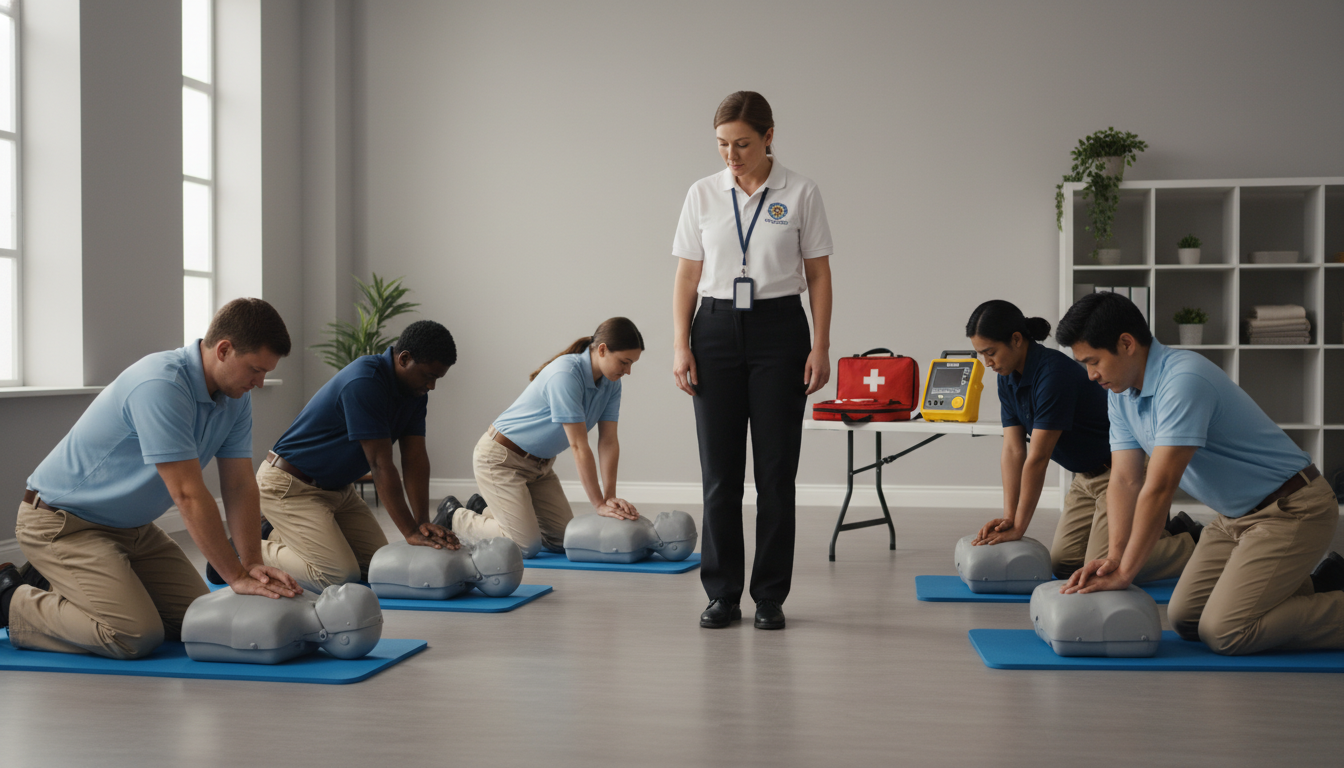
Mobile instructors reverse the travel equation by rolling their gear onto your gravel drive instead of the interstate. The concept is simple: gather eight to twelve learners, clear a meeting room, and let the trainer handle the rest. Because several parks can pool people into one class, individual invoices shrink even as headcounts climb.
Collin County’s CPR Training Nurse program illustrates the upside. The on-site program shows up with bilingual instructors, lakefront-specific drowning modules, and manikins that fit in a pickup bed. Operators pay nothing for travel, borrow no conference hall, and schedule the session during shoulder season, when cabins sit empty and maintenance crews can spare an afternoon.
Neighbor-to-Neighbor Collaboration Builds Critical Mass
Outdoor hospitality businesses rarely operate in isolation; another campground, marina, or glamping resort usually lies within a half-hour radius. Inviting those neighbors does more than fill seats. It forges an inter-park safety network that pays dividends when lightning strikes a ropes course or wildfire smoke drives campers to unfamiliar territory.
National providers such as the American Red Cross accept blended-learning or fully instructor-led requests once a small-group threshold is met. One invoice covers multiple businesses, and a shared completion roster simplifies compliance audits for everyone. In rural corridors where full-time staff counts are slim, this cooperative approach is often the only way to reach the mandatory headcount without busting budgets.
Walk the Grounds Before the Instructor Arrives
Cost savings matter, but relevance saves lives. A formal, site-specific risk assessment turns a generic class into a tactical drill. Start by walking the property with your chosen trainer or a safety consultant, spotlighting high-risk zones such as waterfronts, propane refill areas, splash pads, and remote hike-in cabins.
Ranking each zone’s likelihood of incidents against potential impact guides elective module choices. A desert park plagued by rattlesnakes needs bite protocols; a lakeside resort should emphasize drowning reversals. Document the assessment and map average EMS response times to every quadrant. Insurers often reward a written analysis with premium credits, and the exercise pinpoints areas where extra automated external defibrillators (AEDs) or burn kits warrant installation.
AED Density and Upkeep: Certification’s Essential Sidekick
Even the world’s best chest compressions stall without a shock. A practical rule sets one AED within a one- to two-minute walk of every guest cluster. Weather-resistant cabinets now ship standard, making outdoor placement as easy as mounting a fire extinguisher.
Staff must know not only where devices hang but also how to keep them rescue-ready. Weekly self-tests, logged pad and battery expiry dates, and a CPR mask plus gloves in each cabinet shave seconds when adrenaline peaks. A laminated “AED 50 ft ahead” arrow points panicked bystanders in the right direction, turning equipment compliance into real-world usability instead of rusty décor.
Bring Local Responders Into the Loop
Training day doubles as the perfect moment to hand the microphone to county EMS or the volunteer fire crew. Invite them to tour the property, test gate codes, and locate utility shutoffs. Laminated maps that show the fastest ambulance routes through RV loops or glamping tents give dispatchers a head start long before the sirens wail.
Establishing a shared radio channel or text group—especially where cell coverage drops at the treeline—prevents dead air during chaos. A Knox-style rapid-entry box at the main gate secures master keys yet grants first responders instant access. These small collaborations convert isolated acreage into a node on the regional emergency grid.
Drills, Refreshers, and Cross-Training Keep Skills Alive
Certification cards gather dust faster than picnic tables after Labor Day if practice stops at the classroom door. Embed recert dates in the master HR calendar so no credential lapses on July Fourth weekend. Fifteen-minute micro-drills during shift changes—two minutes of compressions on a manikin, a race to locate the nearest AED—transform mundane meetings into muscle-memory reps.
Seasonal hires who show up mid-summer benefit from blended online refreshers that cover theory in advance and hands-on checks during orientation. Groundskeepers, shuttle drivers, and maintenance techs often reach emergencies first; cross-training them turns every golf cart on property into a mobile response unit rather than a spectator seat. Regular skill checks guarantee new recruits stand shoulder-to-shoulder with veterans when seconds count.
Turning Safety Into a Revenue Stream
Guests weigh many factors when choosing one campground over another, and visible readiness tips the scales. Listing AED locations and certified staff counts on the park map or mobile app signals professionalism before a camper even reserves a site. Group-sales packets for family reunions, rallies, or corporate retreats gain a competitive edge by showcasing a documented safety program, complete with action photos from training day.
The marketing pop syncs with insurance leverage. Sending completion rosters and your documented risk assessment to brokers opens conversations about lower liability premiums and higher coverage confidence. Safety, once considered a sunk cost, becomes both a booking differentiator and a negotiable asset at renewal time.
The Numbers: Hosting vs. Sending Staff Out
Let’s crunch a sample budget. Sending twelve employees to town costs $95 each in course fees, $60 in wages, and $25 in mileage—$2,220 total, not counting the skeleton crew left behind. Hosting a regional class costs $1,100 for the instructor plus coffee and pizza—split three ways among neighbors, that’s roughly $400 per property.
An industry-tailored public clinic backs up the math. The Chicago November 18, 2025 session marketed to hospitality workers bundled infant CPR, bleeding control, and opioid overdose reversal—skills matching campground demographics—and cost attendees just one shift of wages for all modules combined. When the right material arrives under one roof, value compounds.
Your Seven-Step Quick-Start Plan
Launching a safety initiative stalls when teams don’t know where to begin, so a concise checklist removes paralysis. By mapping each action to a clear outcome—gathering headcount, aligning course content, or looping in EMS—you keep momentum high and decision fatigue low. The result is a streamlined path from “We should do this” to “Class is booked, AEDs are mounted, and marketing has the proof.”
1. Phone or email two to three neighboring properties to hit the 10-participant minimum most providers require.
2. Walk the grounds and rank hazards so elective modules address real threats.
3. Request a proposal from a mobile instructor or book through the Red Cross portal.
4. Slot the class in the shoulder season or a mid-week lull when empty RV pads double as parking for attendees.
5. Invite EMS to the walkthrough and mock call-in.
6. Install or reposition AEDs and stock PPE kits before class day so trainees practice with real gear.
7. Record certifications, schedule recerts, and promote your new safety credentials in marketing channels and insurance reviews.
Checklists only deliver if someone owns them, so assign a lead coordinator and set calendar reminders for each step. Celebrate small wins—like confirming the instructor date—to keep teams energized. Within one quarter, you’ll shift from piecemeal intentions to a sustainable safety culture that pays dividends for seasons to come.
Safety sets you apart, but only if your guests and insurance partners know about it—and that’s where Insider Perks steps in. From AI-driven campaigns that spotlight your newly certified team to automated recertification reminders that keep every card current, our marketing and automation tools turn today’s workshop into tomorrow’s occupancy boost and premium break. Ready for a campground headline that reads “We saved a life” instead of “We wish we’d been ready”? Connect with Insider Perks to broadcast your preparedness, streamline the paperwork, and fill sites with travelers who value peace of mind as much as a perfect sunset. Book a quick strategy chat with our team now.
Frequently Asked Questions
Q: How many participants do we need to make a regional on-site class financially viable?
A: Most mobile providers set a break-even threshold around 8–12 learners; once you and one or two neighboring parks hit that headcount, the per-person rate usually drops below what you would pay to send even half that number off-site, and any additional seats beyond the minimum often cost only the price of the certification card.
Q: Who issues the certification cards, and are they accepted by state regulators and insurers?
A: Reputable mobile trainers partner with nationally recognized bodies such as the American Red Cross, American Heart Association, or Health & Safety Institute, so the wallet cards your staff receive carry the same legal and insurance weight as those earned at a brick-and-mortar training center.
Q: What is the typical cost per employee once we split expenses with neighboring properties?
A: After dividing the instructor’s flat fee, materials, and light refreshments, most parks report all-in costs between $45 and $75 per person—about half of what they previously spent on course fees, mileage, and lost labor when sending staff into town.
Q: Do we need special insurance or liability waivers to host the class on our grounds?
A: Your existing general-liability policy usually covers onsite training events; the instructor will also carry professional liability insurance, and a simple facility-use agreement or rider naming your park as additional insured is standard practice.
Q: Can seasonal or part-time employees participate, and will their cards stay valid after they leave?
A: Yes, anyone on your payroll—or even volunteers—can certify, and their two-year credential remains valid wherever they work next; many operators use this as a hiring perk that attracts quality seasonal staff.
Q: What if we lack a clubhouse or indoor space large enough for the whole group?
A: Trainers can set up under a pavilion, in a tented picnic area, or even in an empty RV bay as long as there’s shade, a flat surface, and access to electrical outlets for AED trainers, so building size is rarely a deal-breaker.
Q: How do we decide which elective modules—bleeding control, drowning response, snakebite—make sense for our location?
A: Conduct a quick risk walk with the instructor, ranking incident likelihood and EMS response times in each activity zone; this five-minute audit converts your anecdotal worries into a prioritized list of modules that deliver the biggest real-world payoff.
Q: Will the trainer bring all the manikins, AED simulators, and supplies we need?
A: Mobile programs are self-contained; they arrive with adult, child, and infant manikins, feedback devices, training AEDs, practice Epi-Pens, and sanitized barrier masks, so all you provide is floor space and a power strip.
Q: How often must we recertify, and can refreshers be squeezed into peak season without closing the front desk?
A: Standard CPR/AED and first-aid certifications last two years, but many instructors offer one-hour skill refreshers or blended online renewals that can be completed before or after a regular shift during high-traffic months.
Q: Is bilingual instruction available for Spanish-speaking or international staff?
A: Increasingly, yes; many mobile trainers either teach in multiple languages themselves or bring a co-instructor who can deliver simultaneous Spanish translation and provide exam materials in the preferred language.
Q: How far out should we book, and what happens if severe weather forces a cancellation?
A: Secure your date at least 30–45 days ahead to coordinate with neighboring parks, and confirm the written rain-check clause—most providers allow no-penalty rescheduling within a 12-month window when Mother Nature refuses to cooperate.
Q: Do local EMS or volunteer fire crews charge to join the walkthrough or training day?
A: Typically they participate at no cost because the visit helps them pre-plan responses, but offering a donation to the department’s community fund or providing lunch is a goodwill gesture that builds stronger ties.
Q: How soon after the workshop can we approach our insurer for premium credits?
A: Once you email the completion roster and your updated risk-assessment notes, brokers can usually adjust liability or workers’ comp rates at the next billing cycle—sometimes within 30 days—because the underwriters now have documented mitigation.
Q: Can we advertise our certified staff and new AED program without increasing legal exposure?
A: Yes, as long as your claims are factual; listing “Certified in CPR/AED as of March 2026” or showing AED locations on the park map signals preparedness to guests and regulators without creating additional duty beyond what the law already expects.
Q: Are blended online/in-person courses eligible for the same certifications and insurance discounts as fully instructor-led classes?
A: They are; employees complete theory modules online at their own pace and then perform hands-on skills during the onsite portion, resulting in identical certification cards and identical recognition by insurers and health departments.