

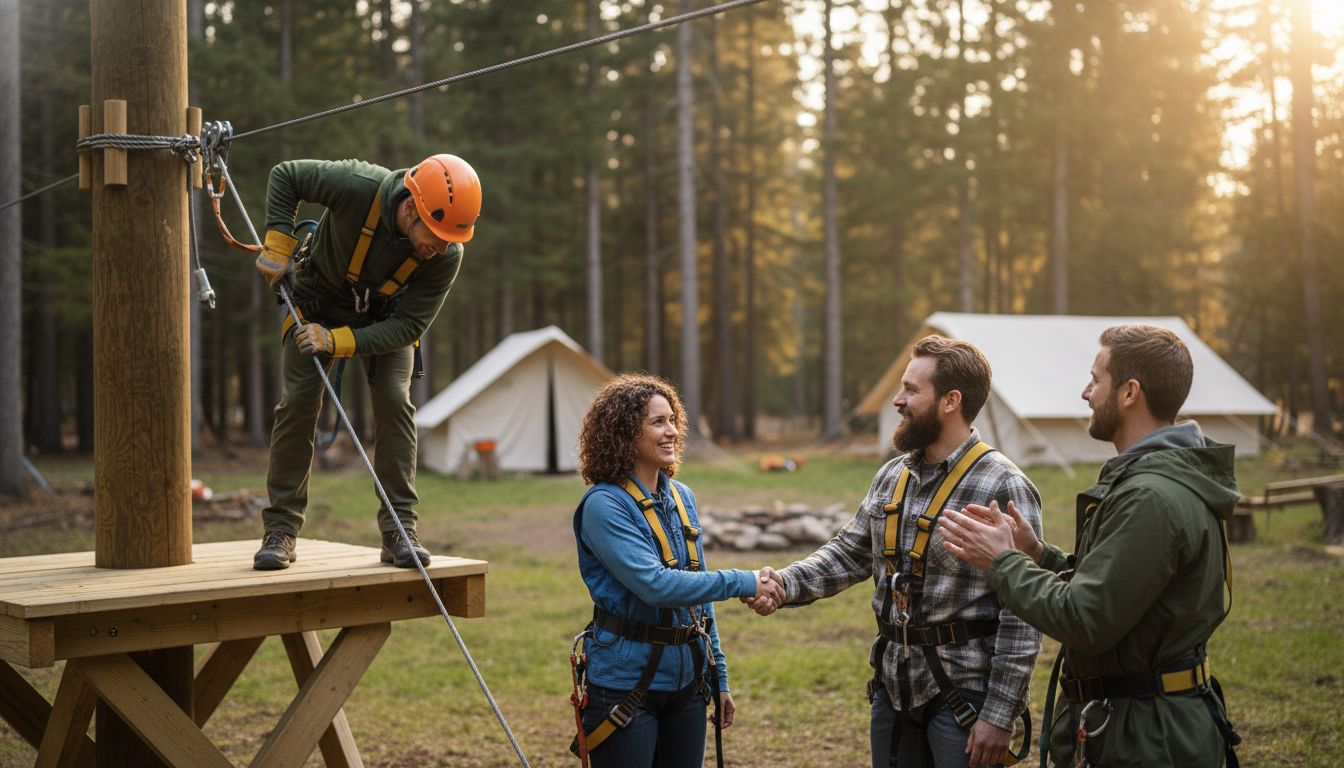
What if the next “wow” photo that floods social media from your region listed three different campground tags—yours included—under the same soaring rider? A communal zip-line turns neighboring parks into co-investors, spreads six-figure startup costs across multiple balance sheets, and lures both overnight guests and ticket-buying locals through a single, high-adrenaline gateway.
Guests crave bigger bragging rights than Wi-Fi speeds. While Camp Fimfo’s Guadalupe Glider rockets riders 40 mph over the river and Ventura Ranch KOA’s Eagle’s Nest packs waitlists every themed weekend, smaller operators nearby reap spillover traffic—and none of them paid full price. Ready to swap “amenity arms race” for “shared adventure dividend”? Keep reading; the blueprint, the cost-split math, and the safety playbook are below.
Key Takeaways
– A single zip-line can be shared by neighboring campgrounds, cutting big costs for everyone
– Exciting ride photos on social media bring in more guests than basic perks like Wi-Fi
– Guests will pay higher rates and buy tickets just to try the ride, boosting income
– Create one LLC so money, voting rights, and exit rules are clear and written down
– Hire certified builders and follow ACCT/ASTM rules to keep riders safe and insurers calm
– Offer easy, medium, and fast lines so kids, families, and thrill seekers all feel welcome
– Sell extras like night “glow rides,” photo packs, and snack vouchers to raise spending per guest
– Use one website and rotating promo codes so all partner parks get fair marketing time
– Keep a shared calendar for daily checks, yearly cable tests, and weather shutdown rules
– Set aside part of each ticket sale for repairs, so the ride stays open and profitable.
The “Why Now?” Moment
Adventure amenities are climbing the priority list for outdoor hospitality developers, with industry data pointing to a 27 percent uptick in new builds that include zip-lines, ropes courses, or climbing walls. That surge parallels guest behavior: smartphone-armed travelers actively filter booking sites for “unique activities,” and social algorithms reward dramatic footage of riders bursting through treetops. A zip-line photo, especially when multiple campground handles are tagged, becomes free retargeting that outperforms standard ad spend.
Economic pressure also favors collaboration. Construction materials and insurance premiums trend higher each quarter, yet average daily rates (ADR) flatten without fresh sizzle. By pooling cash and land, operators dodge the solo six-figure outlay while unlocking a marquee attraction that pushes rates upward. The timing is perfect: local tourism bureaus seek regional anchors to extend visitor stays, and a jointly owned zip-line satisfies that brief without any one park shouldering the spotlight alone.
Real-World Proof a Zip-Line Pays Off
Camp Fimfo zip-line in Texas Hill Country invested in a four-line course that plunges 130 feet toward the Guadalupe River. The ride, open to day visitors as well as campers, generated earned media from outlets like Modern Campground and sparked a wave of influencer reels within weeks of launch. Ticket sales created a revenue channel that operated independently of site occupancy, and the park reported measurable ADR lift due to guest willingness to pay a premium for on-site thrills.
On the West Coast, Ventura Ranch KOA Holiday layered eight beginner lines, a 12-element ropes circuit, and a four-line thrill segment into its Family Adventure Course. Special “SOAR Over Ventura” weekends sold out, even in shoulder season, while a flexible staffing model kept labor predictable. The lesson is clear: premium design attracts buzz, but programming cadence sustains revenue. Both projects crossed the six-figure mark in CapEx—steep for a single operator, manageable for a consortium.
From Rival Parks to Venture Partners
Co-ownership need not be messy. Borrow the structure championed by residents of a Colorado co-op, who formed a cooperative and secured $1.5 million in municipal backing to buy their community. The same legal mechanics work for campgrounds: create an LLC with defined capital shares, voting rights, and exit clauses. Transparent bylaws establish how profits are split, how maintenance calls are funded, and what happens if one partner sells.
Financing rarely comes from a single bucket. An SBA 504 loan covers fixed assets like towers; state tourism grants pay for eco-friendly infrastructure; member loans plug any gaps. Draft the operating agreement early, then attach insurance and maintenance schedules as exhibits. When a dispute arises—and it will—the paperwork becomes the neutral referee rather than emotions around a campfire.
Designing a Shared Zip-Line Course
Start with a natural corridor that links parcels: a river bend, a wooded ravine, or an existing utility easement. Siting launch and landing platforms outside riparian setbacks protects shoreline ecology while simplifying permits. Tree-friendly cable wraps and floating decks guard bark growth, ensuring the ride lasts as long as the partnership.
Route variety multiplies ticket yield. A low-speed beginner line calms nervous first-timers; a family scenic run skims the river surface; a thrill segment hits 40 mph for adrenaline junkies. Mid-course bailout ladders let anxious guests exit without halting throughput. Capacity modeling is math, not guesswork: two guides can shepherd 60 to 80 riders per hour in 30-minute blocks when reservation software staggers arrival times.
Safety, Compliance, and Risk Control
Adventure courses live or die on trust. Design-build firms aligned with ACCT and ASTM standards bake regulatory compliance into engineering, giving inspectors and insurers little to question. Before the first rider clips in, a licensed Professional Engineer must sign off on load calculations, and that review repeats after any material modification.
Operations manuals, often ignored until audit day, become daily muscle memory when guides perform opening checks, verify rider weights, and log condition reports. Require every guide to hold current first-aid and CPR cards and to complete operator-level aerial training. Specialty adventure policies—distinct from general campground coverage—couple with digital waivers that time-stamp parent signatures and age verification. An annual, scenario-based rescue drill reinforces readiness and satisfies carrier audits in one adrenaline-filled afternoon.
Maintenance and Lifecycle Economics
Downtime costs more than cable. A color-coded tagging system—green in service, yellow inspect, red retire—lets any partner spot gear status at a glance. Daily visual inspections of cable tension and trolley wheels capture most issues early; annual magnetic wire-rope scans and load tests uncover hidden fatigue before it becomes a news headline.
Budgeting remains transparent through a rolling five-year CapEx plan that forecasts cable replacement, platform refinishing, and braking-system upgrades. Instead of surprise cash calls, partners contribute to a maintenance reserve off the top of gross ticket sales. Severe-weather shutdowns, paired with a pre-written reopening checklist, protect both guests and balance sheets.
Building Layers of Revenue
Ticket tiers turn a single ride into multiple SKUs. Offer zip-line only, day-pass combos, and sunset “glow ride” experiences that command premium pricing. Add-ons—helmet-mounted GoPro rentals or commemorative photo packages—push per-cap spend without extra ride capacity.
Cross-property snack vouchers or craft-beer tokens encourage riders to linger at all partner parks, distributing ancillary spend. Because the LLC processes all sales through a unified gateway, revenue tracking remains clean for accountants and fair for owners. Transparent dashboards then let partners compare add-on uptake in real time.
Marketing as a Regional Adventure Brand
A shared microsite with integrated booking funnels riders through one digital door, reducing abandoned carts. The same domain hosts an “Adventure Triangle” trail map, highlighting each partner campground plus nearby breweries, paddle rentals, and hiking trailheads. By positioning the zip-line as the region’s crown jewel, every park benefits from the halo.
Earned media loves a cooperative story. Press releases referencing Camp Fimfo’s influencer buzz provide journalists with proof that zip-lines trend well online, while local-resident preview days generate neighborhood goodwill and user-generated content simultaneously. Rotating promo-code ownership each quarter ensures no single park hogs the megaphone; analytics dashboards surface which campaigns spike bookings so partners can refine spend together.
Twelve-Month Implementation Roadmap
Months 0–2 focus on forming the LLC, drafting MOUs, and aligning visions during site walks. Parallel outreach to lenders and tourism offices sets early capital expectations while goodwill still overflows. Months 2–4 involve feasibility studies, environmental assessments, and preliminary Professional Engineer consultations. Operators will determine corridor viability, tree health, and noise-impact buffers during this window.
Once permits and financing lock in by Month 6, construction begins. Towers rise, cables string, and guide recruitment kicks off. Staff complete ACCT operator training as platforms take shape. Soft openings with resident preview days launch around Month 10, collecting feedback for minor tweaks. Finally, a grand-opening influencer trip in Month 12 floods social feeds, tagging every partner park and underscoring the cooperative victory.
Common Pitfalls and Pro Moves
Insurance exclusions sink projects—not rides—so loop in a specialty carrier during design, not after ground break. Document guide-to-guest ratios in both SOPs and policy applications; underwriters reward clarity with lower premiums. Gear retirement dates sneak up on even diligent managers, making the shared compliance calendar a non-negotiable line item at every partner meeting.
Marketing momentum can stall if one park shoulders all the social posts. Rotating responsibilities quarterly keeps content fresh and engagement metrics evenly distributed. Finally, resist the urge to tinker with route configuration post-launch without an Engineer review. The fastest way to void coverage and spark partner tension is to move a cable without updated calculations.
A shared zip-line may send guests flying between treetops, but the real lift happens in your revenue reports—provided the right eyes and algorithms see every soaring selfie. That’s where Insider Perks steps in. Our marketing, advertising, AI, and automation tools stitch your partners’ booking engines, promo codes, and social channels into one friction-free flight path, so every click, waiver, and overnight stay lands exactly where you want it. Ready to turn collective gravity into collective growth? Connect with Insider Perks today and let’s engineer the buzz that keeps harnesses—and campsites—fully booked all season long.
Frequently Asked Questions
Q: How much capital should each campground plan to contribute to a communal zip-line project?
A: Most three-to-four-park consortiums find that a $400,000 to $600,000 turnkey build can be split into roughly equal shares of $125,000 to $200,000 per park, though equity can be weighted by land donated or in-kind services; a 10 percent contingency fund and a maintenance reserve are normally funded from first-year ticket revenue rather than the initial cash call.
Q: What’s the realistic payback period on that investment?
A: Case studies and pro-forma modeling show that 5,000 to 7,500 riders a season at an average net of $40 per head typically recoup principal in 24 to 36 months, after which ticket income, add-ons, and ADR lift flow directly to partner profits through the LLC’s quarterly distributions.
Q: How is liability shared and what insurance is required?
A: The operating LLC purchases a specialty adventure-park policy that names each member as an additional insured, assigns claim defense to the carrier, and allocates premiums by ownership percentage; individual parks then carry only their standard campground GL policies with an exclusion carve-out acknowledging the master zip-line coverage.
Q: What if one partner wants to exit the venture down the road?
A: The LLC’s operating agreement should include a buy-sell clause that uses either a preset multiple of trailing 12-month EBITDA or a third-party valuation to establish price, giving remaining members a right of first refusal before the departing owner can offer their share to an outside buyer.
Q: Will multiple property lines complicate permits and inspections?
A: Not significantly; surveyors simply plot easements for the cable corridor, then each county or municipality issues its own platform permit while the Professional Engineer’s single load-path report satisfies inspectors across borders, streamlining approvals under a master site plan.
Q: Can ticketing integrate with my existing reservation system?
A: Yes; most partners route online and walk-up sales through the LLC’s cloud-based booking engine, then push nightly guest discounts or combo packages back into each park’s PMS via API, ensuring that guests can add zip-line slots to their campsite reservation in one cart.
Q: How many staff members are needed and can we share them?
A: Two certified guides per operating line segment cover up to 80 riders an hour, and partners commonly pool a 12-to-15-person guide roster whose schedules flex between parks’ housekeeping or activities shifts, keeping labor costs variable and cross-trained.
Q: What about guests who are too light, too heavy, or have mobility issues?
A: Weight and age minimums—typically 60 lb and 7 years—are enforced at check-in through digital waivers, while ADA-compliant launch ramps, tandem harness rigs, and lower-speed scenic lines allow many guests with limited mobility to participate safely under ACCT guidelines.
Q: Will noise from trolleys or rider screams create neighbor pushback?
A: Sound studies show zip-line noise rarely exceeds 55 dB at 200 feet; by orienting the fastest spans away from residential edges and scheduling flights no earlier than 9 a.m. or after dusk, most projects avoid zoning complaints and maintain goodwill.
Q: How do we keep revenue flowing in off-season or foul weather?
A: Dynamic scheduling allows the course to run weekends only in shoulder months, and prepaid gift cards plus off-season glow-rides or holiday light flights capture winter sales when weather cooperates, while clear refund policies and text alerts manage cancellations.
Q: How frequently does gear need to be replaced and what does that cost?
A: Daily visual inspections and annual magnetic rope-scan reports typically flag cable replacement at the seven-to-ten-year mark, with a full cable swap on a four-line course running $25,000 to $35,000, costs that are pre-funded through the maintenance reserve.
Q: Will adding a zip-line spike my property taxes or individual park insurance?
A: Because the asset is owned by the LLC, its taxable value sits on that entity’s books; only the portion of land under a launch or landing deck might be re-assessed for each parcel, and carriers usually apply a nominal rider to a campground’s existing GL premium since primary risk is transferred to the adventure policy.
Q: Can each park still run its own branding without diluting the collective message?
A: Absolutely; the venture markets the attraction under a neutral “Adventure Trail” brand, while all partner parks continue their independent campaigns and simply add co-branded creative that positions the zip-line as a regional amenity accessible from every campground.
Q: Are state or federal grants actually attainable for a small consortium?
A: Outdoor recreation and rural tourism grants routinely fund 10 percent to 40 percent of capital costs when applications emphasize economic impact and accessibility, and consortiums often score higher because collaborative projects align with regional development mandates.
Q: From initial handshake to first rider, how long should we budget?
A: With decisive partners and competent design-build firms, the timeline averages 12 to 14 months: two months for LLC formation and financing commitments, four months for studies and permits, five months for construction, and a final month for staff training, soft openings, and marketing ramp-up.