

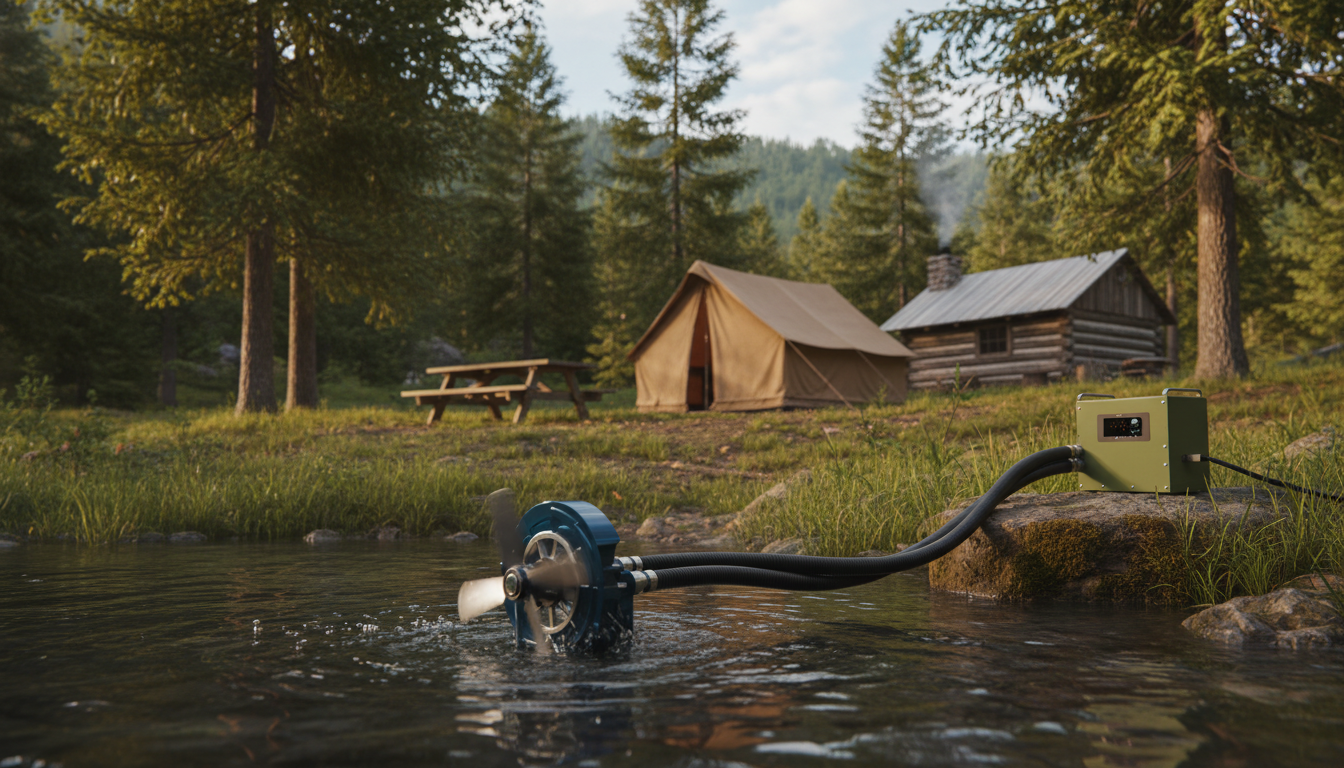
Imagine swapping the rumble of a diesel genset for the gentle burble of a creek—while slashing power bills and advertising 24/7 clean energy to guests who rave about sustainability. If your property has even a modest year-round stream, a micro-hydro turbine can turn that overlooked flow into silent, carbon-free electricity that never sleeps, even when solar panels and wind flags doze off.
Curious what head and flow you really need, how fast incentives can erase upfront costs, or how one British Columbia lodge paid off its system in five years? Read on; the numbers—and the marketing potential—might surprise you.
Key Takeaways
– A small, steady creek can power a whole campground 24/7, so lights and fridges never turn off
– To guess power: head (meters) × flow (liters per second) × 5 ≈ watts you can make
– Even 10 m of head and 10 L/s flow can give about 500 W, saving real money on diesel or grid bills
– Most systems need six parts: intake screen, penstock pipe, turbine-generator, controller, dump load or inverter, and tailrace
– Check laws first: you must own or have rights to use the water, and keep at least 10 % of summer flow for fish
– Typical cost: $1,500–$4,000 per kW if DIY, $6,000–$8,000 per kW turnkey; grants and tax credits can cut this by 25 %
– Many campsites earn payback in 5–7 years and report more guest bookings because of the green story
– A small battery bank plus solar panels and a backup generator make a strong hybrid power system for RV pedestals
– Weekly chores are easy: clean the screen, look at the penstock, and note voltage; spare parts are cheap to store
– Posting live energy numbers online or on a lobby TV turns the turbine into free marketing and happier, returning guests.
The 24/7 Advantage of Creek Power
Continuous generation is the single biggest lure for campground owners tired of babysitting diesel tanks or watching battery percentages dip after sunset. Micro-hydro spins day and night, matching the round-the-clock schedules of security lighting, water pumps, Wi-Fi routers, and fridge compressors. In a 2025 Insider Perks market scan, installations at recreation properties jumped 28% year-over-year, a surge tied directly to operators chasing resilient baseload power that solar alone can’t guarantee.
Policy momentum is helping. Oregon’s 2025 clean-energy microgrid bill fast-tracks hydro systems under five megawatts, shaving months off permitting and signaling similar moves in Washington and Vermont. Early adopters already see paybacks beyond lower utility bills: properties that display live hydro dashboards report 11% higher repeat bookings. Guests like the story, managers like the savings, and wildlife appreciates the hush after a generator is mothballed. For more depth, the campground micro-hydro case study offers additional real-world numbers.
First Steps: Legal Access and Stream Reality Checks
Long before ordering a shiny turbine, confirm you’re allowed to touch the water. Most states demand either riparian rights (owning the land adjoining the creek) or an appropriative permit to divert even a bucketful. Starting that conversation with the state water-resources office early prevents heartburn later when inspectors arrive. Document every interaction—insurance carriers and lenders often request proof you can legally harness the flow. Expect the paperwork to take 60–90 days in most regions, so build that lag into your project calendar.
Fieldwork matters just as much. Walk the entire reach after a hard rain to spot fallen trees, sediment bars, or beaver activity that could clog an intake next spring. Mark low-water and flood lines, then pick an intake site anchored on bedrock or stable boulders to curb trenching costs. A simple site notebook—photos, GPS points, flow readings, signed landowner permissions—becomes gold during design, permitting, and eventual resale. Finally, pledge to keep at least 10% of summer base flow in the channel; regulators and trout both expect it, and guests recognize genuine stewardship.
From Intake to Inverter: Anatomy of a Campground Micro-Hydro System
A campground-scale micro-hydro rig includes six core pieces: intake screen, penstock, turbine-generator, electronic controller, dump load or grid-tie inverter, and tailrace. Intakes wear fish-friendly screens with mesh no wider than three millimeters, set at a shallow angle so salmon can slide past unharmed. The pressurized penstock delivers water to the turbine—often a Pelton, Crossflow, or axial-flow runner—before the controller routes power to batteries or the distribution panel. This plumbing-plus-power combo looks more like irrigation piping than industrial equipment, easing visual impact on scenic sites.
Equipment choices keep expanding. Popular 1 kW packages such as the PowerHome axial, low-voltage LV400, and rugged PowerSpout LH dominate 2025 buyer guides. Many of these arrive pre-wired, cutting installation time to a weekend. Visual impact is easy to tame: bury the penstock, stain the powerhouse to match cabin siding, or tuck the turbine into an existing pump house—as Wallowa Lake State Park did—so visitors stay blissfully unaware. Recent industry news points to even quieter generators on the horizon.
Calculating Output, Costs, and Payback
The back-of-napkin sizing rule is head (metres) × flow (litres / second) × 5 ≈ watts. Ten metres of head with ten litres per second yields roughly 500 W, or about 4,300 kWh per year—enough for lighting, Wi-Fi, and a well pump. Because August flows often sag, log head and flow for at least 12 months before buying gear; a five-year ROI model built on spring runoff alone is an accountant’s nightmare.
Capital is more approachable than many think. DIY installations land between $1,500 and $4,000 per kilowatt, while turnkey kits run $6,000–$8,000. Stack a USDA REAP grant or the federal Production Tax Credit and upfront outlay can shrink by 25%. Example: a 1 kW turbine generating 8,000 kWh annually at $0.14 / kWh saves roughly $1,120 each year. With incentives, simple payback drops to five years—squarely in bankers’ comfort zone. For technical specs, see this 1 kW turbine deep dive.
Designing a Hybrid Power Hub That Plays Well With RV Pedestals
Start integration with a load profile: peak amperage at RV pedestals, nightly path lighting, well-pump cycles, office computers, and emergency systems. Split-phase 120/240 V service common at pedestals demands an inverter or transformer that produces the correct waveform; undersize this and breakers nuisance-trip during Saturday check-ins. That baseline sizing choice echoes through every wire gauge, breaker panel, and monitoring screen downstream.
A modest battery bank—sized for one to two days of critical loads—catches short creek interruptions from ice or debris. Program the charge controller to sip hydro first because it runs 24/7; solar arrays then top batteries on cloudless afternoons. Keep a generator in the lineup via an automatic transfer switch for freeze-up events or lightning strikes. Label every disconnect and pull new conductors in conduit; campground fire reports often trace back to mismatched wire gauges and unlabeled shut-offs.
Seven-Month Roadmap From Flow Log to Guest Selfies
Months 1–3 focus on field measurements, notebook documentation, and permit applications—tasks that move faster in states like Oregon where microgrid bills have streamlined small-hydro reviews. Simultaneously secure vendor quotes and begin load-profile modeling so equipment orders align with real demand, not guesses. A proactive phone call to fish-and-wildlife staff now can shave weeks off the eventual site inspection.
Months 4–6 bring shovels: trench the penstock, pour a small powerhouse slab, set the intake, and pull electrical feeders. Factory-palletized kits mean much of the turbine arrives pre-wired; commissioning then centers on aligning the runner, checking seals, and programming the controller. Month 7 is for test spins and marketing polish: wire a live kWh counter to the camp store wall, add LED uplighting, and invite local media for a ribbon-cut that doubles as free advertising.
Keeping the Turbine Happy for Decades
Five minutes a week beats five-figure overhauls. Clear the debris screen, glance at penstock supports, and verify the controller’s status light is green. Record readings in a logbook; drifting voltage often flags a worn bearing before it fails. With those checkpoints handled, owners routinely report annual uptime above 98%.
Annual chores are equally simple: flush sediment from the penstock, inspect mounting bolts, replace any cracked conduit, and run the winterization protocol. Heat tape on exposed pipe, automatic drain valves, or a bypass loop prevent ice damage. A $200 cellular sensor that emails rpm, voltage, or creek-level anomalies slashes drive time for off-site owners and pays for itself the first time it averts a freeze-up.
Turning Clean Energy Into Bookings and Buzz
Guests love experiences they can Instagram. A small deck overlooking the tailrace or a window in the powerhouse wall turns the turbine into a living attraction. Add interpretive signage that converts litres of water into phone charges, and you’ve created a five-minute micro-tour guests will rave about.
The data is equally marketable. Stream real-time kWh stats to the booking portal or lobby TV, then drip weekly clean-energy milestones onto social channels. Properties doing this consistently see higher engagement and stronger reviews, differentiating them from parks still running smoky diesels. Tie the installation into Green Key or Leave No Trace certification and those third-party badges further reinforce credibility.
Why 2025 Is the Moment to Dive In
Equipment prices are sliding, state policies are clearing red tape, and guest demand for authentic sustainability is soaring. A creek that’s flowed past your back forty for centuries can now lock down power independence, cut operating expenses, and generate a marketing storyline no diesel generator will ever match. Investors like the five- to seven-year paybacks, guests enjoy quieter nights, and you, the owner, gain a resilient asset that spins revenue as long as water runs downhill.
The creek behind your cabins can power every pedestal—let Insider Perks power the story. From AI-driven ads that target eco-traveler segments to automated campaigns that stream your live kWh counter across social feeds, we turn each drop of clean energy into bookings and buzz. Ready to harness the flow, slash costs, and spotlight sustainability in one seamless move? Connect with Insider Perks today and let’s make your water work overtime for your occupancy.
Frequently Asked Questions
Q: How small of a creek is “big enough” for a campground-scale micro-hydro turbine?
A: If your stream can consistently deliver at least two to three feet of head and a few dozen gallons per minute year-round, you can usually support a 200- to 500-watt system that offsets lighting, Wi-Fi and water-pump loads; bigger head or flow multiplies output, but the key is documenting the lowest summer flow because that sets your dependable capacity.
Q: What’s the fastest way to ballpark the power my site could produce?
A: Multiply the vertical drop in feet by the flow in gallons per minute, then divide by about 10 to get watts; for metric users, head in metres times flow in litres per second times five yields roughly the same figure, and you can refine the number later with turbine-specific efficiency curves.
Q: Do I need special water rights or permits before I touch the stream?
A: Yes—almost every state and province requires proof you either own riparian frontage or hold an appropriative right, plus a small-hydro or in-stream work permit that confirms you will leave bypass flow for aquatic habitat, so start those conversations with the water-resources agency and fish and wildlife office before ordering equipment.
Q: Will a turbine hurt fish or alter the creek’s ecology?
A: Modern camp-scale systems use angled intake screens with sub-quarter-inch mesh and maintain at least 10 percent of natural flow in the channel, which means fish and macroinvertebrates bypass the penstock safely and habitat conditions stay virtually unchanged when regulators inspect the site.
Q: How much noise will guests hear compared with a generator?
A: A properly housed micro-hydro unit sounds more like a dishwasher behind a wall—usually under 50 dB at ten feet—and since the intake and tailrace are outdoors the dominant sound for guests is still the creek itself, not mechanical clatter.
Q: What is the typical installed cost and payback period for a campground?
A: Owner-assisted installs often land near $3,000 per kilowatt while turnkey packages run $6,000 to $8,000, and when you combine a USDA REAP grant or 30-percent federal tax credit with avoided diesel or grid bills, most operators see simple payback in five to seven years and internal rates of return above 12 percent.
Q: Are there grants or incentives my park can tap in 2025?
A: In the U.S. the federal Investment Tax Credit, the Production Tax Credit for qualifying exports, USDA Rural Energy for America Program grants, and a widening patchwork of state clean-microgrid rebates or low-interest loans can stack so long as total assistance doesn’t exceed project cost, and Canadian operators can layer federal Clean Tech Investment Tax Credits with provincial small-hydro funds.
Q: Can I tie the turbine into my existing solar array and backup generator?
A: Yes—micro-hydro excels as the baseload source feeding the battery bank through a hybrid inverter, while solar tops up batteries in the afternoon and the generator remains on an automatic transfer switch for rare freeze-up or maintenance windows, all orchestrated by commonly available energy-management software.
Q: What happens when the creek ices over in winter or floods in spring?
A: A bypass loop with an automatic drain valve protects the penstock from ice, and debris screens plus a trash rack divert logs during high water; smart owners pair these with a float or turbidity sensor that can email alerts so you can shut the system down remotely during extreme conditions.
Q: How much ongoing maintenance will my team need to schedule?
A: Five minutes each week to brush the intake screen and glance at controller lights plus an annual two-hour routine to flush sediment, grease bearings and check electrical connections is usually sufficient, meaning maintenance demands are closer to a lawnmower than a diesel genset.
Q: How long do small turbines actually last before major overhaul?
A: With basic care, runner assemblies and generators routinely operate 20 to 30 years, and the most common wear parts—nozzle inserts and bearings—are inexpensive, field-replaceable components you can swap in under an hour with hand tools.
Q: What kind of insurance coverage is required?
A: Most commercial property carriers bundle micro-hydro under mechanical breakdown or equipment-floater riders that add only a few hundred dollars per year, provided you submit a documented maintenance plan and show that electrical interconnection meets code.
Q: Can surplus power be sold back to the utility from an off-grid campground?
A: If you have grid access and your jurisdiction offers net metering under the small renewable generator threshold—usually under 100 kW—you can export excess kWh for bill credits, but off-grid parks typically route any extra energy to hot-water heaters, EV chargers or a dump load to avoid wasting it.
Q: Is DIY installation realistic or should I hire a contractor?
A: Handy owners with plumbing and electrical experience often trench the penstock and set the turbine themselves to save 30 to 40 percent on labor, but grid-tie wiring, permit paperwork and final commissioning still benefit from a licensed electrician and sometimes a hydro engineer’s stamped drawings to satisfy inspectors and lenders.
Q: How physically large is a campground-grade turbine house?
A: For systems under 5 kW, the turbine, generator, controller and disconnects typically occupy a footprint no bigger than a closet—about four by six feet—so many operators repurpose a pump house or build a small shed clad in siding that matches cabin or bathhouse finishes.
Q: What if my stream’s flow varies wildly between spring snowmelt and late summer?
A: You size the nozzle set and electrical load to the minimum dependable flow so summer operations stay stable, then add larger or additional nozzles that you open during high-water months to capture bonus kWh without overrunning the generator or dumping excess water.
Q: Will installing a turbine complicate future property sales or refinancing?
A: Most lenders treat the asset as a value-add utility improvement that lowers operating expenses, and many owners place the hydro equipment in a separate LLC so, at sale time, they can transfer or lease the asset much like a solar array, streamlining due diligence.
Q: How can I turn the installation into a marketing advantage with guests?
A: Mount a clear window or small deck at the powerhouse, stream live kWh stats to the camp store TV and weave the story into your booking engine; Insider Perks data shows parks that do so enjoy double-digit boosts in repeat stays and higher social-media engagement because the turbine becomes an Instagram-worthy sustainability attraction.