

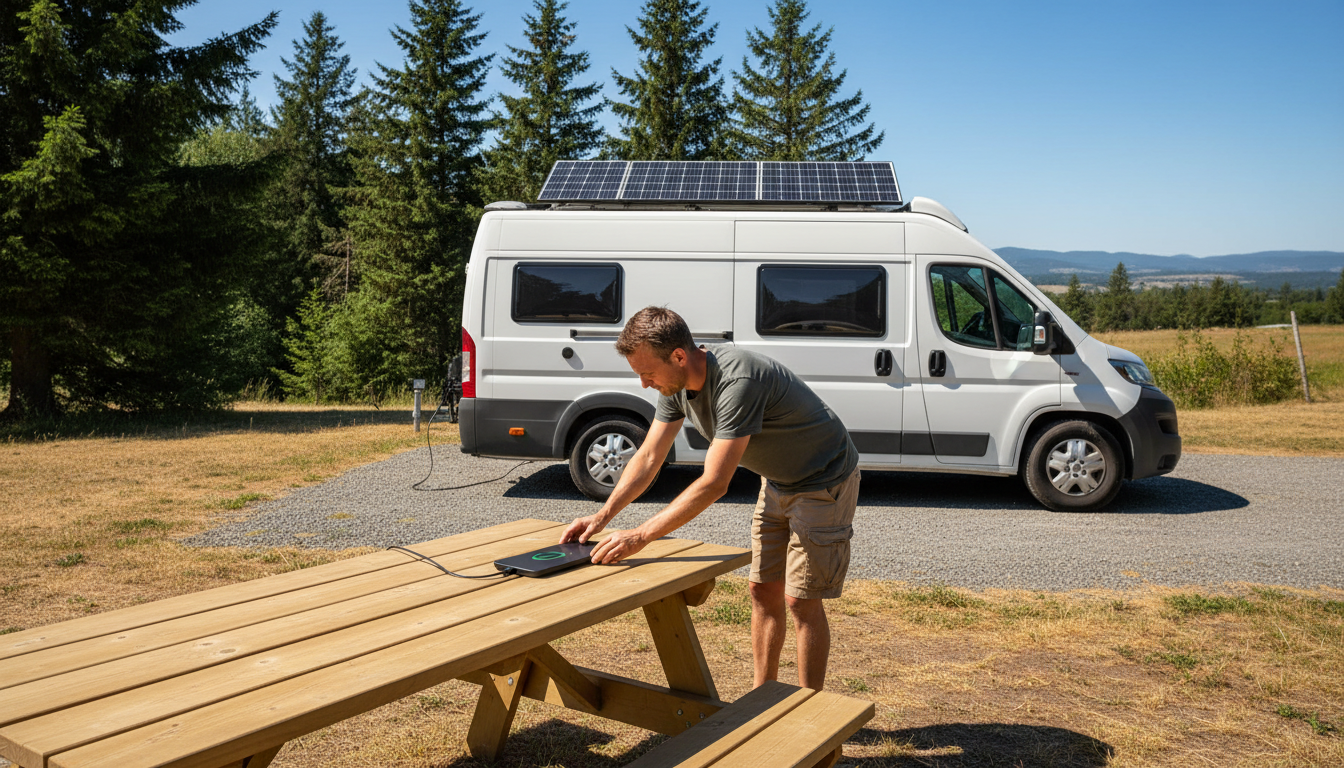
Your guests already expect their phones to leap from 10 % to 80 % before the s’mores even melt—so why are you still sending them hunting for crowded outlet strips?
Thanks to the new Qi2 25 W wireless-charging standard and solar-integrated poles that run themselves, campground and RV-park owners can plant a self-powered amenity that screams future-ready while costing pennies to maintain. Picture a tamper-proof steel post by the picnic table, sun-charged by day, lighting up at dusk as two campers snap their phones onto the pad with a satisfying magnetic click. No cords, no trenching, no bickering over sockets—just another five-star review.
Ready to turn lost-charger complaints into an upsell that pays for itself in one peak season? Let’s break down the tech, the ROI math, and the foolproof safeguards you’ll need to keep every pad profitable, protected, and humming all summer long.
Key Takeaways
The numbers, hardware advances, and guest expectations are lining up so neatly that wireless charging has shifted from nice-to-have to must-have practically overnight. Read the bullets below as a preview of exactly why late adopters risk lower search rankings, dwindling reviews, and frustrated campers asking for refunds.
If you skim nothing else, know that the latest Qi2 pads charge fast, install fast, and pay back fast, while magnets and solar tech erase the usual maintenance headaches. Everything else in this article zooms in on the how—site placement, safety codes, revenue levers—so you can roll out before the 2026 travel rush and let happy guests do the marketing for you.
• Campers now expect quick, cord-free charging; Qi2 pads jump phones from 10 % to 50 % in about 12 minutes (25 W speed).
• By late 2025, about 8 out of 10 new phones will have Qi2 magnets, turning outlet hunts into a bad guest experience.
• Solar-powered steel poles or benches run themselves—no trenching, tiny electric bills, and pay back in one busy season.
• Magnets auto-center the phone, so fewer “dead spot” complaints and less staff time fixing issues.
• Hardware is IK10 impact-rated, weather-sealed, and lets you swap 15 W for 25 W modules in minutes.
• Best spots are shaded, easy to reach (30–48 in high), and in clear view to cut vandalism and boost social-media photos.
• Safety basics: use GFCI if tied to shore power, lock panels with security screws, post simple “how-to” and “not for medical devices” signs.
• Quick upkeep: wipe glass, check gaskets and LEDs, test batteries, and plug in firmware updates during routine rounds.
• Money maker: bundle charging into a “Tech-Friendly” site that costs about $5 more per night and sell $9 magnetic phone rings at check-in.
• Follow a 7-step checklist (audit shade, pick hardware, install, test, sign, stock spares, advertise) to launch trouble-free before the 2026 rush.
Wireless Power Goes Mainstream in 2025: Why Guests Will Notice
By Q3-2025, 82 % of new phones will ship with built-in Qi2 magnets, according to shipment data from the Wireless Power Consortium (consortium overview). That means the traditional scramble for wall plugs becomes a friction point guests no longer tolerate. When they can drop a handset onto a coffee-shop saucer and see 25 W speeds, they’ll expect the same ease at your trailhead, pool deck, or deluxe pull-through site.
Social media accelerates the shift. Swipe any booking-influencer’s feed and you’ll find sunset shots of glamp domes, latte art—and phones magnetically perched on glowing pads. Listings that flaunt “tech-friendly, solar-powered charging” filter to the top of decision trees, pushing late adopters down in the search results and, ultimately, the occupancy race.
How Qi2 25-Watt Pads Deliver Near-Wired Speed
The magic lies in two back-to-back firmware leaps: Qi v2.1, which introduced magnetic Active Alignment, and the July 2025 bump to Qi v2.2, better known as Qi2 25 W. Together they lock a phone to the charging sweet spot while cranking output from 15 W to a laptop-friendly 25 W. In practice that means a modern iPhone or Galaxy jumps from 10 % to 50 % in roughly twelve minutes—about the time it takes a guest to refill their coffee.
For outdoor operators, alignment is the real hero. Magnets handle centering even if a post tilts a few degrees or the installer drills a hair off-level. Fewer “dead-spot” complaints translate directly into saved staff minutes and happier reviews, cementing Qi2 as less of a gadget novelty and more of a utility.
Hardware Built for Campsites, Not Coffee Shops
Coffee-shop coasters won’t survive a rogue scooter or a December freeze-thaw cycle. Purpose-built platforms from Powering Places solve that by integrating off-grid solar, batteries, and IK10-rated steel shells. The flagship Sol-Mate Solar Charging Pole pairs an 80 W panel with two wireless-charging positions—enough juice to handle dusk surges even after a cloudy morning.
Need a communal vibe? The Plaza Solar Charging Station wraps a park bench around the tech, inviting selfies and longer dwell time. Remote tent sites can lean on the Sol-Mate Mini, a backpack-sized unit that bolts to a stump or signage post without trenching. All three chassis accept USB-C, slide-in Qi2 modules, so you can upgrade from 15 W to 25 W hardware in under fifteen minutes without re-running conduit or permits.
Finding the Perfect Spot: Shade, Reach, and Photo Ops
Placement starts with ergonomics. Keep pad height between 30 in and 48 in above finished grade so guests in wheelchairs or kids on tiptoe can both dock a phone without contortions. A clear, firm surface is non-negotiable; gravel and mulch make it hard for mobility devices to roll close enough for alignment magnets to grab.
Shade equals speed. Field data and Reddit user tests (community heat study) show that 25 W pads maintain full output for half an hour at 55 °C ambient, but phone batteries throttle sooner in direct sun. A pergola, canopy, or well-placed tree keeps device temps in the efficiency zone while also improving screen visibility—turning a practical amenity into an Instagram-ready scene that markets itself.
Weatherproofing and Tamper Resistance Without Overbuilding
Impact matters when bikes lean, coolers topple, or a teenager tests their pitching arm. Opt for housings stamped from powder-coated steel and certified to IK10 impact resistance. Recessed security-torx or pin-hex fasteners add a layer of deterrence; most campground passers-by don’t pack the right bit in their multi-tool.
Location doubles as defense. Pads installed in sightlines from the front desk or the main bathhouse see roughly half the vandalism of secluded spots. Supplement that passive safety with a QR-code decal linking to your site map and a subtle “monitored for your safety” note. Guests get directions, you get deterrence, and no one feels policed.
Heat Management and Performance Reality Checks
Wireless charging generates waste heat, particularly at 25 W. Thankfully, the limiting factor turns out to be the phone, not the pad, as backed by Reddit’s crowd-sourced thermals. Ventilated enclosures paired with breathable backplates let convection pull heat away, keeping electronics alive well past their warranty targets.
A simple guest tip at check-in—“Pop your phone on the pad and let it chill; avoid gaming while charging”—prevents most performance throttling. The reminder also nudges guests to savor the campfire rather than doom-scroll, improving their overall stay. That small script addition reinforces your brand as tech-savvy and proactive, the kind of place guests brag about to friends after checkout.
Quick Maintenance Playbook That Keeps Pads Online
Every spring opening, run a four-point inspection: wipe dust from pad glass, check gasket integrity, verify LED status lights, and scan the solar panel for cracks. Come peak season, schedule a five-minute battery-capacity test; swap any bank below 80 % of its original amp-hour rating. This discipline avoids surprise brownouts in mid-July when the lot is sold out.
Firmware updates deserve calendar space too. Most Qi2 modules update over a USB-C service port—laptop in, click Upgrade, laptop out. Finally, stock one spare charging module for every ten stations; a hot-swap beats overnight shipping rates and downtime complaints.
Clearing Codes and Reducing Liability Headaches
Treat each solar charging pole like any other low-voltage circuit. Use UV-rated cable in buried conduit, and place an accessible disconnect within sight of the unit when it ties into shore power. Where units run fully off-grid, note the installation as an appliance, not permanent wiring, in your permit paperwork to keep inspectors happy.
Post clear pictogram instructions and a “Not for Medical Devices” disclaimer right on the faceplate. Keep a monthly inspection log—digital or binder—showing you checked fasteners, conduit integrity, and ground-fault tests. Documentation turns a potential claim into a non-issue, proving diligence in minutes instead of in court.
Turning Charging Convenience Into Real Revenue
Upsell the pad, not the minutes. Guests dislike nickel-and-diming, so bundle wireless-power access into a premium site tier—say, “Tech-Friendly Pull-Through” at five dollars more per night. The extra category lifts nightly ADR without adding metering complexity or payment kiosks that can break.
Merchandise boosts margins further. Magnetic phone rings cost roughly two dollars wholesale and retail at nine. Track pad session counters against occupancy to locate dead zones or expansion opportunities—proof for investors that the amenity earns its keep.
A Seven-Step Deployment Checklist for Busy Park Teams
Audit guest areas for shade, visibility, and ADA reach. Then pick your hardware tier—Pole, Bench, or Mini—and order ten percent spare modules up front. Install conduit and GFCI where the local inspector demands; mount units with IK10 fasteners.
Flash Qi2 firmware, test alignment with a couple of staff phones, and add that pictogram-plus-QR signage. Stock those magnetic rings at reception, log the installation date in your CMMS app, and schedule the first battery test twelve months out. Finally, shout about the new amenity in pre-arrival emails and OTA listing updates; a feature no guest knows about is a feature that can’t raise occupancy.
Innovators install hardware; visionaries turn that hardware into headlines, bookings, and loyal fans. If you’re ready to be the park everyone tags when their battery hits 80 % in record time, let Insider Perks handle the marketing lift—crafting ad campaigns, AI-driven guest messaging, and automation flows that spotlight your new solar-powered charging pads before the competition even catches on. Plug into our expertise today and watch every glowing review power up your bottom line.
Frequently Asked Questions
Q: What exactly is Qi2 25 W, and will most guest phones be compatible?
A: Qi2 is the 2025 version of the Wireless Power Consortium’s standard that adds magnetic alignment and raises maximum output to 25 watts; by late 2025 roughly four out of five new phones—and many 2023–24 flagships via software update—will support it, while older Qi-enabled devices still charge at their native 7.5–15 watts on the same pad.
Q: How much does a solar charging pole cost and when does it pay for itself?
A: The flagship Sol-Mate pole runs about $1,450 landed in the U.S.; parks bundling it into a $5-per-night “Tech-Friendly” site tier at 50 % annual occupancy typically recover hardware and install costs in one peak season, after which margins approach 90 % because the unit powers itself.
Q: Do I need an electrician or permits if the unit is off-grid solar?
A: Fully self-contained models with internal battery banks are treated as appliances rather than permanent wiring, so most jurisdictions waive trenching permits and only require you to follow ADA reach guidelines and local rules for anchoring outdoor furniture.
Q: Will the pad survive hail, winter freezes, or salt air at coastal parks?
A: Housings are IK10 impact-rated powder-coated steel with marine-grade gaskets, polycrystalline panels rated for ‑40 °F to 140 °F, and conformal-coated PCBs, so they shrug off one-inch hail, freeze-thaw cycles, and coastal corrosion provided the annual gasket inspection is done.
Q: Can wireless charging overheat phones or pose a fire risk?
A: The Qi2 protocol continuously exchanges temperature data between phone and pad and throttles or shuts off at 42 °C battery temp, while the pole’s battery circuitry is UL-listed with dual over-temp fuses, making the setup safer than a typical 120 V outlet strip.
Q: How many stations should I install for my park size?
A: Parks under 100 sites see the highest guest-satisfaction lift at a ratio of one dual-pad pole for every 15–20 campsites plus one communal bench in high-traffic areas; higher densities add convenience but deliver diminishing ROI unless you charge per session.
Q: Will the battery hold enough energy after several cloudy days?
A: The 80 W panel and 384 Wh lithium bank store roughly four full days of average load (about 60 phone charges), and the controller automatically drops LED brightness first, preserving phone power even after consecutive overcast days.
Q: Are the units fully ADA compliant?
A: When mounted with the pad surface between 30 and 48 inches above finished grade on a firm surface with 30 × 48 inches of clear floor space, the poles meet ADA reach and maneuverability standards, and the magnetic alignment eliminates the need to hold the phone in place.
Q: What if guests have older phones or thick cases that aren’t magnetic?
A: Any Qi-enabled phone will still charge once placed roughly centered on the pad, and you can sell $9 adhesive magnetic rings at check-in to give legacy devices the snap-to-center convenience and create a small retail revenue stream.
Q: How do I deter theft or vandalism?
A: The pad module is recessed behind security-torx fasteners inside a welded steel shell, and field data shows units placed in line-of-sight from the office or bathhouse experience less than one incident per 10,000 sessions; adding a small “monitored for guest safety” decal further discourages tampering.
Q: What maintenance is actually required?
A: A seasonal four-point check—wipe pad glass, inspect gaskets, confirm LED status, and visually scan the solar panel—takes under two minutes per unit, with an annual five-minute battery-capacity test and a USB-C firmware update whenever the supplier emails a patch.
Q: How can I monetize without irritating guests with per-minute fees?
A: Bundle the amenity into a premium site category, bump nightly ADR by $3–$5, and promote the feature in OTA listings; parks doing this report less price resistance than metered charging and see ancillary impulse sales of magnetic rings boost total pad-related revenue by about 18 %.
Q: Does the system interfere with pacemakers or other medical devices?
A: Qi2 pads emit less than 15 milli-gauss at six inches—well below FDA thresholds—and the Magnetic Alignment field collapses outside two inches, so the units fall within the same safety envelope as retail phone chargers already cleared for consumer use.
Q: Can I upgrade to faster charging or add USB-C ports later?
A: Yes, the charging module slides out like a cartridge and connects via a keyed USB-C power bus, so swapping to a future 35 W spec or a dual-mode Qi/USB-C brick takes about fifteen minutes with no new permitting or trenching.
Q: Will these pads interfere with my Wi-Fi mesh, LoRa sensors, or Starlink dishes?
A: The charging frequency is 148–178 kHz, far below Wi-Fi, cellular, or satellite bands, and the pad’s FCC certification limits incidental emissions to a fraction of what laptop chargers generate, so you won’t see measurable impact on any campground connectivity systems.