

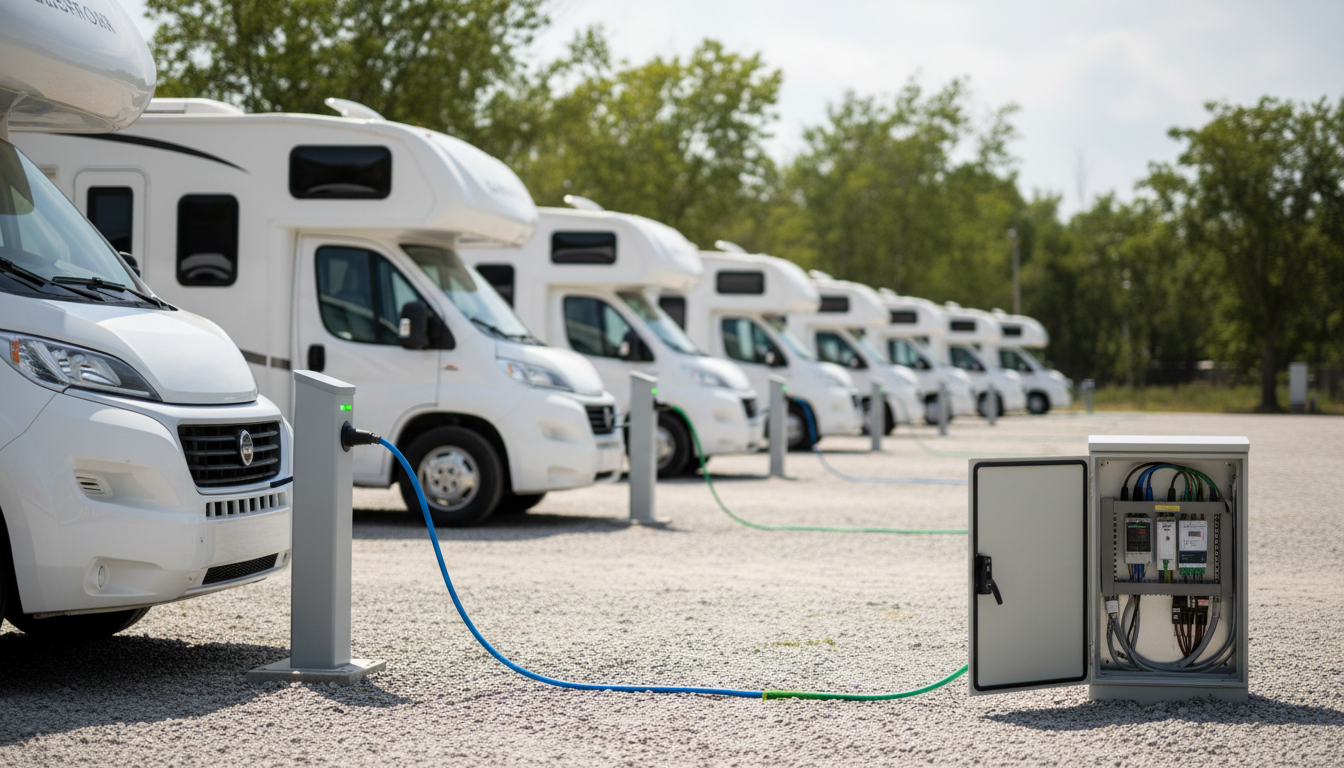
It’s 3 p.m. on the Saturday of a holiday sell-out, every pedestal lit up, dual A/Cs roaring—and somewhere off-site a utility demand meter just slapped another surcharge on your bill. What if, instead of bracing for that hit, you could redirect power in real time, smooth the spike, and pocket the difference?
Dynamic power-sharing makes it possible, and the parts are finally plug-and-play: Wild Energy meters feed live load data straight into CampLife and Firefly dashboards; Bluetti’s hot-swappable battery clusters roll wherever demand swells; new control algorithms cut both energy loss and hardware wear. Parks that grab these tools are already trimming five-figure demand fees and extending transformer life without guests noticing a flicker.
Stick with us to see exactly how a 12-month bill pull, a few smart wires, and a “Power-Smart Site” sign can flip your electric line item from anxiety to advantage—before the next RV even checks in.
Key Takeaways
– Utilities punish the single biggest 15-minute power burst each month; cutting just 5–10 kW during that spike can save thousands of dollars.
– Live Wild Energy meters now feed power use straight into CampLife and Firefly dashboards, showing staff exactly which RV sites pull the most electricity.
– Moveable Bluetti battery carts store cheap or solar power and release it during busy, hot times to flatten those costly bursts.
– Smart control software waits until load hits about 85 % of transformer capacity before discharging, saving both energy and battery life.
– Four easy steps: Measure every site, Store extra power off-peak, Share battery power when loads jump, Verify savings on each bill.
– Signs, emails, and small guest rewards (like discounts or loyalty points) nudge campers to stagger A/C and microwave use, trimming peaks without hurting comfort.
– A typical park may spend about $72 k up front, avoid roughly $9,600 in yearly demand fees, and see payback in a little over five years—quicker on holiday weekends.
– Adding dual 30/50-amp pedestals, bigger conduit, and data lines now prepares the park for future EV chargers and growing electric loads..
Why Demand Fees Keep Sneaking Up on Campgrounds
Most operators track kilowatt-hours because that number marches across every monthly invoice, but the quiet budget killer is the kilowatt demand charge. Utilities bill the single highest 15-minute spike each month at $4–$12 per kW, and in a 150-site park that spike often occurs during two or three brutally hot weekends. One 98 kW surge can add roughly $2,450—money that no nightly rate increase can erase quickly.
Pulling a full year of electric bills reveals those outliers and shows how little shaving it takes to land in a cheaper tier. Many parks discover that trimming just 5–10 kW during the worst quarter hour keeps them below the next threshold, protecting hundreds of dollars per month. That insight underpins every financial model you’ll run later, so start your project by asking the utility for a 12-month data export or downloading it from the customer portal.
Real-Time Eyes on Every Pedestal
Until recently, gathering per-site data meant wandering loops with a clipboard. In June 2025, the Wild Energy integration pushed live meter readings straight into the CampLife dashboard operators already use for reservations. Two months later the same feed reached Firefly Reservations, letting dual-platform properties reconcile utilities at checkout in six minutes instead of twenty-two. The benefit goes beyond faster billing: second-by-second visibility exposes which Class A rigs fire both roof A/Cs at 2 p.m. and which rows of seasonal trailers cruise at half that draw.
Armed with that knowledge, staff can nudge behavior in ways guests barely feel. A pre-arrival email noting that dual-zone A/C set two degrees higher still chills an RV quickly plants the seed. Pedestal signage branded “Power-Smart Site” reminds travelers to stagger microwave use with air conditioning. When operators layer in a micro-discount or loyalty-app badge for guests who opt into real-time metering, they create a friendly competition that trims peaks further—often without flipping a single breaker.
Storage That Moves With the Crowds
Static battery banks once belonged only in utility substations, but campground-ready storage arrived at CES 2025 when Bluetti rolled out the Apex 300 and EnergyPro 6K. An Bluetti Apex 300 cluster scales to 58 kWh, links with rooftop or canopy solar, and accepts both 120- and 240-volt loads. Hot-swappable packs mean staff can wheel a cabinet to Loop B for Fourth of July, then relocate it to the winter-snowbird row after Labor Day—all without shutting down the system.
Mobility multiplies return on investment. By staging batteries nearest the rigs that draw hardest you cut cable losses, discharge less energy, and extend pack life. One park that rotated battery cabinets weekly saw transformer temperature drop eight degrees on peak days, delaying an expensive utility upgrade by at least three seasons. When storage doubles as standby power for bathhouses and gate systems during outages, insurance carriers often shave premiums, adding an unplanned line to your benefit column.
Smarter Algorithms, Longer Battery Life
Hardware only pays off if it discharges at the right moment. A February 2025 study by Guo and colleagues introduced a cluster-level dispatch routine that trims daily energy loss 3.7 percent and slows degradation (cluster-level control). The takeaway is practical: you need software that learns the park’s load rhythm and fires watts only when demand nears 85 percent of transformer rating—a threshold easily flagged by the Wild Energy feed.
Most modern storage vendors now bundle similar logic, but confirm your quote includes it. If not, third-party energy-management systems drop in-line and pay for themselves quickly. Every avoided cycle is a slice of deferred CapEx, so richer algorithms are more than a software fee; they are an insurance policy on battery lifespan.
The Four-Step Blueprint: Measure, Store, Share, Verify
Every successful peak-shaving program follows the same rhythm. First, measure per-site load in real time. Set text or email alarms that chirp when aggregate draw touches 85 percent of capacity. Second, store off-peak power or harvest solar noon excess into modular batteries. Charging at 3 a.m. on a shoulder-season rate often costs half of what a 3 p.m. pull will.
Third, share and shave. When the alert fires, dispatch storage to hold the transformer below its pain point. Use live meter data to see whether Loop C or Loop E causes the climb, then divert energy where it matters. Finally, verify savings. During the weekly managers’ huddle, pull up the utility dashboard and celebrate the dollars avoided. Turning energy management into a scoreboard transforms staff from passive observers into active participants—and helps the program outlive turnover.
Penciling the Financial Roadmap
Investors care about payback, not theory. Break project costs into three buckets—meters and software subscriptions, storage hardware, and any pedestal or wiring upgrades. Classify each as CapEx or OpEx so the ROI math compares apples to apples with your current electric bill. Many midsize parks land at $18 k for metering, $42 k for storage, and $12 k for pedestals: roughly $72 k upfront.
Now layer incentives. Tie batteries to a small solar canopy and you qualify for the 30 percent Federal Investment Tax Credit. Accelerated depreciation and rural electric co-op loans routinely chop another 8–12 percent off net cost. At that point a park avoiding $9,600 in annual demand fees sees a simple payback near 5.3 years, faster once you account for the 4-plus-percent average utility inflation. Sensitivity tests tell an even happier story: during sold-out holiday weekends the system often shaves twice the usual kW, shortening payback by months without additional equipment.
Infrastructure Tweaks That Stretch Every Kilowatt
Smart electrons deserve smart copper. Dual 30/50-amp pedestals let staff assign modest trucks to 30 amp outlets, sparing 50 amp circuits for the bus conversions. One event-ground retrofit that spread these pedestals across loops cut nuisance trips 40 percent and flattened the evening spike enough that batteries discharged 12 percent less each night. Oversized conduit and pull-strings, installed while trenches are open, future-proof the park for Level 2 EV chargers and bigger battery cabinets. Dig once, benefit twice.
Inside panel rooms, semi-annual thermal imaging spots hot lugs before they cascade into peak-hour breaker trips. Pair the scan with GFCI tests at each pedestal and your maintenance crew knocks out two compliance chores in one truck roll. Documenting firmware updates for meters and inverters in the same logbook as reservation-system patches closes the cybersecurity loop—because a hacked inverter that flatlines at 3 p.m. can erase an entire season’s worth of demand savings.
Shaping Guest Behavior Without Sacrificing Comfort
Technology alone cannot shoulder every kilowatt. Guests who understand the stakes often become allies. Simple signage explaining that staggering microwave use with A/C keeps nightly rates stable has surprising power. Offering a five-percent nightly discount or loyalty points for users who opt into real-time metered billing turns conservation into a game, and dashboards in the camp store that display live park-wide kW foster communal pride.
Stocking the office with surge protectors and dog-bone adapters nudges rigs capable of 30 amps to choose that lower draw. Front-desk scripts place energy-intensive fifth wheels on sites closest to battery clusters, reducing discharge losses. These micro-interventions, multiplied over hundreds of check-ins, often equal the impact of a second battery cabinet—at a fraction of the cost.
Staff Training: The Human Battery
Every program needs an energy champion. Pick one team member to check battery state of charge as faithfully as they test pool chlorine. Write a simple SOP: when aggregate demand hits 85 percent of transformer rating, switch clusters from charge to discharge. Laminate a one-page quick-start guide, tape it to each cabinet, and run a mock outage drill twice a year so seasonal hires know how to island bathhouses and Wi-Fi if the grid blinks.
Weekly utility-dashboard reviews keep momentum alive. Printing the avoided-fee total in bold on the conference-room whiteboard reframes the initiative from “extra work” to “found money.” Celebrate when the number spikes after the Fourth of July; staff who see their actions quantified tend to double down, creating a virtuous cycle of savings and engagement.
Regulations and the Road Ahead
Before ordering hardware, request an interconnection packet from your local utility. If batteries never back-feed the grid, a simple non-export letter often sidesteps lengthy studies. Confirm that your insurance carrier has a lithium-ion rider; most update policies at no cost once they see UL-listed cabinets and proper ventilation. Install conduit one size larger than current need so you can slip in EV charger circuits later without trenching twice.
Design decisions made today must also anticipate tomorrow’s electrified tow vehicles. Early prototypes already pull 12 kW from pedestals overnight. Planning for that load now—bigger transformers, spare pedestal breaker spaces, data lines for smart chargers—protects your investment and positions the park as “EV-ready,” a marketing edge likely to matter within five years.
Case Snapshots From the Field
One Midwest event-ground relocated pedestals to distribute 30/50-amp receptacles evenly. The change reduced breaker trips 40 percent, flattened the 7 p.m. spike, and let a single 58 kWh battery cluster cover the remaining peak instead of two. Staff now spend less time resetting breakers and more time guiding guests, adding an unexpected service boost.
In the Southwest, a 3,500-panel solar array over an RV storage lot now supplies half of annual kWh; paired with modular storage, the park’s afternoon peaks nearly vanished. That solar-plus-storage stack also delivers shade for stored rigs, a value-add guests notice immediately. Operators using CampLife plus Wild Energy report utility reconciliation time shrinking from 22 minutes to six, freeing staff hours for revenue-generating tasks.
The next time a holiday weekend approaches, imagine seeing the transformer hold steady while alerts stay silent. You did not throttle guest comfort, yet your demand charge barely budged. That is dynamic power-sharing at work, converting kilowatts into competitive advantage. Pull last year’s bills tonight, highlight the ugly spikes, and sketch how many of those kW you need to erase. Everything else—meters, batteries, algorithms, signage—slots in after that first simple truth. The sooner you smooth the curve, the sooner peak-shaving profits start rolling in.
Dynamic power-sharing will keep the lights on and the bills low—now make sure everyone knows it. Insider Perks can turn your new “Power-Smart” credentials into irresistible talking points, from AI-driven guest emails that applaud conservation in real time to ad campaigns that spotlight your EV-ready sites before competitors even plug in. When your transformers relax, your marketing should accelerate. Connect with our team today and see how effortlessly we fuse energy wins into occupancy gains.
Frequently Asked Questions
Q: How much can a typical 100–200-site park expect to save with dynamic power-sharing?
A: Parks that deploy real-time metering and a right-sized mobile battery cluster usually shave 6–12 kW off their monthly peak; at $6 per kW demand rates that’s $430–$860 every busy month, or $7,000–$10,000 per year, which puts simple payback near five years once federal tax credits and accelerated depreciation are applied.
Q: Can I start with metering only and add batteries later?
A: Yes; Wild Energy meters and their CampLife or Firefly dashboards function as stand-alone visibility tools, letting you benchmark true peaks for a season before you commit capital to storage, and the same data feed later drives the battery dispatch algorithm without rewiring.
Q: How do I determine the correct battery size for my property?
A: Pull a 12-month demand report, identify the worst 15-minute spike, subtract the threshold for the cheaper demand tier, and size storage to cover just that gap plus 10 percent headroom; most parks find that 40–60 kWh of mobile lithium storage, charged off-peak, erases the expensive kilowatts without overbuying capacity.
Q: Will my guests notice when batteries take over during a peak event?
A: No; the inverter seamlessly supplements grid power so pedestal voltage stays within utility tolerances, and because discharge occurs for only minutes at a time guests’ air conditioners and appliances run exactly as they would on utility power alone.
Q: What happens if the battery cabinet empties before the peak subsides?
A: The system automatically reverts to full grid draw, so the only downside is that the remaining minutes of that spike may be billed at the higher demand rate; no service interruption or equipment damage occurs.
Q: Are lithium battery cabinets safe to place around RVs and tents?
A: Modern units are UL-listed, enclosed in steel, include fire-suppression modules, and carry outdoor NEMA ratings, so when sited on level pads with three feet of clearance they meet NFPA and most local fire-marshal guidelines, often lowering, not raising, insurance risk.
Q: Do I need utility approval or an interconnection study?
A: If the batteries are configured as non-export (meaning they never push power back onto the grid) most utilities accept a simple notification letter and require no study, but always file the paperwork early to avoid surprises during inspection.
Q: Will my insurance premiums change after installing storage?
A: Carriers typically add a no-cost lithium rider once they see UL certifications, a ventilation plan, and staff SOPs; some even reduce premiums because the batteries double as backup for life-safety loads like gate arms and bathhouse lighting.
Q: How long do the batteries last and what maintenance is involved?
A: Lithium iron phosphate packs are rated for 6,000-plus cycles, which translates to 12–15 years in a peak-shaving role, and maintenance is limited to quarterly firmware checks, dusting filters, and verifying the cabinet’s ventilation path.
Q: What training does staff need to run the system?
A: A one-hour onboarding covers reading the dashboard, flipping the charge/discharge toggle, and checking state of charge each morning, after which a laminated quick-start sheet at each cabinet and automated text alerts handle 98 percent of day-to-day decisions.
Q: Will the system integrate if I use a reservation platform other than CampLife or Firefly?
A: The Wild Energy API is open, so property-management vendors can pull live meter data with minimal development, and several regional software houses have already built adapters, making integration more a question of vendor willingness than technical limitation.
Q: How does this prepare me for future EV charging demand?
A: The same batteries that shave RV peaks can absorb midnight solar or off-peak power and deliver it to Level-2 chargers without upsizing your transformer, so installing conduit and spare breakers now lets you add revenue-generating EV stations later with little new infrastructure.
Q: Are there grants or incentives beyond the 30 percent federal tax credit?
A: Many rural electric co-ops offer zero-interest loans or rebate $150–$300 per kWh of installed storage, state energy offices frequently stack an additional 10–15 percent incentive, and some insurers discount 3–5 percent when the batteries provide standby power for safety systems.
Q: Can I legally meter power and pass costs through to guests?
A: In nearly all U.S. states RV parks qualify as sub-metered campgrounds under the public-utility exemption, so you may bill actual kilowatt-hours provided that you disclose rates at check-in and do not mark up above the utility tariff.
Q: Does the system provide outage backup or just peak shaving?
A: While designed primarily for peak shaving, the inverters can island critical loads like bathhouse lights, POS terminals, and gate controllers during grid failures, giving you a basic resiliency package without purchasing a separate generator.