

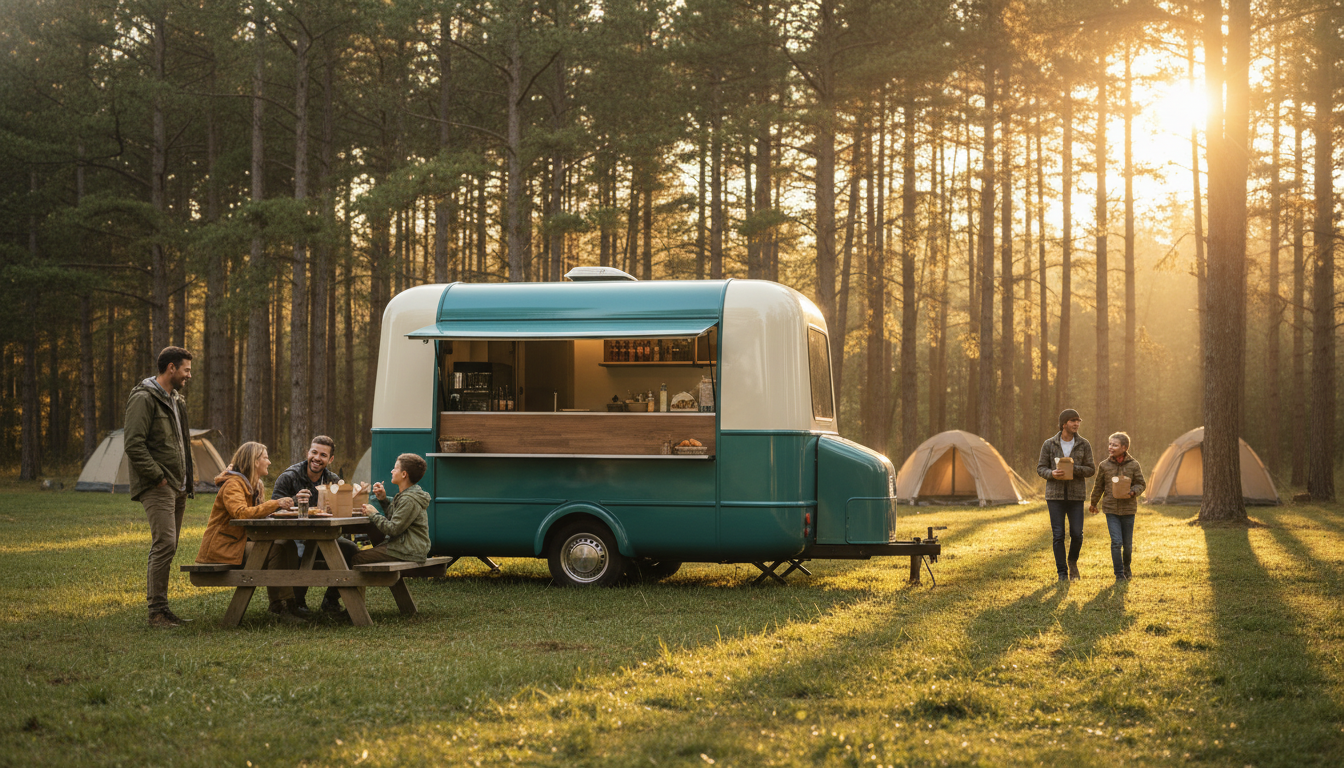
Last season, how many campers left your property after sunset in search of dinner—and took their wallets with them? Picture the alternative: phones across the park buzz, “Taco Tuesday just rolled up at Site 42,” string lights flip on, and a chef-driven truck starts serving smoked-brisket hash before the campfire even crackles. Average spend jumps $10 a head, Instagram lights up, and you still have quiet hours intact.
Ready to turn a simple pull-through pad into a micro food court that feeds guest satisfaction and your bottom line? Stick around; we’re breaking down the proven playbook—from vendor contracts to geo-fenced alerts—that keeps campers (and their appetites) right where you want them: on-site and spending.
Key Takeaways
The food-truck model lets campground operators add chef-quality dining without breaking ground on a brick-and-mortar café, tapping directly into travelers’ growing demand for convenient, memorable meals. Use the list below as your lightning-round blueprint before diving into the deeper strategy that follows.
• Campers book sites that offer tasty food right at the park
• Food trucks boost guest spending by about $10 each without building a restaurant
• Start small: one afternoon with three trucks can prove demand
• Pay trucks a flat fee plus a few percent of sales; review their POS reports
• Match menus to guests—pizza for families, coffee for early birds, BBQ for night events
• Give trucks a level pad, 50-amp power, water drain, clear lanes, seats, shade, and lights
• Stay legal: health permits, fire safety gear, insurance, and local zoning rules
• Alert guests with emails, texts, and geo-fence pings when the truck arrives
• Track sales, ticket size, and peak times to guide future plans
• Use a checklist: find trucks, prep pad, market events, follow rules, study the data.
The bullets cover the essentials, but execution is where profit lives. Read on to see how each takeaway unfolds in real-world scenarios, proven revenue models, and tech tips that turn a tasty idea into a long-term profit center.
The 2025 Dining Shift You Can’t Ignore
Campers used to accept dehydrated meals and gas-station pizza as part of the adventure. Not anymore. An OHIO Travel Trends survey shows that 73 percent of 2025 campers now rank “quality, on-site dining” among their top three booking criteria RV-PRO report.
Pop-up food trucks hit the sweet spot of convenience, novelty, and Instagram-ready aesthetics—without the sunk cost of building a restaurant. Pilot parks using chef-driven or farm-to-table trucks report higher Net Promoter Scores and an uptick in average daily rate because guests perceive the entire stay as more premium. Bottom line: elevated food is no longer a nice-to-have amenity; it’s a booking magnet that deflects OTA comparison shopping.
Proof on the Gulf: A One-Day Fest That Printed Buzz
On May 10, 2025, Gulf Shores / Pensacola West KOA in Alabama converted a standard parking row into a Food Truck & Vendor Fest. Three local operators—FoodHaze Coffee Co., Cannon’s Barbecue, and Twisted Sips—rolled up, plugged in, and served campers and curious locals alike KOA event recap. The activation generated ancillary revenue from parking fees, boosted day-pass sales, and built a mailing list of hungry prospects who hadn’t previously considered overnighting at the park.
The key takeaway isn’t the scale; it’s the speed. One carefully curated afternoon validated demand, gave management leverage in future vendor negotiations, and created user-generated content they still recycle in social ads. If you’re hesitant to commit to weekly service windows, mimic KOA’s test-and-learn approach: one day, three trucks, documented results.
Money Mechanics: Picking the Right Pricing Model
Your accountant wants predictability; your entrepreneurial spirit wants upside. Combine them. Many operators start with a base-plus-commission structure: a modest flat fee—say $100 to cover utilities—plus eight to twelve percent of gross sales. If a truck clears $4,000, your cut beats any static rental fee without risking losses on a slow Tuesday.
Collect payment at the end of each service day. Most trucks already run Square or Toast, so request viewer access to their cloud POS and verify sales in real time. Build a $15-to-$20 power surcharge into the contract and require vendors to list your entity as an additional insured on their liability policy. Those three lines—commission, utilities, insurance—protect profit while preventing awkward after-the-fact haggling.
Curation That Converts: Matching Menus to Campers
Think of your campground like a festival with shifting crowds. Families swarm playgrounds at five o’clock? Burgers, fries, and soft-serve anchor the lineup. Digital nomads queuing for Wi-Fi at dawn want third-wave cold brew and acai bowls. Anglers leaving before sunrise will pay for grab-and-go breakfast burritos they can eat on the boat. Tailoring cuisine to guest segments multiplies total spend per cap.
Avoid menu cannibalization by capping cuisine overlap: one savory and one sweet truck per window keeps both operators busy. Lock a crowd-pleasing anchor vendor into a recurring Friday slot—think wood-fired pizza—then rotate experimental concepts mid-week to create FOMO. Require each truck to craft one camp-exclusive item such as s’mores empanadas. Unique dishes serve as social-media bait and discourage guests from driving to town “just for dessert.”
Pad to Plate: Engineering the Perfect Service Zone
Operational friction kills dwell time—and profits. Carve out at least forty feet of pull-through clearance so trucks avoid tricky back-ins around RV rigs. Paint separate order and pickup lanes on the asphalt; clear wayfinding reduces real or perceived wait times, keeping line anxiety low and ticket totals high.
Cluster seating within seventy-five feet of the service window, add shade sails for midday comfort, and run warm LED string lights so evening diners linger for a second round of cookies or craft sodas. Double your trash and recycling stations—one at each end of the seating area—to keep wildlife away and pathways clean. Install a 50-amp pedestal and a greywater drain nearby so vendors set up in minutes rather than hours, freeing you from extension-cord roulette.
The Compliance Net: Staying Out of the Headlines
Nothing implodes a great guest experience faster than a surprise health inspection that shuts down dinner service. Confirm zoning rules for mobile food units; some municipalities limit consecutive service days before a truck is deemed “permanent.” Keep a laminated binder of local health-department guidelines at your front desk so on-duty staff can appease inspectors without frantic phone calls.
Each vendor should show current ServSafe or equivalent food-handler certification, and trucks cooking with open grease should park within thirty feet of a serviced Class K fire extinguisher. Serving alcohol? Funnel canned cocktails or beer through the vendor’s off-premise license whenever possible to sidestep added liquor liability for your campground. These precautions sound tedious—until the day they save you from fines or worse.
Marketing Cadence: From Teasers to Geo-Fence Triggers
A six-month food-truck calendar gives vendors stability and your marketing team runway. Drop a menu teaser into the automated pre-arrival email: “Friday night wood-fired pizza, locally roasted beans Saturday morning.” Two hours before service, fire an SMS or in-app push. Properties running geo-fence alerts—where the message deploys the moment a truck enters a half-mile radius—log higher open rates and faster order bursts Insider Perks study.
Theme alignment amplifies conversion. Pair taco trucks with outdoor movie night, smoothie bowls with sunrise yoga, or barbecue with live music. Incentivize user-generated content by offering a free drink for any tagged photo that features both the park and the vendor. Shared hashtags expand reach without paid ads, and the content doubles as social proof in future booking funnels.
Data Loops: Turning Sales Receipts Into Strategy
Require every truck to grant you daily read-only POS access. Export gross sales, item mix, and peak order times into a simple KPI dashboard that marries revenue with marketing signals such as alert open rates. Over time, you’ll learn whether the 4 p.m. push beats the 6 p.m. push, whether vegan nights merit a higher flat fee, and whether shoulder-season commissions need sweetening.
Use insights to renegotiate partnership terms ahead of renewal. If average ticket size climbs 20 percent after you added shade sails, you’ve quantified the ROI on that capital upgrade. Data also helps justify additions like a second beverage truck or a dessert kiosk, ensuring expansion happens because the numbers say yes—not because a vendor happened to be available.
Your Quick-Start Checklist
Consider the checklist your at-a-glance roadmap from concept to first cash drawer drop. Skipping even one line item can mean a blown breaker, a missed inspection, or a hungry crowd that drives into town instead of lining up on your pad. Run through each step now, and you’ll go live faster, smoother, and with fewer surprises.
• Outreach and Agreements: Compile a list of local licensed trucks, vet certifications, negotiate base-plus-commission contracts, and collect insurance certificates.
• Pad Prep and Utilities: Level surface, paint lanes, install 50-amp power and greywater dump, position Class K extinguisher.
• Marketing Assets: Schedule teaser emails, SMS pushes, social posts, and geo-fence triggers tied to truck GPS.
• Compliance Docs: Zoning confirmation, health-department binder, ServSafe proof, alcohol permissions if applicable.
• KPI Sheet: Link POS viewer access to your dashboard; track gross sales, average ticket, dwell time proxies, and guest-satisfaction deltas.
Food trucks already have the wheels—Insider Perks gives you the engine. From AI-powered geo-fence alerts that fill the order queue before the truck parks to automated POS dashboards that surface margin-boosting insights while you sleep, our marketing and automation suite turns every service window into a data-driven revenue play. Ready to swap guesswork for guaranteed ROI? Book a quick strategy call or explore our resource library and let’s build the on-site dining program your campers (and your balance sheet) will crave all season long. Put simply, the trucks roll in, and the profits roll up.
Frequently Asked Questions
Q: How do I locate and vet food trucks that will match my campground’s guest profile?
A: Start by searching your county’s health-department database for licensed mobile food units, then filter candidates by cuisine that aligns with your guest segments—family-friendly comfort food, early-morning coffee, or late-night desserts—and request recent inspection scores, photos of their setup, sample menus, and proof of $1 million in liability coverage before inviting them on-site.
Q: What revenue model works best for campground operators who want predictability without capping upside?
A: A base-plus-commission structure—such as a $100 flat utility fee plus 8–12 percent of gross sales—covers your hard costs while letting both you and the vendor benefit from high-volume nights; negotiate viewer access to their POS so you can reconcile sales in real time and avoid disputes.
Q: Do we need extra insurance beyond what the truck carries?
A: Require each vendor to name your park as an additional insured on their general liability policy and verify that coverage meets or exceeds your own limits; this transfers primary risk for slips, foodborne illness, or grease-fire incidents to the truck’s insurer and keeps your premiums from spiking after a claim.
Q: What utilities must we provide and how do we quantify the cost?
A: Minimum infrastructure is a leveled pad with a 50-amp pedestal, potable water spigot, and a nearby greywater drain; calculate the average kilowatt draw of commercial kitchen equipment, convert that to dollars per service window, and roll a flat $15–$20 power surcharge into the vendor fee so billing stays simple.
Q: Which permits or licenses typically apply to hosting food trucks on private campground property?
A: Most jurisdictions treat trucks as self-contained restaurants, so they carry their own health permit, but you’ll still need zoning confirmation that mobile vendors can operate more than a set number of consecutive days and, if alcohol is served, either a special‐event permit or use of the truck’s off-premise liquor license.
Q: How frequently should we schedule trucks to keep the experience fresh without overwhelming guests?
A: Anchor one crowd-pleasing truck on peak weekends, add a rotating concept mid-week, and leave at least two truck-free days in a seven-day cycle; this cadence builds anticipation, prevents menu fatigue, and ensures your camp store’s staple items continue to move.
Q: What contingency plan protects us if a vendor cancels last minute or underperforms?
A: Insert a contract clause that imposes a modest no-show penalty, allows you to backfill the slot with another licensed truck, and gives you the right to terminate future dates after two missed or sub-par service windows, ensuring guest expectations and revenue targets stay intact.
Q: How do we manage trash and grease to avoid attracting wildlife or failing inspections?
A: Position two extra bear-resistant receptacles within the seating zone, mandate that trucks remove used oil off-site the same day, and schedule a quick post-service walk-through with staff to pick up litter before quiet hours begin, satisfying both environmental standards and guest comfort.
Q: Will evening service violate quiet hours or disturb campers near the pad?
A: Choose trucks that can shut down generators and run silently off your shore power, set last call at least 30 minutes before quiet hours, and direct any amplified music toward communal areas rather than RV sites so the amenity adds vibrancy without compromising rest.
Q: Could food trucks cannibalize sales from our existing camp store or snack bar?
A: Data from pilot parks shows that trucks lift overall spend by adding higher-ticket meals guests would otherwise buy off-property, while the camp store still captures convenience purchases like firewood, ice, and sundries; cross-promote by offering a store coupon on truck receipts to keep dollars circulating on-site.
Q: How long does setup usually take and do we need staff on hand?
A: With a properly engineered pull-through pad, marked lanes, and preinstalled hookups, most trucks can park, connect utilities, and open the window in under 15 minutes; a brief staff check-in to verify insurance, power load, and extinguisher proximity is usually all that’s required.
Q: Are alcohol sales worth the added compliance burden?
A: Yes if your demographic skews toward weekend leisure travelers who expect craft beer or canned cocktails; by routing sales through the vendor’s mobile liquor license and confining consumption to a designated area, you can boost per-cap revenue without taking on full beverage liability yourself.
Q: What performance metrics should we track to know if the program is working?
A: Monitor gross sales, average ticket, peak order times, SMS alert open rates, and post-stay Net Promoter Score; correlating these numbers in a dashboard lets you prove ROI, fine-tune service windows, and negotiate stronger terms when renewals come up.
Q: How quickly can pop-up trucks pay back the cost of pad prep compared to building a brick-and-mortar café?
A: In most cases the $2,000–$5,000 spend on grading, power, and signage is recouped within a single high-season by commissions alone, whereas a permanent café can take five to seven years to amortize—making food trucks a low-risk, high-agility path to elevated guest dining.