

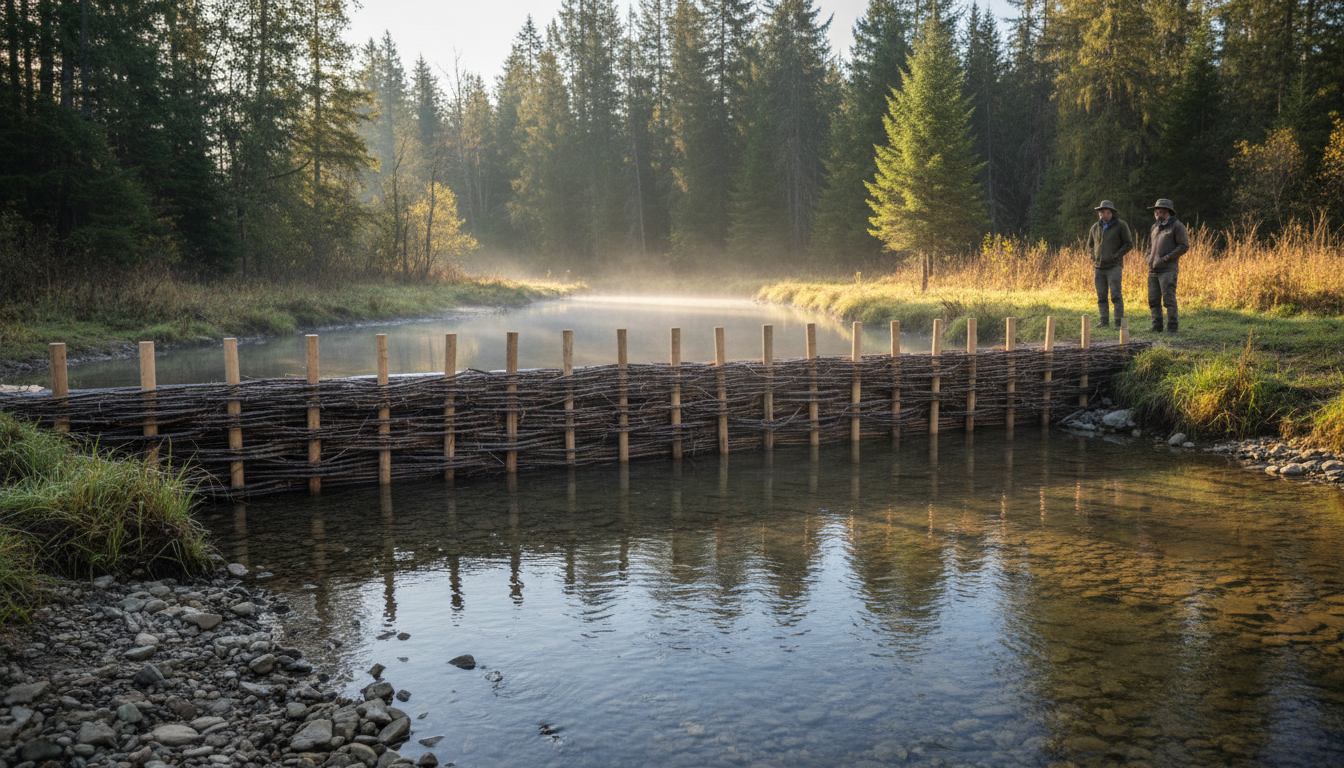
That picture-perfect creek beside Site 12 looks charming—right up until a summer downpour turns it into a chocolate-brown torrent that chews away tent pads, trashes trails, and spikes your liability worries. What if you could hand that problem to the one contractor who works for free and never misses a shift: the beaver?
Enter beaver dam analogs—simple, low-tech walls of posts, brush, and mud that copy nature’s own water-managers. They slow flow, catch sediment, and raise local groundwater, turning a flashy stream into a calm chain of ponds that doubles as a wildlife viewing arena.
Cranberry farmers in Wisconsin are already banking on them; Missouri researchers are documenting wider, slower channels after just one season. The payoff for campground and RV-park owners? Fewer washouts, lower maintenance bills, fresh marketing photos, and guests who linger longer to watch dragonflies dance at dusk.
Ready to trade rip-rap and regrading invoices for sticks and stewardship? Read on to see the permitting shortcuts, safety rails, and budget hacks that make BDAs a revenue-friendly reality.
Key Takeaways
– Beaver dam analogs (BDAs) are small, hand-made stick dams that copy what real beavers build.
– BDAs slow rushing water, stop erosion, and raise the water table.
– Slower water means fewer floods, less repair work, and greener, prettier campsites.
– Most materials come from on-site, so a starter project of 2–3 BDAs costs around $5,000.
– Success stories in Wisconsin and Missouri showed less bank damage and more wildlife in one season.
– Check with state water officers early; some areas treat BDAs like regular dams and need permits.
– Place BDAs in fast, narrow stream spots and keep them 50–75 feet away from busy guest areas.
– Inspect twice a year, clear blockages, and cut a small spillway before big storms.
– Add signs, fences, and benches so guests can safely watch birds, fish, and dragonflies.
– Lower repair bills, possible insurance savings, and new nature photos can quickly pay for the project..
The Beaver-Dam Analog Basics
A beaver dam analog, or BDA, is nothing more than a human-built riff on what real beavers do every day. Crews drive untreated wooden posts into the creek bed, weave in branches and brush, then let spring flows pack the gaps with silt and leaves. That porous wall reduces water velocity, spreads flow onto the floodplain, and raises groundwater levels—all without concrete or rebar. The National Park Service (NPS overview) lists sediment trapping, habitat expansion, and erosion control among the primary benefits of BDAs.
For outdoor hospitality, those hydrologic perks translate into business gains. Slower water means less bank undercutting below tent pads, fewer gravel washouts on access roads, and greener, lusher riparian zones that photograph beautifully. Because materials are often harvested on-site—think willow whips or blow-down logs—capital costs stay closer to a new picnic-table set than to an engineered culvert. When guests ask what you’re doing about sustainability, you can point to a living, breathing solution right outside their cabin door.
Lessons from Real-World Pilots
In 2025, a Wisconsin farmer installed twelve BDAs that now hold roughly 1.7 acre-feet of floodwater. Within months, waterfowl nested in the new pools and bank erosion almost disappeared. The flip side: the state classified each structure as a “dam,” adding a year and about $20,000 in paperwork and inspections. Campground owners drawing up plans should take that red-tape lesson to heart—early agency conversations prevent mid-project stalls.
Farther south, the Missouri case study teamed scientists with land managers to test BDAs on four prairie streams. After one season, channels had widened, current had slowed, and wet-meadow plants sprang back, creating a softer, more resilient edge that would suit any riverside RV site. Those measurable successes—wider channels, higher groundwater, richer vegetation—offer data points operators can show insurers and investors when pitching a BDA pilot of their own.
Choosing the Right Stream Reach
Not every trickle deserves a dam, even a stick-built one. Walk the creek during both low flow and after a storm to spot narrow, incised segments where water races through a trench, eroding the banks. These “flashy” reaches give the biggest bang for your BDA buck because small structures there can spread flood pulses across a wider area without threatening hookups or bathhouses.
Overlay guest zones on your map and aim to keep BDAs at least 50–75 feet from high-traffic sites unless you’re ready to add railings and warning signs. Placement slightly upstream of trouble spots—like the bend that always slumps after spring melt—lets the slowed water do the heavy lifting before it reaches revenue-generating real estate. Take photos and jot GPS points; that documentation speeds permit reviews and proves you did due diligence if a guest ever asks why you changed the stream.
Permits, Liability, and Peace of Mind
Paperwork rarely excites operators, yet skipping it can sink even the greenest project. Borrow a page from Wisconsin and call your state water-resource office before driving the first stake. Bring a simple plan-view sketch, a cross-section, and a rough floodplain impact note; regulators appreciate clarity and may offer expedited paths for habitat-focused, low-head structures. Some states roll small BDAs into general stream-alteration permits, shaving months off timelines—knowledge that keeps contractors on schedule and budgets intact.
Guest safety sits beside compliance on the must-address list. Post-and-cable barriers or a rustic split-rail fence near family loops steer kids away from freshly pooled water, while multilingual icon signage warns of slippery banks and storm surges. Add the BDA coordinates to your emergency action plan and train seasonal staff to check for undercut banks or storm debris during routine patrols. A documented pre-season and post-storm walkthrough demonstrates reasonable care—gold when insurers or attorneys review an incident.
Building and Maintaining on a Modest Budget
Treat BDAs like you would a new bathhouse roof: start small, assess, then scale. A pilot of two or three structures often fits into a single shoulder-season weekend using in-house maintenance staff and wood harvested on the property. That timing avoids overtime during peak occupancy and lets guests arrive to a finished, photo-ready feature. Keep receipts and labor hours in a dedicated folder; you’ll need them when you apply for erosion-control grants that often favor projects with documented matching contributions.
Maintenance is refreshingly low tech. Schedule a spring pre-runoff inspection to clear any branches pointing flow toward campsites and an autumn post-leaf-drop check to remove clogs before freeze-up. A one-page log noting water depth, sediment depth, and any damaged posts becomes a no-cost adaptive-management tool over the years. During flood watches, pre-cutting a relief notch with a chainsaw lets high water spill safely—denying Mother Nature the chance to improvise her own breach route through Tent Loop B.
Turning Infrastructure into Guest Magic
A slow, reflective pond framed by willow catkins is more than flood insurance—it’s an Instagram backdrop begging for a hashtag. Align a nature trail to loop past one or two BDAs and place a bench where families can count dragonflies. Interpretive panels that explain how “baby beaver dams” protect campsites and fish habitat turn a behind-the-scenes project into visible stewardship guests will share online. Weekly “creek-peek” walks cost nothing but staff time and keep visitors on-site longer, boosting ice-cream and firewood sales.
Kids’ clubs or scout troops can help plant willow cuttings along new pools, turning stewardship into a memory that sparks repeat stays. Early-morning quiet hours around the ponds cater to birders eager for heron photos, while dusk kayak launches from a safe gravel ramp satisfy adventure-seekers. Every beam of guest programming woven around the BDAs reinforces your brand as the resort that marries comfort with conservation.
The Numbers That Matter
Let’s stack a modest BDA pilot against the status quo. Three structures built with on-site wood and a rented post-pounder often land near $5,000 including labor. Compare that to a single post-storm gravel replacement that can top $4,000, not counting lost revenue while riverside sites sit closed for repairs.
Beyond bean counting, consider the intangibles: photo-driven social buzz, higher occupancy as word spreads about resident kingfishers, and the competitive edge of quantifiable sustainability. Investors love a line item that reduces risk and enhances guest experience in one stroke, and your maintenance crew will appreciate a project that relies more on loppers than loaders. Those softer returns often prove even more persuasive when you’re courting environmentally minded guests and lenders.
Slow the water, speed the buzz. Beaver-dam analogs can save you thousands in repairs, but the real payout comes when every mirrored pool starts filling sites instead of floodplains. If you’re ready to turn those conservation wins into scroll-stopping visuals, automated guest journeys, and smarter ad spend, connect with Insider Perks. Our marketing, advertising, AI, and automation tools make sure the story of your “free beaver contractor” reaches the campers who’ll book next weekend—and the investors who’ll back your next big idea. Let’s transform creekside stewardship into year-round occupancy.
Frequently Asked Questions
Q: How large does a stream need to be for a beaver dam analog to make sense?
A: BDAs work best on small to medium creeks—channels two to twenty feet wide that exhibit flashy, high-energy flows after storms—because slowing water in those sizes yields measurable sediment drop and floodplain reconnection without creating a deep reservoir that would demand engineered spillways or extensive permitting.
Q: Do I need real beavers on the property for a BDA project to succeed?
A: No; human-built structures function on their own by interrupting flow, and if wild beavers eventually discover them they usually add material that only strengthens the system, essentially providing free labor rather than introducing new problems.
Q: What permits are typically required for campground owners?
A: Most states roll stick-built BDAs under general stream-alteration or minor wetlands restoration permits, but you still need to file a basic plan set and flood-impact note with your water-resource or environmental quality agency before construction to stay compliant and avoid costly redesigns later.
Q: Will installing BDAs increase flood risk for downstream neighbors or my own lower campsites?
A: Properly sited BDAs actually reduce peak downstream flows by briefly storing and slowly releasing stormwater, and contingency relief notches cut during construction ensure high-water bypass so the structures never raise the one-percent annual chance floodplain elevation in any meaningful way.
Q: What should I budget and who can handle the build?
A: A pilot of two or three BDAs typically lands near $5,000 using in-house maintenance staff, volunteer groups, or a local conservation crew equipped with a gas post-pounder and hand tools, and costs remain low because most materials—untreated posts, brush, and mud—are harvested on-site.
Q: How much annual maintenance will they require?
A: A spring inspection and a fall cleanup to remove debris or repair a few posts are usually sufficient, amounting to less than eight staff hours per structure per year, which compares favorably with the loader-and-gravel routine many parks face after every big rain.
Q: When will I notice tangible benefits like reduced erosion or greener banks?
A: In many pilots vegetation rebound, bank stability, and clearer water become visible within one growing season, while groundwater rise and sediment trapping typically hit measurable targets—often a five- to ten-inch water-table bump—by the end of year two.
Q: Do BDAs create mosquito problems around campsites?
A: Because the ponds stay shallow and support fish, dragonflies, and other mosquito predators, well-functioning BDAs rarely increase nuisance insects and often improve overall biodiversity that naturally keeps larvae in check.
Q: How do I keep guests, especially children, safe around the new pools?
A: A rustic split-rail or cable barrier set back a few feet from the bank, paired with multilingual “slippery when wet” icons and inclusion of the BDA zone in staff patrol checklists, satisfies most insurers’ reasonable-care expectations without detracting from the rustic aesthetic guests enjoy.
Q: Will my insurance carrier recognize BDAs as a risk-mitigation measure?
A: Carriers that underwrite outdoor hospitality generally view BDAs favorably once you provide design documents, a maintenance log, and evidence of agency sign-off, and some even apply small premium credits for documented flood-damage reductions.
Q: What about fish passage and environmental compliance?
A: The porous, low-head nature of BDAs allows most fish and aquatic organisms to swim through or over during higher flows, and agencies often waive fish-ladder requirements provided you demonstrate the structures sit below critical migration barriers and maintain pool-to-riffle connectivity.
Q: What happens if wild beavers colonize the analogs and start expanding them?
A: Their activity generally enhances flood storage and habitat value, but if water backs up farther than planned you can notch or partially remove new material with hand tools under the same maintenance provisions in your permit, keeping control firmly in your hands.