

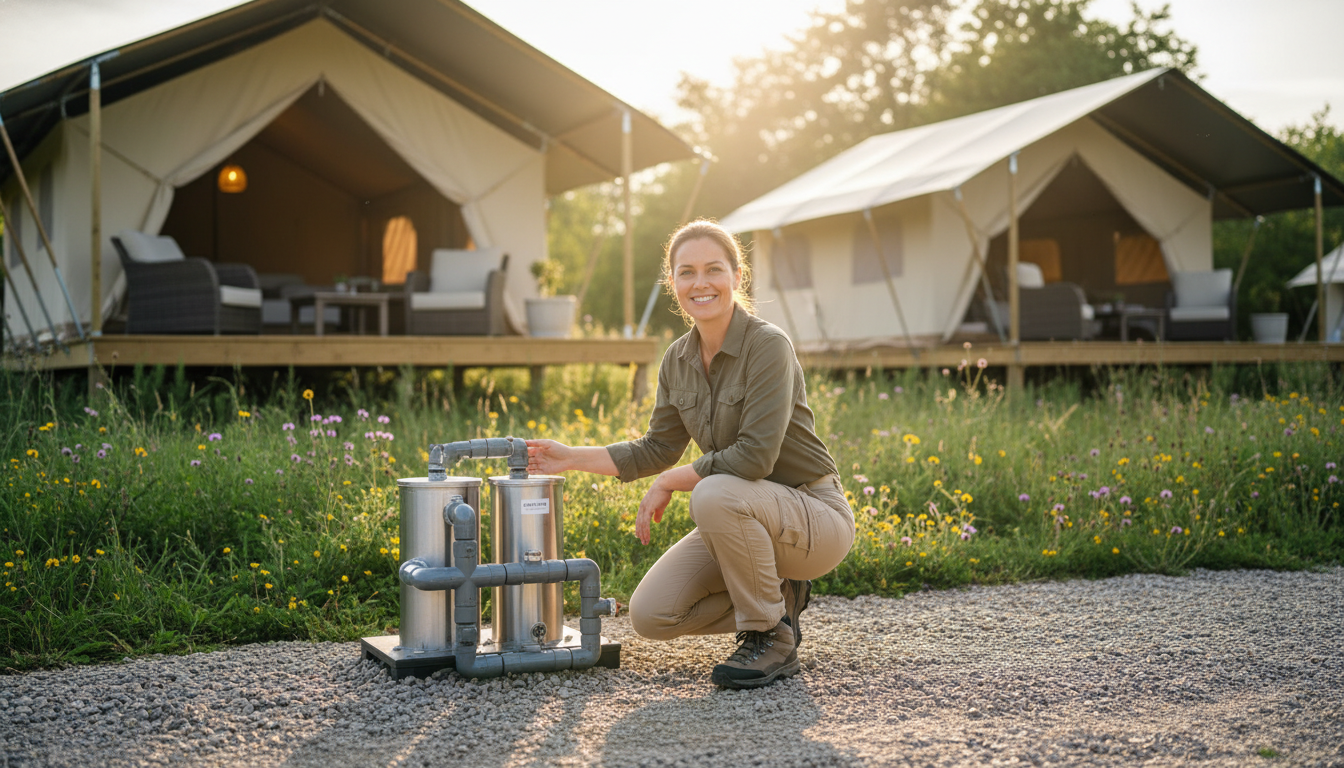
What if the cheapest, cleanest water your park will ever buy is already swirling down the shower drain? With drought-driven restrictions tightening and utility rates creeping up each season, every gallon that leaves your bath house untapped is profit slipping through the sewer grates.
Greywater recycling flips that script—turning yesterday’s rinse water into today’s toilet flush or landscape irrigation, trimming potable-water purchases by up to 45 percent while showcasing visible sustainability guests love to brag about. Ready to see how a compact, low-maintenance system can stretch your infrastructure, slash operating costs, and score you greener reviews? Dive in; the numbers may surprise you.
Key Takeaways
• Greywater is used water from showers, sinks, and laundry—not from toilets or kitchens.
• Cleaning and reusing this water can cut fresh-water buying by 25–45 percent.
• Savings come twice: less to buy, less to send down the sewer.
• Drought rules and new laws may soon require reuse; acting early avoids fines and delays.
• Small, low-care systems use settling, air, and UV light to make greywater safe for toilets and plants.
• Real parks and hotels already save money and millions of liters each year.
• First step: collect a full year of water bills to size the system correctly.
• Put tanks close to showers and toilets; use gravity when possible to save pump power.
• Label purple pipes and add backflow stops so inspectors sign off quickly.
• Tell guests about the recycling; it boosts green ratings and positive reviews.
Why Water Stewardship Now Pays Directly Into NOI
Most campground P&Ls groan under a 4–7 percent annual rise in water and sewer tariffs, a pace outstripping average nightly rate growth. Leaving shower and laundry water unreclaimed essentially doubles the hit because you pay once to pump or purchase it and again to flush it down the sewer or septic. Convert that same stream into toilet-flushing or irrigation supply and you reduce both invoices at once, instantly boosting net operating income.
The opportunity grows in drought-prone states where caps on daily consumption or punitive tiered pricing magnify savings. Operators who move early also sidestep looming regulatory pressure: Spain’s RD 1085/2024 already mandates on-site reuse for new hospitality builds, projecting 30–60 percent potable-water cuts (official decree guide). U.S. municipalities from Tucson to Santa Rosa are drafting similar language, so the system you install for cost reasons today could be the permit accelerator that beats tomorrow’s competition to market.
Greywater 101: Sources, Uses, and Safe Treatment
Greywater is simply the lightly used runoff from showers, bathroom sinks, and laundry—everything except toilets and kitchen wastelines. In glamping resorts, those sources typically make up 55–70 percent of all indoor water use, giving them outsized leverage on utility bills when reclaimed. Reuse targets vary by property layout, yet toilet flushing, drip irrigation, and pool top-up generally deliver the fastest payback because fixtures already exist and demand is year-round.
Modern systems such as Hydraloop employ a four-stage process—sedimentation, flotation, aerobic bioreaction, and UV disinfection—without consumable filters or chemicals, keeping maintenance low. Built-in sensors check turbidity and flow, while a cloud dashboard notifies staff if anything drifts out of spec. Water quality meets NSF/ANSI 350 and European EN 16941-2 guidelines, allowing broad non-potable applications and satisfying most state plumbing codes.
Field Results That Quiet Skeptics
Camping Weltevreden in the Netherlands slashed potable consumption by 25–40 percent after installing modular Hydraloop units tied to guest shower blocks (campsite data). The operator folded those savings into a higher green-tourism rating, attracting eco-tour travelers willing to pay a small premium for documented stewardship. Staff report no guest complaints and minimal extra workload—an attractive narrative to share with hesitant maintenance teams.
On a larger canvas, voco Brussels City North linked five H600 units to 58 rooms and now saves 1.2 million liters of drinking water and roughly €6 300 in fees each year (hotel case study). Although a hotel differs from a campground, the hydraulic math is identical: match peak shower output to toilet demand, hold buffer storage, and let automation handle the rest. A 40-site glampground can downsize that blueprint and still enjoy the same ROI curve.
Start With a Twelve-Month Water Audit
Before you order equipment, pull at least one year of water bills—shoulder seasons included—to capture occupancy swings. Layer in sub-meter data for high-volume zones such as bath houses, laundry huts, and staff housing. Operators who skip this step often over- or under-size tanks and pumps, leading to mid-season outages or stranded capital.
Peak-day demand, not annual average, should guide system sizing. Factor in elevation changes on your site map; a well-placed gravity line can eliminate a booster pump and its energy draw. Finally, run a simple payback or net-present-value model assuming 3–5 percent utility escalation. Often the math shows a phased rollout—starting with one bath house—delivers the shortest return while building a proof point for lenders and regulators.
Designing the Flow Path to Fit Existing Infrastructure
Retrofitting an active campground requires choreography. Schedule construction so at least one bath house remains open, preserving guest satisfaction scores and occupancy revenue. Position treatment units as close as practical to both the greywater source and the biggest reuse zones, usually toilet clusters, to shorten pipe runs and thermal losses.
Integrate high-level and fault alarms into the same panel that already monitors wells, lift stations, or pool pumps; central visibility makes after-hours troubleshooting simpler for limited staff. Use union connections and isolation valves on every inlet and outlet so a failed pump becomes an hour-long swap, not a weekend emergency. And don’t forget purple pipe and “non-potable” labels—two dollars in signage can prevent a two-week inspection delay.
Seasonal Operation Without Surprise Freezes
Before each busy season, flush and disinfect lines, inspect UV bulbs, test float switches, and install firmware updates. These tasks fit easily into a one-hour shoulder-season checklist yet head off the smells or color shifts that tank guest reviews. Keep a modest stock of consumables—UV lamps, pump seals, a spare gasket set—on site; shipping delays during holiday weekends cost more in refunds than the parts themselves.
In freeze-prone regions, bury exterior tanks below frost depth or move units into conditioned service rooms. Drain and bypass irrigation loops when nightly lows flirt with freezing, then reopen them at spring thaw. Log weekly readings for flow, turbidity, and power draw in a shared spreadsheet; consistent numbers signal healthy biology, while sudden jumps spotlight issues days before noses pick up an odor.
Permits, Incentives, and Finance That Align With Service Life
Open a dialogue with the local building or environmental health department early, supplying manufacturer specs that align with existing greywater clauses. Inspectors commonly request a cross-connection control plan—usually just a backflow preventer and annual test—so include it upfront to avoid resubmittals. Utility districts in water-stressed regions often rebate storage tanks or dual-flush toilets; a brief call can uncover grants that shave months off payback.
If financing, match loan terms to the system’s 15-plus-year service life; this keeps monthly debt service roughly equal to water savings and avoids negative cash flow. Build a reserve equal to one or two percent of initial capex for future pump or controller upgrades. That discipline prevents midnight raids on the operating budget and reassures lenders that the project remains accretive long term.
Turn Water Recycling Into a Marketing Magnet
Sustainability stories resonate most when guests meet them early and often. Mention recycled water on booking pages, highlight drought resilience in confirmation emails, and reinforce the narrative at check-in. A simple “Water’s Journey” infographic on the bathroom wall transforms what could be a confusing purple pipe into a badge of environmental honor.
Offer weekend behind-the-scenes tours of the treatment unit. Watching yesterday’s shower power today’s toilet flush creates social-media moments and five-star review fodder. Tie the greywater story to other initiatives—solar path lighting, native landscaping—to craft a cohesive low-impact brand. Equip front-desk staff with a one-sentence reassurance: “This water is disinfected to the same standard hotels use for laundry worldwide.” Confidence is contagious.
Nine Steps From Audit to Operation
With your storytelling engine engaged and guests primed to celebrate the change, it’s time to execute the nuts-and-bolts rollout. Begin by collecting twelve months of water bills and high-resolution sub-meter data, then rank shower, laundry, and staff facilities by volume. Use those numbers to draft a conservative ROI model, deciding whether a phased installation or full build-out pays back fastest for your specific tariff structure. Finally, sketch a site schematic showing elevation, preferred tank locations, and any gravity-fed opportunities that could eliminate booster pumps and their ongoing energy expense.
Next, package the schematic and equipment specs into a permit application that highlights cross-connection safeguards, then stage construction so at least one amenity block stays open to preserve guest experience scores. When the system arrives, commission it methodically: calibrate sensors, train at least two staff members on routine checks, and integrate alarms into your central control panel. Once water starts circulating, launch guest-facing marketing—think signage, emails, and optional tours—while logging weekly performance data and scheduling seasonal maintenance. Those final touches ensure the equipment, the narrative, and the bottom-line savings all keep flowing in perfect sync.
Common Mistakes That Inflate Costs
The single biggest failure mode is undersized storage that runs dry at midday, forcing automatic switchover to potable supply and erasing savings. Close behind is ignoring elevation, which can make pumps work overtime and quadruple energy costs. Operators who neglect spare UV lamps often find themselves issuing refunds when a bulb fails on a holiday weekend.
Paperwork oversights hurt, too. Forgetting purple-pipe labels or cross-connection documentation can stall final inspection for weeks, keeping the system idle while interest accrues on the loan. Each of these pitfalls traces back to incomplete planning—proof that the cheapest risk mitigation is a thorough pre-installation audit and compliance checklist.
Every gallon you rescue is a line item recovered, but the impact doesn’t stop at the meter—guests notice, reviews improve, and your search rankings climb when they understand the story behind those purple pipes. Insider Perks can amplify that narrative: our marketing, advertising, AI, and automation tools transform operational wins like greywater recycling into magnetic campaigns that fill calendars and lift ADR. Ready to pair smart water management with smarter customer messaging? Contact Insider Perks today and make every drop—and every impression—work harder for your park.
Frequently Asked Questions
Q: What is the ball-park capital cost for installing a modular greywater system at a 40-site glamping resort, and how quickly does it pay for itself?
A: Most operators spend $55,000–$85,000 for treatment units, tanks, and purple piping to serve a 40-site layout; when annual water and sewer bills top $18,000, that investment generally returns cash in 3–5 years at today’s utility-rate escalation, with savings accelerating as tariffs rise.
Q: How disruptive is the retrofit process to guests already on property?
A: A phased approach that keeps at least one bath house open allows you to trench and plumb in segments, so most resorts report only minor daytime noise and no drop in nightly occupancy when construction is scheduled mid-week or during shoulder season.
Q: Do regulators treat campground greywater differently than hotel or residential systems?
A: Nearly every U.S. plumbing code now references NSF/ANSI 350 or IAPMO 324, which classify campgrounds, RV parks, and hotels under the same “commercial building” rules, so the approval path is identical as long as you show backflow protection and a maintenance plan.
Q: Will recycled water smell, stain fixtures, or leave film on glamping-style white tents and décor?
A: When the system is sized correctly and UV disinfection is maintained, recycled water is clear, odor-free, and low in dissolved solids, so it performs like municipal supply in toilets and subsurface drip lines without creating stains or noticeable residue.
Q: How much staff time does routine maintenance actually take?
A: Expect about 30 minutes a week to check sensor alerts, empty a pre-filter basket, and glance at turbidity readings, plus a one-hour seasonal service to swap UV bulbs and sanitize tanks—tasks that fit neatly into the same checklist as pool chemistry or lift-station inspections.
Q: What happens if guest demand exceeds the recycled supply on a peak weekend?
A: Systems include an automatic bypass valve that reverts to potable water once the greywater buffer drops below a set level, so toilets still flush and irrigation timers keep running while you avoid any health or satisfaction issues; the only impact is a temporary dip in savings.
Q: Can I run the system only during warm months and shut it down for winter?
A: Yes, you can drain exterior pipe loops, bypass irrigation, and move treatment units into a conditioned service room or bury tanks below frost depth, allowing you to mothball the process each fall and restart with a simple flush-and-disinfect procedure each spring.
Q: Does greywater reuse interfere with my septic system or existing leach field?
A: By diverting 55–70 percent of daily flow away from the septic tank, recycling actually extends drain-field lifespan and reduces pump-out frequency, with no negative hydraulic impact as long as you redirect only shower, sink, and laundry lines—not blackwater.
Q: Are kitchen sinks or food-truck wash stations eligible greywater sources?
A: No; U.S. codes classify water from food preparation areas as “blackwater” due to grease and organic load, so sticking to showers, bathroom sinks, and on-site laundry keeps you in compliance and minimizes treatment complexity.
Q: What financial incentives are available to offset upfront cost?
A: Many water-stressed utilities—from Austin Water to Southern Nevada Water Authority—offer rebates of $1–$3 per gallon of tank capacity, and some states allow low-interest PACE financing or green-building tax credits, so a phone call to your municipal conservation office often uncovers funds that shave 10–30 percent off capital expenditure.
Q: How do I determine the right storage volume so I don’t run dry at noon?
A: Use your highest single-day sub-meter readings for showers and laundry, multiply by 50-70 percent to estimate reclaimable flow, and size storage at roughly 1.2 times that peak to provide a cushion; matching this buffer to the number of toilets or irrigation zones ensures supply keeps pace through the busiest checkout mornings.
Q: How do I communicate the safety of recycled water to skeptical guests?
A: Train front-desk staff to explain in one sentence that the water is treated to the same NSF standard large hotels use for laundry worldwide, display clear “non-potable but disinfected” labels on purple pipes, and post an infographic in restrooms detailing the four-stage process so eco-curious campers turn your investment into five-star review fodder.