

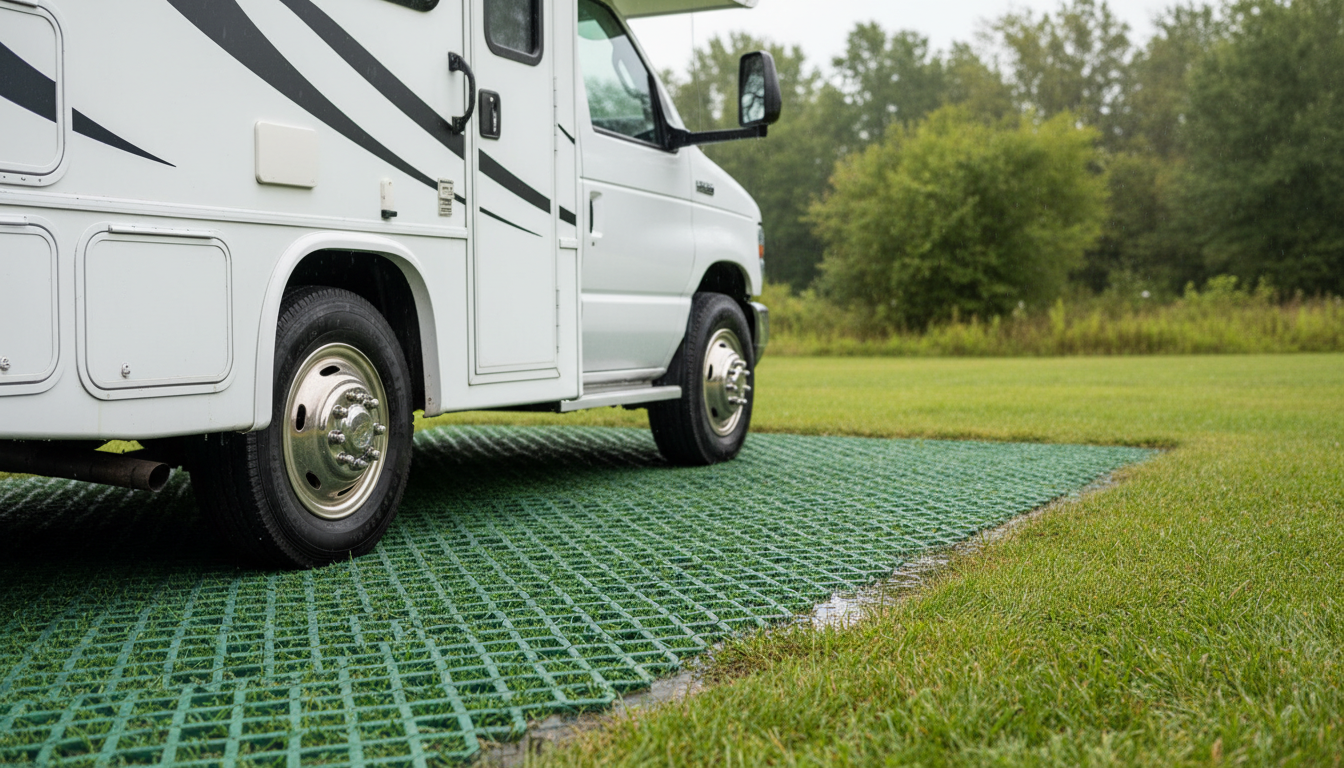
Mud-splashed campers, eroded gravel pads, and surprise letters from the storm-water inspector—sound familiar? There’s a fix that keeps regulators happy, guests cleaner, and your bottom line healthier: permeable turf-reinforcement grids.
Imagine rolling a 40-foot Class A onto a lush green pad that drains like sand, holds 300-plus tons, and still blends into the landscape. No ruts, no runoff sheets racing toward the fire ring—just a firm, ADA-friendly surface your staff installs once and practically forgets. Curious how a plastic honeycomb hidden under the grass can deliver all that? Keep reading; the math, the materials, and the marketing upside might change the way you build every site from here on out.
Key Takeaways
– Hidden plastic honeycomb under the grass lets rain soak in, not run off
– Pads stay firm and clean, so shoes, paws, and RV floors stay mud-free
– Strong enough to hold huge RVs, fire trucks, and other heavy gear
– Passes storm-water and ADA rules, keeping inspectors happy
– Costs a little more than gravel but saves money on repairs and fees over time
– Quick to install and needs only simple, light maintenance
– Works with real grass or decorative gravel, blending into the campground
– Cleaner, greener pads boost guest reviews and allow higher nightly rates.
Why Gravel Is Failing Modern Campgrounds
Gravel pads once checked every box: cheap, fast, and forgiving of amateur installations. Yet today’s guests arrive in heavier rigs and expect resort-style cleanliness; one muddy step into a $300K motorhome can tank a review score. Rising storm-water fees and accessibility audits only add pressure, exposing gravel’s Achilles’ heel—poor drainage that leads to rutting, ponding, and constant regrading.
Operators also face evolving low-impact-development mandates. Regulators now view runoff from compacted gravel the same way they view asphalt, so a “temporary” surface no longer buys compliance grace. Each rainstorm that sweeps fines into the nearest creek risks warnings or penalties, pushing owners to search for a surface that performs like pavement but acts like turf. Guests hunting “mud-free campground pad” options are quick to book elsewhere when they see negative photos online.
How Permeable Turf Grids Work
Permeable turf-reinforcement grids replace a loose stone top layer with an open-celled plastic lattice resting on a free-draining aggregate base. The cells spread axle loads across a wider footprint, keeping soil pores open so rainwater travels vertically instead of sheeting across the surface. Once filled with grass or decorative gravel, the grid virtually disappears, preserving the natural look guests associate with camping.
Because infiltration happens in place, operators often earn storm-water fee credits and avoid building costly detention ponds. The same structure that delights inspectors also pleases maintenance crews—no more chasing displaced gravel after every thunderstorm. That maintenance bonus shows up in labor reports and annual budgets alike, proving the system’s value beyond its green pedigree.
Strength You Can Park a Fire Truck On
Skeptical about plastic under heavy equipment? Consider the test numbers. The HERMEQ grid handles 326,000 lb over just under 11 sq ft, enough for a Class A plus a towed car. CORE Grass honeycomb panels reach roughly 350 tons per m², resisting lateral twist on slopes and switchbacks. Bodpave 85 porous pavers push past 367 tons per sq yd and interlock tightly for wheelchair-friendly surfaces. Translation: one surface can double as an RV pad, fire lane, and overflow parking—no redundant pavement required.
Field results mirror the lab data. Fire chiefs in multiple states have approved permeable grids for emergency access roads, citing zero rutting after fully loaded pumpers performed 20-turn maneuver drills. That same resilience translates to everyday campground abuse—think leveling-jack point loads, tandem-axle pivots, and the occasional septic truck that strays off the loop road. When a surface shrugs off all that, guests notice—and mention it in five-star reviews.
Building a Base That Never Sags
Every resilient pad starts with excavation deep enough to clear organic soil—typically 6–8 in. for passenger vehicles and 10–12 in. where fire apparatus might roll. Layer a non-woven geotextile before pouring in open-graded ¾-in. clean stone; the fabric stops soil fines from migrating upward, preventing frost heave and pumping. Compact in 3- to 4-in. lifts so the finished surface stays firm under leveling blocks, jack stands, and wheelchair casters. A gentle 1–2 percent crown or cross-slope guides overflow toward a swale during 100-year events.
Skip any of those steps and you’ll pay later. Uneven compaction telegraphs through the grid, leading to low spots that collect water and kill turf. Overly fine stone throttles infiltration, undermining the “pervious surface” classification your engineer signs off on. Follow the recipe and you’re rewarded with a pad that behaves like a concrete slab but drinks water like a sponge—an unbeatable combo for a permeable RV parking surface.
Choosing Grass, Gravel, or a Hybrid Surface
Grass delivers the coveted “camping on a lawn” vibe and stays up to 30 °F cooler than dark gravel on sunny days. In temperate zones, perennial rye and turf-type tall fescue tolerate both drought and 20,000-lb axles. Warmer parks favor Bermuda or Zoysia. Where shade or needles make turf tricky, fill cells with decorative gravel or run a hybrid—grass in the stall, gravel in the access aisle. Whatever the infill, the load-spreading science stays the same.
Think about your maintenance reality when choosing infill. Turf needs irrigation, fertilizer, and seasonal overseeding, while gravel asks only for brooming and the occasional rake. Some resorts start with gravel for instant use, then overseed half the cells the following shoulder season, letting revenue flow while the living surface establishes. The flexible approach lets you dial-in aesthetics without sacrificing durability or uptime.
Designing Pads Everyone Can Use
Accessibility rules no longer stop at the bathhouse door. Plan a 20 × 8-ft parking bay plus a 5-ft access aisle built from the same grid so surfaces stay flush. Keep running slopes under 5 percent and cross-slopes under 2. Utility pedestals within 36 in. reduce over-reach, and tactile edge markers help low-vision travelers. These small tweaks turn compliance into guest delight—and ADA inspectors take notice.
Add value by integrating site furniture on the same level plane. Picnic tables set on grid-reinforced turf remain stable, preventing wobble that can frustrate wheelchair users. A flush pad for the fire ring eliminates tripping hazards after dark, and routing the concrete walk to the bathhouse over grid-reinforced shoulders maintains uniformity. When every element feels intentional, guests sense premium quality—even if your nightly rate sits mid-pack.
Crunching the Life-Cycle Numbers
Permeable turf reinforcement costs roughly 15–25 percent more up front than a well-built gravel pad, yet owners recoup the premium through fewer regrades, lower storm-water fees, and the option to charge a $5–$10 nightly “green pad” premium. With a 20-year design life, the grids align with common depreciation schedules and often pay back in three to seven seasons.
Add indirect savings to the ledger. Fewer mud-tracking complaints shorten housekeeping runs, and reduced sediment runoff keeps nearby ponds clear—avoiding dredging invoices that can dwarf pad construction costs. Marketing ROI also rises: parks highlight sustainable infrastructure in social ads, attracting eco-minded travelers willing to extend stays.
Turning Storm-Proof Pads Into Five-Star Marketing
Guests notice when tires, shoes, and pet paws stay clean after a downpour. Pads that remain flat and mud-free translate into fewer housekeeping calls and more glowing reviews. Eco-minded travelers also appreciate signage explaining how infiltrating surfaces recharge groundwater—a story worth sharing on social feeds.
Amplify that organic buzz with targeted outreach. Email drip campaigns spotlight before-and-after photos, while geo-fenced ads capture road-trippers stuck in rain farther south. Every testimonial about a pristine pad builds authority, nudging algorithms to favor your listing when users search “best RV spot after rain.”
Step-By-Step Installation Timeline
Lightweight panels arrive palletized and can be staged with a skid steer. A three-person crew typically covers 8,000 sq ft per day: spread and compact base stone, snap grids together, then fill and roll. Turf needs two to three weeks to root; gravel-filled cells open to traffic almost immediately. Document each step with photos and compaction readings for peace of mind at inspection time.
Scheduling matters. Complete heavy site work before the rainy season and you’ll compact a drier subgrade, ensuring a stronger final product. Many parks phase installations—loops 1–3 this fall, loops 4–6 next spring—so revenue from finished sections funds the next round without straining cash flow.
Maintenance in Minutes a Month
Monthly walk-throughs catch issues early: exposed cells, thin turf, or clogged infill. Top-dress seed or rake gravel as needed. After major storms, fill depressions deeper than ½ in. Winter care is simple—plow with a rubber-edged blade set ½ in. high and swap salt for sand where possible.
Keep a small stash of spare panels and infill on-site. If a guest fires up levelers without blocks and cracks a cell, pop out the damaged square and replace it in minutes. A quick fix protects aesthetics and shows other campers you’re serious about upkeep—subtle branding that reinforces premium positioning.
Operator Benefits Recap
Permeable turf grids satisfy storm-water rules, ADA guidelines, and guest expectations in a single capital project. Tested load capacities reassure fire marshals, and the surface doubles as a marketable amenity that can raise ADR. With the right base, the right grass, and light maintenance, these systems turn parking pads from a headache into a silent profit center.
That blend of compliance, resilience, and guest wow factor explains why forward-thinking parks are standardizing grids on all new sites. Fewer renovation cycles free capital for amenities that directly drive bookings—think splash pads or Wi-Fi upgrades. When infrastructure stops bleeding cash, creativity can flourish elsewhere.
Every grid you bury is another story you can surface. When guests roll onto a rain-soaked pad and find nothing but clean, level turf, they’re primed to rave—online and in person. Insider Perks can turn that instant wow into a season-long booking engine, pairing sharp creative with AI-driven automation that markets your sustainable upgrade 24/7. Ready to let storm-proof pads power storm-proof occupancy? Schedule a strategy call with Insider Perks and watch your greener sites translate into greener profits.
Frequently Asked Questions
Q: How much more does a permeable turf-reinforcement pad cost than a traditional gravel pad?
A: Budget roughly 15–25 percent more in material and labor than you would for a well-built gravel pad; on a typical 20 × 40-foot RV site that translates to an added $800–$1,200 up front, which most operators recoup within three to seven seasons through lower maintenance, storm-water fee reductions, and the ability to charge a modest nightly premium for “green” sites.
Q: Can my maintenance crew install the grid system or do I need a specialized contractor?
A: If your team is comfortable running a skid steer, plate compactor, and laser level for base prep, they can handle the install because the panels arrive palletized, interlock by hand, and cut with a circular saw; most parks only hire outside help for final grading or when local codes require a licensed contractor to sign off.
Q: Will the surface really handle fire trucks or septic pumpers without rutting?
A: Yes; manufactured grids such as TYPAR BodPave 85 and CORE Grass are lab-tested to hold more than 350 tons per square yard when installed over an 8–12-inch open-graded stone base, a load rating that exceeds the axle pressures of fire apparatus, Class A motorhomes, and fully loaded pump trucks.
Q: How quickly does grass grow through the cells, and what happens in shady or drought-prone areas?
A: In full sun with proper irrigation and a starter fertilizer, perennial rye or fescue will knit through the cells in two to three weeks; in dense shade or arid climates you can switch to Zoysia, Bermuda, or simply fill the cells with decorative gravel and still keep the drainage and load-spreading benefits.
Q: Do I still need a detention pond or oil-water separator to satisfy storm-water regulations?
A: In most jurisdictions the grid system’s tested infiltration rates qualify the pad as a pervious surface, which allows you to reduce or eliminate detention requirements and often gain monthly storm-water fee credits, though you should confirm with the local engineer of record to document compliance.
Q: How does snow removal work without damaging the plastic lattice or the grass?
A: Use a plow blade fitted with a rubber or UHMW plastic edge set about half an inch above the turf line; the slight clearance skims snow while protecting grass crowns and grid walls, and any remaining dusting melts through the permeable surface rather than forming ice sheets.
Q: Are permeable pads considered ADA compliant for wheelchair users?
A: When the cells are fully filled and rolled level, surface firmness and stability tests meet or exceed ASTM F1951 mobility standards, so as long as you maintain slopes under 2 percent cross-grade and 5 percent running grade, the pad and adjacent access aisle can be counted as ADA compliant.
Q: What ongoing maintenance is required compared with a gravel pad?
A: Monthly visual checks for exposed cells, a yearly top-dress of seed or a light raking of gravel, and occasional debris removal with a stiff broom replace the constant regrading and stone replenishment gravel demands, leading to a few labor hours per season instead of per month.
Q: Will spilled oil, fuel, or gray-water discharge contaminate the soil beneath the pad?
A: Minor drips are captured in the upper few inches of aggregate where native microbes break them down, but for larger spills you can lift out affected infill, replace it, and restore full permeability without excavating the entire pad, a task that generally takes under an hour.
Q: How long do the grids last, and is there a warranty?
A: UV-stabilized polypropylene panels are rated for a 20-year design life with some manufacturers offering 10- to 15-year limited warranties against cracking or deformation, and real-world tests at municipal fire lanes show functional performance well past the two-decade mark.
Q: Can I retrofit existing gravel pads or do I need to start from scratch?
A: You can usually convert by excavating the loose top few inches, compacting additional open-graded stone to reach the required depth, overlaying a geotextile if one is missing, snapping the grids in place, and then backfilling, which keeps disruption minimal and lets you reopen the site in as little as 48 hours.
Q: Does the pad stay cooler than asphalt or gravel in peak summer heat?
A: Yes; turf-filled grids can run 20–30 °F cooler than dark gravel or blacktop because evapotranspiration from the grass canopy dissipates heat, increasing guest comfort and reducing the likelihood of pets or children burning paws and feet on hot surfaces.