

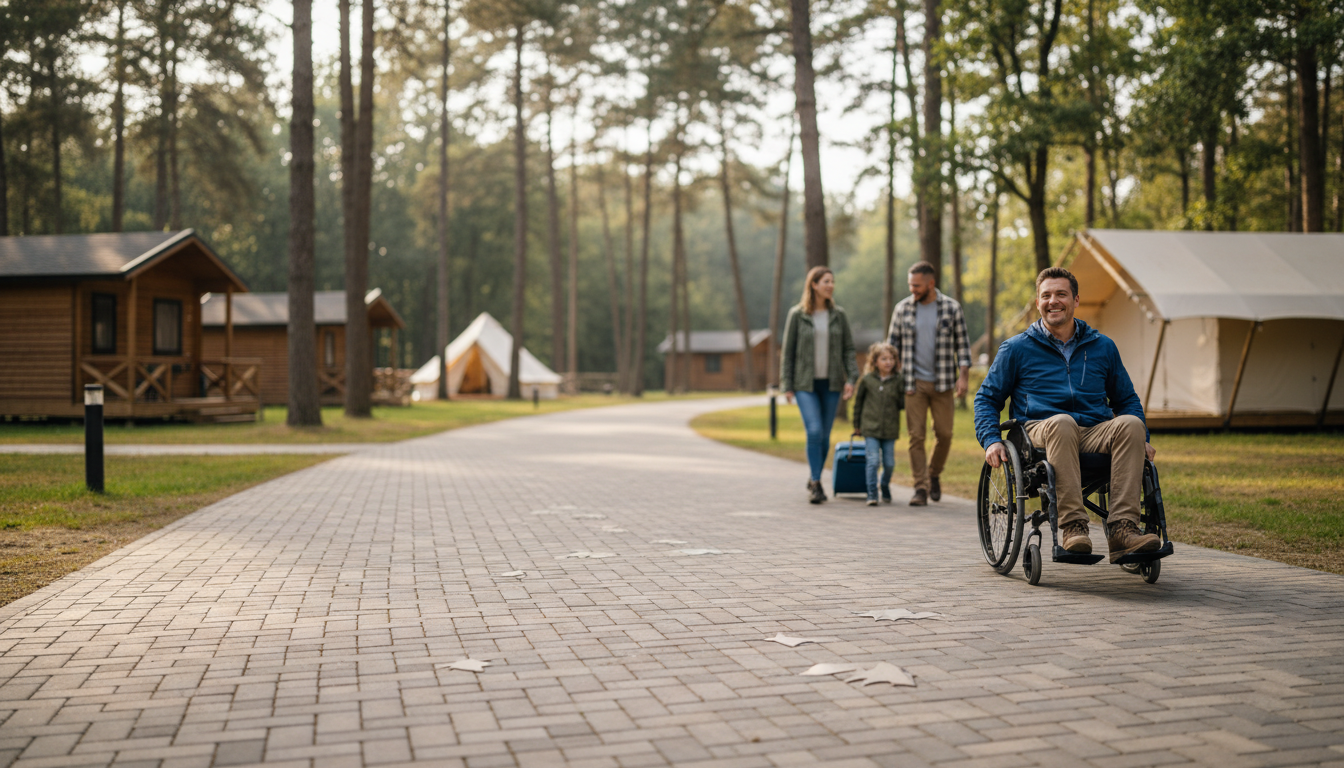
One camper in five now arrives carrying more than luggage—they’re carrying a silent question: “Will I be able to find the restroom without help?” For outdoor-hospitality businesses, answering that question is no longer optional; it’s a direct line to repeat stays, multigenerational bookings, and fatter shoulder seasons.
The good news? A new generation of multi-sensory pavers turns every pathway into a self-guided tour for visually impaired guests—no expensive tech, no design-school degree required. From award-winning “numbered groove” tiles to concrete mixes that shrug off freeze-thaw cycles, the tools are ready; it’s the strategy that separates leaders from late adopters.
Stay with us to see how three data-backed moves—strategic placement, phased retrofits, and staff-powered storytelling—can transform your park’s paths into profit highways.
Key Takeaways
– One out of five campers has trouble seeing well. Clear paths help them feel safe and happy.
– Special pavers guide by touch, bright colors, and gentle sounds—no fancy gadgets needed.
– Follow proven size and spacing rules to pass inspections and make learning easy.
– Choose strong, non-slip materials that stand up to rain, ice, and golf carts; check and replace pieces each season.
– Watch where guests really walk and pave those busy spots first to stretch the budget.
– Use simple codes on the ground—like three grooves for restrooms—and repeat them everywhere.
– Earth-tone colors, native plants, and soft water or wind sounds keep the campground feeling natural.
– Train every worker on the code and put it on maps, websites, and welcome tours.
– Collect feedback, note safety issues, and improve the paths; better access means longer stays and great reviews.
Multi-Sensory Wayfinding Moves the Needle on Revenue
Inclusive design is now measurable business logic. A June 2025 Vacavia feature drawing on KOA research reports that 19 percent of campers struggle with serious vision difficulty—nearly double the rate found in general leisure travel (KOA accessibility data). Those same guests travel with friends, kids, and grandkids, amplifying each booking when they choose a property they can navigate solo. Campgrounds that prioritize accessible navigation report per-site revenue lifts of up to 12 percent in the first full season after installation.
Multi-sensory pavers deliver independence through three overlapping channels—touch, sight, and sound. When surfaces announce “restroom ahead” by texture, color contrast, or gentle audio, guests stop queuing at the front desk for escorts. Staff hours drop, satisfaction scores climb, and the story of thoughtful access spreads across reviews and social feeds.
Start With Standards You Can Trust
Guesswork is the enemy of liability. The 2025 Transit Cooperative Research Program’s Report 248 outlines the latest dimensions for tactile surfaces, from dome height to edge-to-edge spacing (TCRP Report 248). Its pages also explain contrast requirements and recommend modular layouts, giving operators a plug-and-play foundation.
Using a researched baseline pays off twice. First, you avoid costly rework if an inspector raises questions. Second, consistent spacing helps guests learn the pattern faster, especially when every amenity—laundry, playground, dog park—follows the same rhythm underfoot. Think of standards as the sheet music; your site-specific design is the performance.
Choose Materials That Outlast Campground Life
Rain, de-icers, golf-cart traffic—campground paths battle stresses a city sidewalk never sees. Opt for UV-stable concrete, recycled-rubber tiles, or polymer-bonded stone that shrug off freeze-thaw cycles and refuse to fade because pigments run through the mix, not just the surface. Slip-resistant textures keep their grip when mud joins the party.
Durability doesn’t end at purchase. Build a seasonal checklist that flags spalling, loose modules, or debris clogging grooves. Pressure-wash each spring and fall, stash 2–3 percent of spare pavers onsite, and a damaged square can be swapped in minutes without closing a trail. Preventive care beats reactive payouts every time.
Map Movement, Phase the Build
Before ordering the first pallet, shadow your guests. Watch how families zigzag from parking pad to playground, how early anglers cut across lawns toward the dock. High-risk edges—vehicle crossings, waterfront drop-offs—and high-value destinations—restrooms, registration, laundry—deserve Phase 1 placement.
Budget-friendly timing matters, too. Pair installs with scheduled resurfacing or utility trenching to share labor costs. Modular tiles can surface-mount on existing asphalt today, then recess flush when a full rebuild happens later. Clear detours and temporary edge protection keep accessibility intact while construction hums—a detail that inspection reports, and guests, both notice.
Craft an Intuitive Language on the Ground
The Sightwalks system from Peru shows what’s possible: numbered raised lines tell a cane user they’ve reached the restroom, reception, or picnic spot (Sightwalks tactile tiles). Choose a signature pattern—three grooves for restrooms, four for laundry—then repeat it relentlessly so guests read the campus like Braille. The tactile code functions like roadside signage, only underfoot.
Reinforce the tactile code with high-contrast earth tones and braille or large-print signage. Solar bollards washing the path with even, glare-free light keep nighttime navigation stress-free. Every sense tells the same story; that harmony builds confidence step after step.
Let Nature Set the Palette
Good accessibility can still look like the forest. Earth-tone pigments or exposed-aggregate mixes blend with regional soil while maintaining luminance contrast. Keeping pavers flush with grade removes trip points and preserves the visual sweep of a pine-needle trail.
Native plant buffers frame the path, guide cane tips away from drop-offs, and soften the geometry of precast modules. Where auditory cues help, select natural options—wind chimes near the dog run, a low burbling fountain by the bathhouse—so the soundtrack matches the setting, not a subway platform. Contrast and calm can coexist.
Train Staff, Tell the Story
Your pavers can’t answer every question; trained staff fill the gaps. Add a 15-minute accessibility module to new-hire orientation covering cane-detectable warnings and sighted-guide basics. Hand each employee a quick-reference card: three grooves mean restroom, four mean laundry.
Inform guests, too. Printed and digital maps carry simple legends explaining texture changes. Offer escorted tours at arrival so first-time visitors feel the system under their own canes. Then market the amenity—your website, OTA listings, and social channels should spotlight inclusive wayfinding the same way you brag about fiber Wi-Fi.
Listen, Measure, Iterate
Accessibility isn’t a one-and-done install; it’s a living system. QR codes or NFC tags at major nodes invite real-time feedback on path clarity or surface condition. Log incidents and near-misses with other safety reports, hunting for patterns that suggest a missing cue or worn texture.
Quarterly walkthroughs with local advocacy groups keep fresh eyes on the ground. Compare pre- and post-install satisfaction scores, occupancy rates, and average length of stay to justify the next phase of investment. Because modules swap out easily, piloting a new material or IoT sensor costs pocket change, not a capital campaign.
Every groove you install is more than a safety feature—it’s a brand promise that says everyone belongs. Pair those tactile pathways with equally smart marketing, and your upgrades become stories that drive bookings. Insider Perks can help you spotlight accessibility wins, automate feedback loops, and amplify guest narratives that fill shoulder seasons and fuel five-star reviews. Ready to make every step—on the trail and online—easy to navigate? Reach out to Insider Perks today and let’s map your next route to higher revenue together.
Frequently Asked Questions
Q: How much should I budget per linear foot for multi-sensory pavers at a campground scale?
A: Material and installation costs for tactile pavers suitable for outdoor-hospitality settings typically fall between $18 and $32 per linear foot, with polymer-bonded stone at the low end and UV-stable concrete modules at the high end; sharing labor with scheduled resurfacing projects can trim 20–30 percent off that figure.
Q: Can I phase the project over several seasons without confusing guests who rely on the system?
A: Yes; start by installing continuous tactile paths to the most essential destinations—restrooms, registration, and the main accessible campsite—then extend the same pattern outward each off-season, clearly marking any temporary breaks with contrasting tape or portable edge guards so guests know the language is still consistent.
Q: Do these pavers require a permit or special inspection under ADA guidelines?
A: While the ADA does not mandate a permit for tactile paths specifically, most jurisdictions fold them into general surfacing or grading permits; referencing TCRP Report 248 dimensions in your submission and documenting slope, dome height, and luminance contrast usually satisfies inspectors and minimizes liability exposure.
Q: Will raised textures become tripping hazards for sighted guests or interfere with strollers and carts?
A: Properly installed pavers sit flush with surrounding grade and use profiles shallow enough to remain cane-detectable yet smooth under wheels, so golf carts, strollers, and rolling coolers transition without jolts and sighted pedestrians rarely notice a change underfoot.
Q: How do I pick a texture-code that campers can learn quickly without prior training?
A: Select two or three simple, distinct groove counts or dome arrangements—such as three parallel grooves for restrooms and four for laundry—and repeat them relentlessly at every instance of that amenity so even first-time visitors recognize the pattern after a single trip.
Q: What maintenance schedule keeps tactile cues reliable through mud, snow, and freeze-thaw cycles?
A: A spring and fall pressure wash, monthly debris sweeps, and a quick visual check during routine grounds rounds to spot spalling or loose modules are usually sufficient; stocking 2–3 percent spare tiles on-site lets staff swap damaged squares in minutes without closing the path.
Q: Can I retrofit existing asphalt or gravel paths, or do I need full reconstruction?
A: Modular surface-mount tiles can be adhesive-bonded or mechanically fastened onto intact asphalt and even compacted gravel with a geogrid underlay, allowing an immediate accessibility upgrade that can be recessed flush later during a full rebuild.
Q: Are audio beacons or smart-phone apps necessary, or will tactile and visual cues alone suffice?
A: For most campground scenarios, well-designed tactile patterns paired with high-contrast color and consistent lighting deliver adequate independence; low-volume audio beacons can supplement at complex nodes but are optional rather than mandatory.
Q: How do I train seasonal staff so they reinforce, not override, the tactile system?
A: Incorporate a 15-minute module into orientation that lets each employee walk the path with eyes closed and cane in hand, explains the groove code, and covers sighted-guide basics, then provide a pocket card so they can answer guest questions confidently.
Q: What is the typical lifespan of multi-sensory pavers in a campground environment?
A: UV-stable concrete and high-quality rubber or polymer-bonded stone modules routinely last 15–20 years in freeze-thaw climates when maintained, outliving many standard concrete walks and reducing total cost of ownership.
Q: Will bright color contrasts ruin the natural aesthetic my guests expect from outdoor lodging?
A: Earth-tone pigments mixed through the material, exposed-aggregate finishes, and careful edge planting allow you to maintain the required 70 percent luminance contrast for low vision users while blending seamlessly with regional soils and vegetation.
Q: Are grants or tax incentives available to offset installation costs?
A: Many U.S. states offer small-business accessibility grants or tax credits up to $5,000 annually, and federal Section 44 ADA tax credits can cover 50 percent of eligible expenditures for properties with under $1 million in revenue, so retaining invoices and consulting a tax professional can recoup a significant share.
Q: How can I market the new pathway to drive bookings instead of it being just a compliance expense?
A: Feature short video clips of a guest confidently navigating from their RV to the restroom unaided, add accessibility icons and detailed descriptions on OTA listings, and showcase testimonials on social media to turn the upgrade into a unique selling proposition that appeals to multigenerational groups and disability travel networks.
Q: Could raised textures or sound cues disturb wildlife or clash with the campground’s quiet-hours policy?
A: Tactile cues are silent, and if you opt for audio beacons you can select solar-powered units with directional speakers set below 45 decibels, low enough to avoid disrupting wildlife or guests after dusk when paired with motion-or time-based controls.
Q: What should I look for when choosing a vendor to supply multi-sensory pavers?
A: Prioritize manufacturers with ASTM-certified slip resistance, proven freeze-thaw durability, and case studies in outdoor recreation settings, then request samples to test texture clarity with local advocacy groups before signing a contract.