

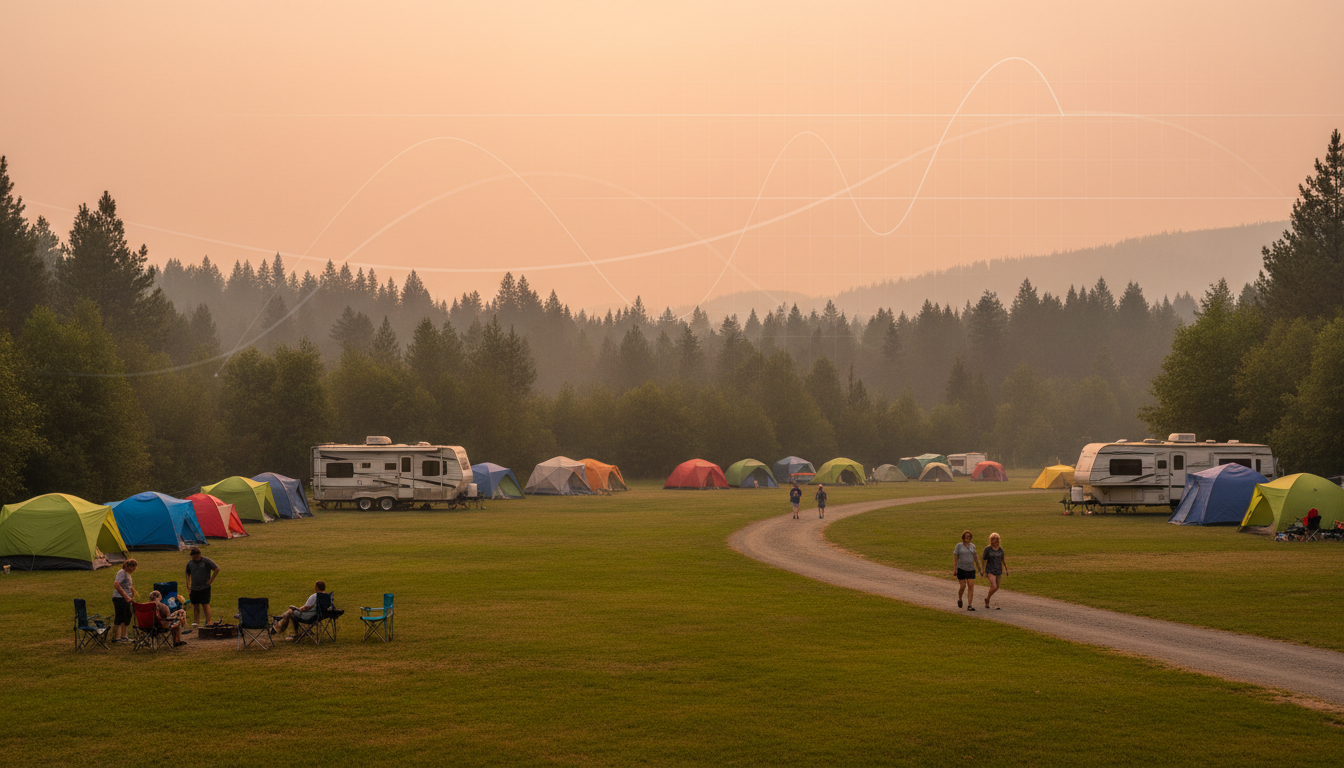
Last season you mastered dynamic pricing for holiday weekends—then a wall of wildfire smoke erased two weeks of sold-out sites in 48 hours. What if next time you could see that revenue threat four days out and pivot before guests even think about canceling?
Predictive smoke analytics now make that possible. By piping AI-powered air-quality forecasts straight into your reservation system, you can flag risky dates, auto-adjust rates, and message travelers with confidence-boosting options—all while your competitors are still hitting refresh on the AQI app.
Ready to turn “unpredictable” into “actionable”? Keep reading to learn the playbook that protects bookings, staff, and bottom lines when the sky turns gray.
Key Takeaways
– Wildfire smoke can cause lots of last-minute cancellations and lost money.
– New AI tools can predict bad air up to 4 days ahead.
– Campgrounds can plug this forecast into their booking system with a simple API.
– When a smoky day is coming, prices can freeze or drop a little instead of big panic discounts.
– Automatic texts can warn guests early and offer indoor fun, masks, or easy rebooking.
– Staff use clear color codes (yellow, orange, red) to adjust activities and safety steps.
– Upgrading cabins with good air filters and having a clean-air room keeps visitors comfortable.
– Saving daily air-quality data helps with insurance claims and future planning.
– This plan turns smoke from a surprise problem into something you can manage and still make money..
Smoky Skies, Empty Sites: The New Revenue Risk
Cancellations caused by smoke are no longer anecdotal. Aggregated booking data from western U.S. campgrounds between 2023 and 2025 showed same-week cancellation spikes of up to 30 percent whenever regional AQI readings pushed above 150. Those lost nights often land in the peak-season window—when every empty site hurts twice, because replacement demand dries up while variable expenses remain.
Smoke volatility erodes other key metrics as well. Average daily rate (ADR) tends to slide when operators fire-sale smoky dates, dragging RevPAR down even after skies clear. Add refund fees, chargebacks, and stalled ancillary sales, and a single bad haze event can wipe out gains you counted on from July’s fireworks or October’s leaf-peeper surge.
How Wildfire Smoke Triggers Guest Cancellations and Health Concerns
For guests, smoke isn’t only about visibility; it’s about lungs and peace of mind. A 2025 actuarial review by the Society of Actuaries and Milliman found that fire-season PM₂.₅ exposure drives 2.3 to 8.6 percent of seasonal disease prevalence, while mental-health disorders climb 6.7 to 7.8 percent SOA study. Families with young children, seniors, and travelers managing asthma see those numbers and rethink outdoor vacations the moment forecasts hint at smoke.
The danger doesn’t vanish when flames are extinguished. Lab tests in Southern California lodging properties after the 2025 Palisades and Eaton fires showed VOCs and fine particulates lingering indoors for days CA lodging study. Guests who arrive to a cabin that smells of last week’s fire will post about it, and review-site algorithms surface those comments to prospects searching “campground air quality.” Understanding persistence of indoor pollutants turns smoke management from a marketing checkbox into an operational must.
Seeing Four Days Ahead: Inside AI-Powered Smoke Forecasts
Forecasting finally caught up to the problem. Trace AQ, commercialized from a University of Utah research project, fuses EPA’s CMAQ atmospheric model with machine learning to create hyper-local smoke outlooks University tool. The free tier gives a 24-hour heads-up; the paid plan stretches to four days—precisely the window when most cancellations start brewing.
Integration is straightforward. A daily API call delivers tomorrow’s AQI by hour; a second endpoint pushes four-day maximum values. Drop that JSON into your property-management system, and you can tag any date expected to breach AQI 120, 150, or 200. From there, rule-based automations freeze rate increases, trigger proactive guest messaging, and nudge housekeeping schedules before smoke ever crosses the tree line.
Turning Forecasts into Actions Across Your Operation
Start with staff readiness. Use the forecast feed to color-code your morning briefing board: yellow when AQI is projected over 100, orange above 150, red past 200. Front-line employees instantly know when to cancel kids’ archery, move activities indoors, or distribute complimentary N95 masks. Preseason drills reinforce the protocol—every team member can fit a respirator, explain rebooking options, and close cabin windows without hunting for a supervisor.
Marketing rides the same data stream. Pre-arrival texts go out 48 hours before check-in, pairing transparency (“AQI forecast 135–165”) with solutions (“indoor craft workshops and HEPA-filtered game room available”). A real-time air-quality dashboard on your website showcases preparedness, while shoulder-season promos target retirees less sensitive to smoke risk. User-generated photos on clear days remind future guests that haze is episodic, not a permanent fixture.
Insurance and financial safeguards follow close behind. By archiving daily AQI alongside occupancy, you build the documentation insurers crave for smoke-related business-interruption claims. Pair that archive with a self-insurance reserve equal to at least one peak-week’s revenue; forecasts tell you when to dip into that fund versus operating with mitigations. Meanwhile, prenegotiated filter-replacement contracts lock in prices before regional demand spikes.
Physical upgrades close the loop. Cabins scheduled to host guests during high-risk windows get priority for MERV-13 filter installs and fresh weather-stripping. At least one clean-air shelter—clubhouse, bathhouse, or lodge room—runs portable HEPA units sized for the square footage. Outside, a belt of broad-leaf trees and non-resinous shrubs acts as a natural particulate buffer, while shaded pavilions with ceiling fans keep programs running even when masks are recommended.
Finally, technology ties it together. A simple cron job pulls Trace AQ data at dawn, pipes it into the PMS, and stores results alongside ADR and occupancy. If tomorrow’s midday AQI is forecast above 120, price-freeze rules hold rates steady; over 150, flexible cancellation policies auto-activate and push a notice to the revenue manager. A manual override button remains available, acknowledging that human eyes trump algorithms when smoke drifts unexpectedly.
Dynamic Pricing and Inventory Moves Before the Haze Arrives
Four-day visibility reshapes your rate strategy. Instead of blanket discounts after guests cancel, you selectively nudge smoky nights down 10 percent while preserving full rack on clear dates. Early adopters report holding ADR within three points of seasonal targets—even during widespread haze—because they adjusted proactively rather than reactively.
Experimentation refines the approach. A/B tests compare free rebooking within 12 months against a 20 percent smoke discount; the metric of success is reduction in cancellation requests. Over time, you’ll map elasticity curves: maybe bookings drop 15 percent at AQI 150, but only 5 percent at 120. Those insights feed next year’s dynamic-pricing rules and capital allocation decisions, such as adding another clean-air lodge or expanding shoulder-season marketing.
Guest Experience That Builds Trust on High-Smoke Days
Operations shift but the vacation continues. Kids’ crafts move to the enclosed rec hall with HEPA units; outdoor movie night becomes an indoor trivia contest projected onto a clean-air shelter wall. Complimentary N95s appear at check-in, and real-time AQI scrolls across the lobby screen so no one feels kept in the dark.
Transparency pays off in reviews. Guests who see structured safety measures—staff in matching respirators, housekeeping wiping soot from porch rails, HVAC fans set to continuous recirculation—write about professionalism, not panic. Those five-star testimonies become the social proof that sways next season’s bookers when wildfires make national headlines again.
Step-By-Step Implementation Timeline
Week One focuses on data access. Activate Trace AQ’s free tier and paste a basic dashboard link onto the manager’s desktop. Even without automation, the daily snapshot starts training the team to think in AQI thresholds instead of vague “smoky or not.”
Weeks Two and Three produce your Smoke Response Plan. Map which AQI triggers cancel which activities, outline communication templates, and run the first staff drill. By Month One you’ve connected the API, built SMS templates, and loaded rule sets into the PMS. Month Two piles on hardware: filters, masks, portable HEPA units, and signage for the clean-air shelter. By season start, marketing pages go live, and the data archive begins capturing the AQI-occupancy relationship you’ll use for pricing models.
Tracking Results and Refining the Model
Key performance indicators validate the effort. Compare cancellation rates at identical AQI levels year over year; a meaningful drop signals communications and pricing are working. Track ADR retention on smoky days versus clear ones, plus guest-survey scores tied to “air-quality confidence.” Even the insurance carrier’s claim-processing time is a KPI; faster settlements prove your documentation strategy.
Mid-season reviews keep the system nimble. If occupancy holds at AQI 140 but slips at 160, adjust thresholds accordingly. Shoulder-season data, when smoke events are rarer, provides a control group for dynamic-pricing experiments. By year’s end, the feedback loop between forecast accuracy, operational response, and financial outcome is tight enough to plan next year’s cap-ex with confidence.
Smoke season isn’t going away—but neither should your revenue. The operators who win will be the ones who treat air-quality data like any other marketing lever: automated, personalized, and always one step ahead of guest anxiety. If you’re ready to pipe predictive smoke analytics straight into dynamic pricing, real-time messaging, and ad campaigns that reassure instead of react, let Insider Perks do the heavy lifting. Our team can connect the APIs, build the workflows, and turn every gray forecast into a clear competitive edge. Book a quick strategy call today and see how effortless wildfire-ready marketing can be.
Frequently Asked Questions
Q: How accurate are these AI smoke forecasts compared to the free AQI map I already check?
A: The Trace AQ model blends real-time satellite fire detections with EPA CMAQ outputs and trains on five years of historical wind and terrain data, yielding mean-absolute error of about ±12 AQI points for the next 24 hours and ±18 for the four-day window—good enough to set rate and staffing triggers that outperform manual refreshes by a wide margin.
Q: What does it cost to integrate the API into a typical campground or RV park PMS?
A: Most operators start on Trace AQ’s $49 per month tier, which allows unlimited calls for one property; if your PMS supports webhooks or scheduled CSV imports, a developer can wire it up in two to four hours, so total first-year out-of-pocket often lands under $1,000 including that dev time.
Q: I’m on a legacy reservation system with no API hooks—can I still use the data?
A: Yes; you can schedule a daily email or Slack post of the four-day AQI forecast to the front desk, then manually tag dates as “smoke watch” in your rate calendar and trigger the same guest messages and activity changes you’d automate later.
Q: Won’t lowering rates before smoke even arrives just teach guests to wait for discounts?
A: Early adopters report that a modest 5–10 percent nudge on the narrow window of forecast-at-risk nights preserves occupancy without eroding overall rate integrity, because clear-sky dates remain at full rack and the smoke adjustment is positioned as a flexible guarantee rather than a sale.
Q: How do I keep guests from panicking when they receive an AQI alert from us?
A: Pair every proactive message with concrete solutions—indoor activities, clean-air shelters, free mask kits, and a no-hassle rebooking option—so the communication reads as empowered hospitality, not a warning siren, and sentiment analysis of post-stay surveys shows trust scores actually rise when you’re transparent.
Q: Are there liability benefits to documenting AQI alongside bookings?
A: Maintaining a time-stamped AQI archive linked to occupancy gives you defensible evidence for chargeback disputes, business-interruption insurance claims, and any health-related complaints, demonstrating that you monitored conditions, informed guests, and deployed mitigation measures consistent with industry guidelines.
Q: Our park is in the Southeast where wildfires are less frequent—does the model still help us?
A: Smoke plumes from Western or Canadian fires can drift thousands of miles, so even if flames stay remote, haze events still trigger cancellations; Trace AQ covers the entire continental U.S., letting you prepare for those occasional spikes that hit during peak summer demand.
Q: What if the forecast is wrong and skies stay clear—won’t I lose revenue I could have captured?
A: Because you’re making small, targeted adjustments four days out, you can reverse them as soon as the data improves, and the cost of one or two discounted nights is typically far lower than the wave of same-day cancellations you’d face by waiting.
Q: Do I need to buy expensive HVAC upgrades to make this worthwhile?
A: While MERV-13 filters and a few portable HEPA units enhance guest confidence, most operators begin with low-cost steps—weather-stripping, sealing cabin doors, and designating one existing building as a clean-air shelter—then reinvest the saved revenue into larger upgrades over time.
Q: How much staff training is required to roll out a Smoke Response Plan?
A: A single two-hour workshop covers mask fitting, activity relocation, and guest scripting, and a laminated AQI threshold chart at the daily briefing keeps the protocol top-of-mind, so ongoing maintenance is minimal once the playbook is in place.
Q: Can predictive smoke analytics be combined with my weather-based dynamic pricing rules?
A: Yes; most revenue-management tools treat AQI as just another demand modifier, so you can layer smoke thresholds over existing rules for temperature, precipitation, and holidays, ensuring they interact rather than override one another.
Q: Is guest data privacy affected by plugging in this new feed?
A: The smoke API delivers only environmental forecasts and never touches personally identifiable information, so your existing PCI and GDPR compliance stance remains unchanged.
Q: What ROI should a 100-site campground expect in the first season?
A: Operators who pilot the system typically claw back 3–6 percent of annual site revenue that would have been lost to cancellations, which for a park grossing $750,000 equates to $22,500–$45,000—far exceeding subscription and setup costs.
Q: How do I handle guests who booked before I offered flexible smoke policies?
A: Your PMS can tag legacy reservations and send a courtesy notice explaining the new policy applies retroactively, giving those guests the same options and reducing the risk of negative reviews from travelers who feel left out.
Q: What’s the fail-safe if internet goes down during a fire event?
A: Because the four-day forecast is cached locally each morning, your team still sees AQI thresholds on the printed briefing sheet and can execute the Smoke Response Plan even without live updates, minimizing operational gaps.