

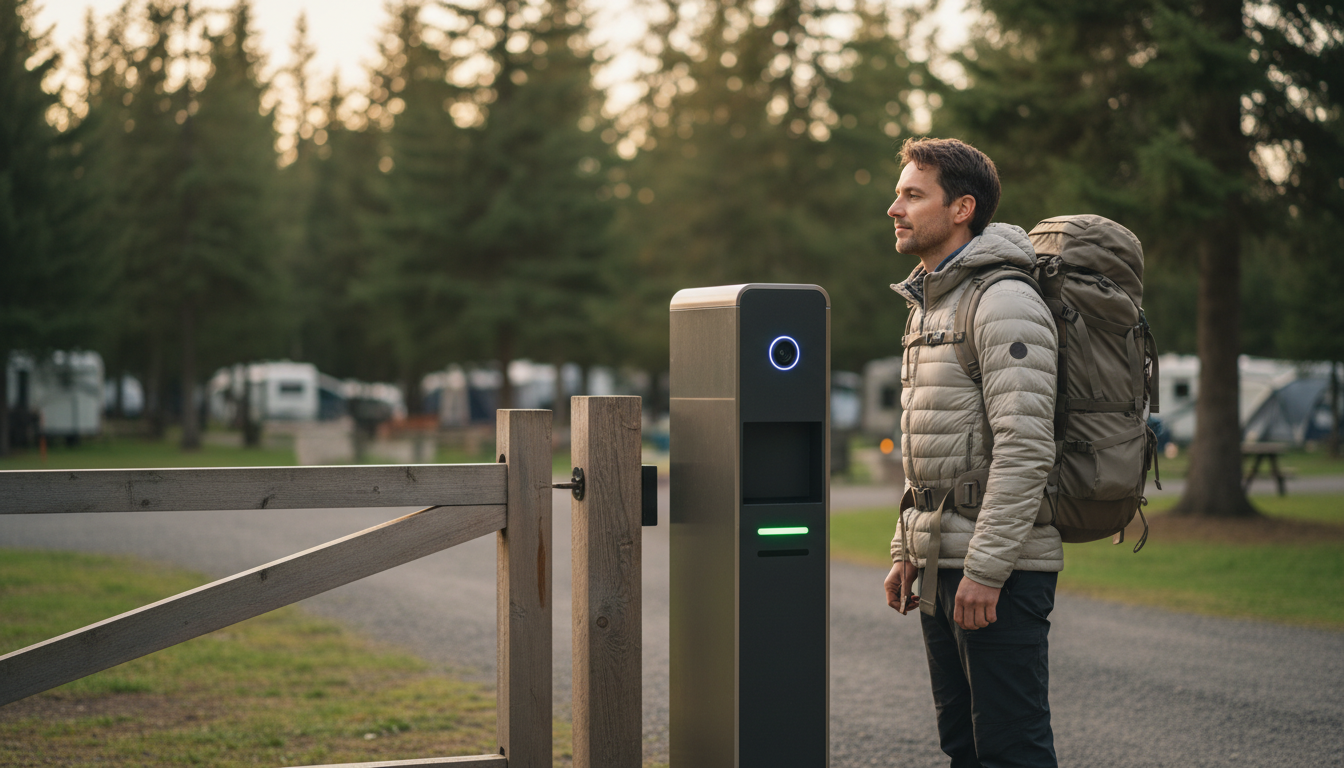
Imagine your Friday-evening rush: headlights stacking up at the gate, radios crackling, staff juggling IDs and waiver forms. Now imagine those same rigs gliding through in seconds—no cards, no codes, just a quick glance at a weather-proof camera that knows your guest is exactly who they say they are.
Airports, stadiums, even border crossings have already cut lines to near-zero with 99%-accurate facial recognition—and travelers are getting used to that speed. The question is no longer “Will guests accept biometrics?” but “How soon will they expect it at your entrance?”
Keep reading to learn how outdoor-ready hardware, PMS integrations, clear opt-outs, and a low-risk pilot lane can turn your check-in bottleneck into a wow-moment that saves labor, boosts security, and starts every stay on the right foot.
Key Takeaways
• Face cameras can let guests drive in within seconds, like the quick lanes at airports
• By 2025 many travelers will already expect this fast, no-ID check because of new rules at borders and stadiums
• Guests sign up with one selfie when they book; the picture is stored safely and deleted after the stay
• A backup lane with staff stays open so people can still choose normal check-in
• Weather-proof cameras, shade, and strong internet are needed so the system works in sun, rain, or at night
• The camera talks to your reservation system, opening the gate and updating records without extra work
• Clear signs and emails must explain how the face scan helps and how to opt out, which builds trust
• Start with one test lane, count time saved, and compare costs; parks often break even in one or two busy seasons.
Why the Next Two Seasons Are the Biometrics Tipping Point
The timeline for mainstream adoption is already on the calendar. In January 2025, the DHS report documented airport systems hitting 99 percent match accuracy while retaining images for only 24 hours, proving that strong privacy controls and high performance can coexist. Travelers passing through these hubs will arrive at your park expecting the same friction-free handoff.
Momentum accelerates again on 26 December 2025, when a new federal rule makes facial checks mandatory for every non-US traveler entering the country. Millions of international guests will experience fast, camera-based identity verification before they even clear customs, making manual paperwork at your gate feel dated by comparison. This regulatory shift will further normalize biometric processes, pushing guest expectations toward seamless, camera-led arrivals wherever they travel.
High-volume venues are reaching for the same playbook. Nearly half of stadiums surveyed plan to add biometric entry in 2025, and NFL sites already using Wicket report dramatic queue reductions, according to a recent stadium survey. If facial recognition can move 70,000 fans through turnstiles, it can certainly handle a dozen RVs at dusk.
What a Face-First Gate Experience Looks Like
The journey starts before a single tire rolls onto your gravel drive. During online reservation or in an email link, guests snap a quick selfie that lives as an encrypted template in your PMS. Enrollment takes less time than adding a license-plate number and creates no extra work for staff.
On arrival, the rig edges toward a pedestal-mounted camera shaded by a simple canopy. The guest looks up—no need to remove sunglasses for most systems—and the boom gate lifts while their template ties into site assignments, Wi-Fi credentials, or even cabin door locks. Anyone uncomfortable with the technology veers into a staffed lane where a traditional ID check keeps inclusivity intact, preventing the biometric option from feeling forced.
Building Outdoor-Ready Infrastructure That Won’t Blink First
Your gate sits in rain, dust, and blinding sun, so consumer-grade webcams won’t survive. Look for IP65-rated cameras and kiosks mounted on lockable, tamper-resistant brackets that shrug off hail and curious raccoons. Position them under a small roof or shade sail to eliminate glare and lens flare that can tank match rates at golden hour.
Power also deserves redundancy. Power-over-Ethernet cuts trenching costs, while a compact solar-plus-battery kit keeps a lane alive during storms or grid hiccups. Low-lux or infrared LEDs guarantee reliable scans at 10 p.m. check-ins, and every component should arrive with gasket seals and stainless screws so your maintenance crew isn’t chasing rust between peak seasons.
Connecting Cameras to Your PMS, Not to More Manual Work
A biometric scan is only valuable if it talks to the software already running your park. Demand open APIs from vendors so the “match” event instantly updates the reservation record, releases the gate relay, and triggers site-specific rules like enabling a 50-amp pedestal. When the guest checks out, that same API should auto-delete the facial template, mirroring the DHS 24-hour retention benchmark and freeing you from a separate data-governance project.
Before peak season, clone your PMS database in a sandbox and push dummy templates through every branch of the workflow. Catch mismatched field names, test Wi-Fi handshakes, and run a simulated blackout to confirm the gate fails over to an offline whitelist. Those dry runs mean the first real guest sees nothing but a smooth green light.
Privacy, Opt-Outs, and Guest Communication That Builds Trust
Guests accept technology that is transparent and optional. Place concise, friendly signage a full RV-length before the camera explaining the benefit—“Skip paperwork, get to your fire ring faster”—and the opt-out alternative. Repeat the message in pre-arrival emails where guests can toggle participation with one click, framing the choice as convenience, not coercion.
After checkout, send a follow-up that confirms the template deletion and links to an FAQ on how the system protects demographic fairness. The same clarity shown in airports and stadiums breeds confidence at a campground, turning potential privacy objections into positive reviews about modern, responsible operations. Over time, these proactive messages can become a distinctive brand asset that sets your park apart in online comparisons.
Train Your Team to Keep the Human Touch
Technology shortens queues, but hospitality still lives in the smiles that greet guests once they roll through. Coach staff to describe the system in everyday language—“It works like Face ID on your phone”—and to troubleshoot quick fixes like removing a ball cap or adjusting the driver’s seat height.
Mock check-ins during shoulder season help employees feel the process from the guest’s perspective. Equip them with pocket-sized reboot cards and a 24-hour vendor support number so even the newest seasonal hire can de-escalate issues without waking you at midnight. With troubleshooting worries minimized, employees can focus energy on creating memorable welcomes and personalized suggestions.
Running a Pilot Lane Without Betting the Ranch
Start small and measure everything. Many operators dedicate one lane to premium sites or annual members whose repeat visits deliver maximum labor savings. Portable pedestals and plug-and-play cameras let you reposition hardware after the pilot, protecting your cap-ex if guest adoption lags.
Track the hours once spent on clipboards and gate radios, then compare the subscription fee of the biometric platform to the wages of two seasonal attendants. Parks in similar trials have realized break-even within one or two peak seasons, especially when late-night arrivals no longer require overtime call-ins. The savings can be reinvested into splash pads, upgraded Wi-Fi, or other amenities guests immediately notice.
Metrics That Prove Success Before You Scale
Average vehicle dwell time is the headline number—anything under 60 seconds signals success. Pair it with the percentage of guests opting into biometrics versus the manual lane to gauge comfort levels and refine signage.
Log every manual exception, such as misreads from sunglasses, and translate those into concrete training or hardware tweaks. Finally, feed post-stay survey scores back into your ROI model. Together, these insights tell you precisely when the pilot has matured enough to become your new operational standard.
The first impression your guests get shouldn’t be a line of brake lights—it should be the feeling that your park is already a step ahead of their expectations. Biometric check-in delivers that wow, but the real magic happens when it’s woven into automated email flows, targeted upsells, and AI-driven guest journeys that keep wallets and word-of-mouth wide open long after the gate lifts. That’s where Insider Perks comes in. We’ve spent the last decade pairing forward-thinking outdoor operators with the marketing, advertising, and automation tools that turn cutting-edge tech into measurable revenue. Curious how a five-second scan can ripple through your entire P&L? Let’s map it out together—reach out to Insider Perks for a no-pressure strategy chat and be the park everyone’s talking about next season.
Frequently Asked Questions
Q: How does facial-recognition check-in actually work at the gate?
A: Guests upload a selfie during online reservation or from a pre-arrival email; that image is converted into an encrypted template stored in your PMS and deleted after checkout, so when the rig rolls up a weather-proof camera captures a live image, the software compares it to the template in under a second, and if it matches the gate relay opens and the PMS logs the arrival automatically.
Q: Is the technology accurate enough to trust with access control?
A: Systems certified for airport and stadium use routinely hit 99 percent match rates even in mixed lighting, and operators can set a conservative threshold so only very high-confidence matches trigger the gate, which means the rare uncertainty simply diverts the guest to a manual lane rather than granting access by mistake.
Q: What happens if the camera doesn’t recognize a guest?
A: The software fails gracefully—after a preset number of unsuccessful scans the boom stays down, staff are pinged by text or radio, and the vehicle is waved into the staffed lane where a normal ID check finishes the process without delaying the next car.
Q: How long are guest images stored?
A: Best-practice configurations mirror the DHS model by keeping raw images no longer than 24 hours, retaining only a scrambled mathematical template until checkout, at which point an automated API call purges that data so nothing personally identifiable lingers in your system.
Q: Are we exposing ourselves to privacy lawsuits?
A: Vendor contracts that specify data minimization, explicit opt-in consent, template encryption, and automatic deletion keep you aligned with Illinois BIPA, California CCPA, and emerging federal rules, dramatically lowering litigation risk compared with ad-hoc video storage or manual photocopies of IDs.
Q: Can guests refuse biometrics and still enter?
A: Yes, every deployment includes a clearly marked staffed lane where traditional ID, license plate, or key-code verification is performed, so opting out never penalizes the guest and demonstrates that convenience, not coercion, is the goal.
Q: What hardware do I need and how weatherproof is it?
A: A single IP65-rated camera on a lockable pedestal, a small canopy for shade, Power-over-Ethernet or solar-battery power, and an inline gate controller are typically all that’s required, and those components are sealed against dust, rain, and temperatures from ‑20 °F to 120 °F so they can live outdoors year-round.
Q: How difficult is integration with my existing PMS or gate system?
A: Most campground PMS platforms now expose REST or GraphQL APIs, and leading biometric vendors deliver plug-ins that map reservation fields and gate relays in a few hours, so after sandbox testing the live cut-over is often completed in a single morning without taking the entrance offline.
Q: What does a typical pilot cost and how quickly can I see ROI?
A: A one-lane starter kit—including camera, pedestal, controller, and a 12-month software subscription—runs roughly $6,000–$9,000; parks replacing two seasonal gate attendants at $15 an hour usually recoup that outlay in one peak season while freeing staff for revenue-generating tasks.
Q: Do sunglasses, hats, or nighttime lighting reduce accuracy?
A: Modern algorithms use infrared and 3-D depth cues that reliably read through most sunglasses and ball caps, while integrated low-lux LEDs illuminate faces after dark, so match rates stay above 97 percent as long as drivers glance toward the camera for a second or two.
Q: How do we handle families or group reservations arriving in one vehicle?
A: The PMS can store multiple templates under a single reservation, so when any enrolled traveler is in the driver’s seat the system approves entry, and non-enrolled guests still riding in the cab are simply associated with that same booking once inside the park.
Q: Does facial recognition comply with ADA and accessibility rules?
A: Kiosks can be mounted at wheelchair-eye height, infrared lighting works for low-vision guests, and audible cues can supplement the onscreen prompts, so the system meets equal-access requirements as long as the human-staffed lane remains available.
Q: What power and internet redundancy is required?
A: A PoE line or a 50-watt solar panel feeding a small battery bank powers the camera, while a secondary cellular hotspot or cached whitelist lets the gate keep working during a broadband outage, which means you won’t strand arrivals if the main fiber line is cut.
Q: Can the system expand to cabin door locks or cash-less purchases later?
A: Because the biometric template lives in your PMS profile, the same API event can unlock smart deadbolts, enable wristband payments, or grant pool access, so adding more touchpoints is usually a software toggle, not a new hardware investment.
Q: How do staff learn to support the technology without IT skills?
A: A two-hour vendor webinar and a few mock check-ins teach employees to explain the system in plain language, spot common issues like dirty camera lenses, and use a laminated cheat-sheet for quick reboots, keeping the learning curve lower than that of a new POS system.
Q: What should I look for in a vendor contract?
A: Insist on clauses covering 24×7 support, SLA uptime above 99.5 percent, automatic data deletion, indemnification for biometric claims, and the right to export encrypted templates if you ever switch providers, guaranteeing you stay in control of guest relationships and compliance.