

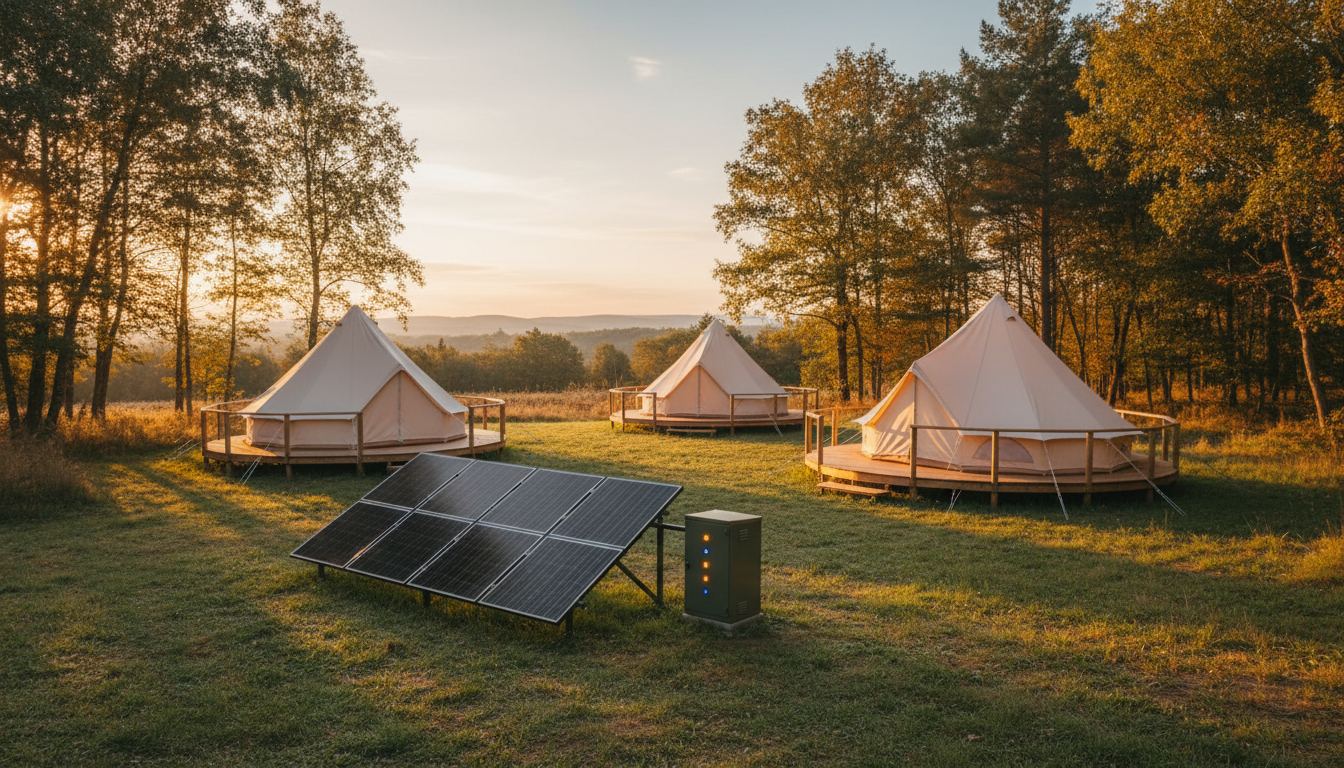
The fastest way to lose a five-star review is the growl of a generator at 2 a.m.—or the invoice that follows the fuel truck. Ready to retire your engine before your guests retire to bed? A well-designed solar microgrid can silence the noise, slash operating costs, and double as the green amenity today’s campers will pay extra to post about.
Shield Ranch’s glamping site runs an entire season on fewer than 75 hours of propane power; Camp Elena’s twin arrays breeze through peak Texas heat with solar by day and batteries by night. What do they know that most parks don’t? Smart load profiles, right-sized batteries, and a generator that’s truly a “just-in-case” player.
This article walks you through five critical gaps—site assessment, battery safety, O&M, financing, and future-proofing—so you can copy their playbook and bank the savings. Stick around; your guests (and your balance sheet) will thank you.
Key Takeaways
- Solar power is quiet, saves fuel money, and makes guests happier than loud generators.
- A microgrid = solar panels for day, batteries for night, small generator for “just in case.”
- Plan for solar to give 80–90 % of yearly power; let batteries and the tiny generator handle the rest.
- Do a full-year shade study first so panels sit where the sun shines most.
- Write down every light, fridge, pump, and charger to pick the right system size.
- Choose LiFePO₄ batteries; keep them in a cool, vented, fire-safe room.
- Wash panels and tighten wires two times a year to stop power drops and alarms.
- Use tax credits, phase the project, and save a little each night for future battery swaps.
- Lay extra conduit and leave space now for more panels and EV chargers later.
- Smart controls today—and AI tomorrow—run the system so fuel use stays tiny.
Solar-First Microgrids in Hospitality Terms
Solar microgrids unite three core pieces of hardware: a photovoltaic array that produces power silently, a battery that keeps lights glowing after sunset, and a generator that fires only when clouds linger or maintenance crews need a safety net. For a campground or glamping site, the result is 24/7 reliability without the diesel drone that ruins night skies and guest reviews. Unlike grid-tied solar installations, an off-grid microgrid must meet every watt of demand, so careful sizing is the difference between confident marketing and apologetic refunds.
Hospitality managers also gain an instant brand story. Posting real-time stats—“96 % solar today, zero gallons burned”—shows eco-credentials guests can feel and share. Add in fewer fuel deliveries, reduced insurance risk from fuel storage, and lower maintenance on silent panels versus internal-combustion engines, and the operating math becomes as attractive as the sustainability narrative.
Proof on the Ground: Shield Ranch and Camp Elena
The Campsite at Shield Ranch south of Austin runs a 46.4 kW array married to a 276 kWh lithium-iron-phosphate battery. The Shield Ranch study documents how that combination powers lighting, refrigeration, and well pumps while relegating its propane generator to fewer than 75 hours a year, mainly during multi-day storms. Those hours equate to roughly two fuel fills per season instead of weekly deliveries—real savings you can enter straight into a cash-flow model.
Farther west, the desert sun of Terlingua beats down on Camp Elena. Two nearly identical microgrids there each pair about 36 kW of solar with 153 kWh of storage and a modest 15 kW generator. The microgrid project coverage highlights how flexible controls favor solar all day, let batteries coast overnight, and bump the generator on only during consecutive cloudy days. By treating load as a moving target—think seasonal bookings and heat-wave AC spikes—the owners avoided oversizing equipment and kept capital costs lean.
Both examples prove that a solar-first design can outperform the expectations of skeptical investors. They also underscore a hidden insight: the quieter the power plant, the higher the guest satisfaction score. That translates into repeat bookings, longer stays, and a competitive edge on listing platforms.
Map the Sun Before You Spend a Dollar
Great microgrids start with great data. A 12-month shade study using drone imagery or LiDAR creates a permanent sun map you can hand to designers, insurers, and, later, resale appraisers. Phone apps are fine for a quick look, but drone data reveals winter-morning shadows from ridgelines that could steal kilowatt-hours during high-occupancy ski or hunting seasons.
Array placement follows four simple rules: face panels as close to true south as site layout allows, tilt between 15° and 30° for year-round production, keep DC wire runs fat and short to hold voltage drop under 3 %, and clear a 10-foot non-combustible buffer so the fire marshal sleeps as soundly as your guests. Choosing racking that lets native plants grow beneath the array controls dust, prevents erosion, and keeps panel temps a few degrees cooler—enough to nudge output upward on scorching afternoons.
Load Profiles Beat Guesswork Every Time
Before ordering a single panel, chart daily and seasonal demand. Spreadsheet every fridge, pump, mini-split, and phone charger, then layer occupancy trends on top. Shield Ranch’s team learned that refrigeration draws stayed flat year-round, but guest-driven loads like lighting and phone charging spiked on weekends. Designing around that insight allowed them to size the battery for overnight autonomy without overshooting daytime solar capacity.
A practical rule of thumb is to aim for solar to cover 80–90 % of annual kilowatt-hours. Batteries pick up the overnight slack, and a small generator mops up the remaining extremes. Free tools such as PVWatts or Helioscope offer a sanity check before you engage an engineer, but the magic is in matching those outputs to the granular load data you’ve gathered.
Batteries Built for Remote Reality
Lithium-iron-phosphate dominates off-grid hospitality because it endures 4,000–6,000 cycles, tolerates partial charges, and resists thermal runaway. Pack the cells inside a dedicated, ventilated enclosure equipped with a fire-rated door and clear signage so inspectors and curious guests feel at ease. A small HVAC unit or thermostatically controlled fan keeps temperature between 60 °F and 86 °F; outside that band, capacity drops and cycle life shortens.
A battery management system monitors every cell’s voltage and temperature, disconnecting the pack if conditions wander outside safe limits. Operate daily within an 80–20 % state-of-charge window, leaving the top and bottom 10 % for emergencies and extending lifespan by years. Post shut-off instructions and emergency contacts right on the door; in a rare fault event, clarity beats chaos.
Maintenance That Protects Reviews and Revenue
Solar panels add value only when they’re clean and connected. A biannual wash—quarterly if you’re near pollen-heavy forests or salty coastlines—recovers 2–6 % of lost output. Every spring, perform a torque check on all electrical lugs; loose connections breed resistance, heat, and surprise inverter alarms.
Redundancy extends to people as well as hardware. Train at least two team members on basic troubleshooting, and stock a small cache of spares: a spare inverter board if your model is modular, a handful of fuses, MC4 connectors, and a replacement combiner fuse holder. Remote monitoring should ping both the on-site manager and the installer, converting most faults into a text resolve rather than a truck roll. Keep a digital or paper logbook—dates of cleaning, daily kWh, any alerts—because patterns reveal developing issues long before guests notice a flicker.
Financing That Grows With Occupancy
Breaking the project into phases aligns capital outlay with revenue. Start with core cabins and communal spaces, then add deluxe tents, EV chargers, or staff housing later. Lease agreements and power-purchase contracts once reserved for commercial rooftops now cater to off-grid sites, preserving cash for marketing or trail-building while still locking in predictable energy costs.
Layer every incentive you can: the 30 % federal investment tax credit, accelerated depreciation schedules, and any state or utility rebates. Establish a battery reserve fund by setting aside a few dollars per occupied night so replacement cells a decade from now are a budget line item, not a crisis. Market the microgrid itself—quiet nights, clean air, and Instagram-worthy solar arrays often justify higher nightly rates, turning energy infrastructure into a revenue generator.
Ready for EVs and Tomorrow’s Upgrades
The day you trench for conduit is the cheapest day you’ll ever trench. Oversize it, leave pull strings, and label spare breakers in the main panel. Modular or string inverters on a common AC bus let you clip in extra PV strings without ripping out controls, and reserving roof or ground real estate for at least 30 % more panel area protects against rising occupancy or growing fleets of electric RVs.
Pre-wire parking pads for Level-2 chargers—even if hardware comes later—because guests will ask sooner than you think. Specify monitoring systems that speak Modbus, SunSpec, or another open protocol, guaranteeing today’s dashboard can talk to tomorrow’s battery pack, charger, or heat-pump water heater. Size the backup generator with a 15–25 % cushion over today’s peak load; running a slightly larger unit a bit less often usually costs less than replacing it when you add five more cabins.
Smarter Controls, Smaller Bills
Basic dispatch algorithms already cut fuel to the bone at Shield Ranch and Camp Elena. Time-of-day settings favor solar, state-of-charge limits protect batteries, and the generator steps in only when batteries sag. The AI dispatch study shows how upcoming software can forecast weather, occupancy, and load, then auto-tune charge and discharge cycles to maximize renewable use and minimize cost.
Hospitality operators should choose monitoring platforms that can accept firmware updates or third-party plugins. When AI optimization becomes a standard feature, you’ll adopt it with a download rather than a hardware overhaul, capitalizing on free kilowatt-hours the algorithm squeezes from the same panels and batteries you already own.
Action Checklist You Can Print and Post
Complete a full-year shade and load study before buying equipment, then aim for solar to cover 80–90 % of total kilowatt-hours. Specify LiFePO₄ batteries in a fire-safe, ventilated room and keep voltage drop under 3 % with short, thick conductors. Build an O&M plan that schedules semi-annual cleaning, annual torque checks, staff training, and spare parts stocking.
Map incentives, decide whether a lease, PPA, or straight purchase fits your balance sheet, and establish a battery replacement fund from day one. Finally, install open-protocol monitoring, oversize conduit, pre-wire for Level-2 EV charging, and leave real estate for 30 % more panels. Follow this list, and you’ll be selling silence, starlight, and sustainability long before your competitors realize fuel trucks are optional.
Silencing generators is only half the win—the other half is shouting your new sustainability story from the digital rooftops. Once the panels are up and the batteries are humming, Insider Perks can amplify every watt of that achievement with AI-driven marketing, automated guest messaging, and ads that put your “silent nights” front-and-center on every booking platform. Turn real-time microgrid data into social proof on your website, trigger automated reviews from delighted guests, and watch eco-minded travelers fill your calendar. Ready to translate kilowatt-hours saved into revenue earned? Tap into Insider Perks’ suite of marketing, advertising, and automation services and let your new solar microgrid power the next surge in five-star reviews—and occupancy.
Frequently Asked Questions
Q: How do I calculate the right size solar array and battery for my campground or glamping resort?
A: Start with a 12-month load profile that captures every electrical device at peak occupancy, then model solar output with weather data from PVWatts or Helioscope; design the array to supply roughly 80-90 % of annual kilowatt-hours, pair it with a battery bank that can cover one full night of typical demand plus a 20 % reserve, and leave a small generator for rare multi-day storms, ensuring you meet National Electrical Code Article 710 for stand-alone systems.
Q: What kind of batteries are safest around guests and staff?
A: Lithium-iron-phosphate (LiFePO₄) chemistry is currently the hospitality sweet spot because it delivers 4,000–6,000 cycles, resists thermal runaway, and remains stable across a wide temperature window; house the packs in a ventilated, fire-rated enclosure with clear signage and automatic shutdown via the battery management system to satisfy inspectors and minimize liability.
Q: How long will the batteries last before I need to replace them?
A: When operated between 20 % and 80 % state of charge and kept within 60–86 °F, LiFePO₄ batteries typically retain 70-80 % of original capacity after 10–12 years, so most operators plan for a replacement reserve funded at a few dollars per occupied night starting from day one.
Q: What does a complete microgrid cost per site and how fast does it pay back?
A: Turn-key systems for small glamping clusters often land between $4 and $6 per installed watt—including solar, batteries, controls, and generator—which translates to $150k–$300k for many boutique properties; after federal tax credits, accelerated depreciation, fuel savings, and premium nightly rates for “quiet, green power,” simple payback commonly falls in the 5- to 8-year range.
Q: Do I still need a generator if I oversize the solar and battery?
A: Yes, a modest generator remains cheap insurance for multi-day clouds, equipment service windows, or emergency events; running it fewer than 100 hours a year keeps fuel use negligible while satisfying most lenders’ and insurers’ reliability requirements.
Q: What permits or inspections are required for an off-grid microgrid?
A: You’ll submit electrical plans to the local AHJ just as you would for a grid-tied system, meet NEC Articles 690 and 710, provide a stamped structural review for racking, obtain fire-marshal approval for the battery room, and, if applicable, file an environmental impact statement for ground mounts on sensitive land.
Q: How much day-to-day maintenance will my team have to perform?
A: Expect two panel cleanings per year, an annual torque and wiring inspection that takes half a day, remote monitoring checks via smartphone alerts, and quarterly visual inspections of battery HVAC filters; most issues are resolved with on-site staff training and a small spare-parts kit, turning maintenance into a predictable line item rather than a surprise expense.
Q: What happens during extreme weather like heavy snow, dust storms, or heat waves?
A: Proper tilt angles shed snow, rapid-shutdown combiner boxes protect firefighters, NEMA-rated enclosures keep dust out of electronics, and battery HVAC maintains temperature so capacity doesn’t plummet during triple-digit days; when solar production drops below forecast, the automated controller taps the battery reserve first and only then cues the generator, so guest power remains seamless.
Q: Can the microgrid handle Level-2 EV chargers for electric RVs and cars?
A: If you pre-wire pads and size conductors for future amperage, the same inverter bus can accommodate Level-2 chargers; plan for roughly 7 kWh per hour of charger use and reserve solar real estate or inverter slots for a 30 % array expansion to cover that demand without compromising cabin loads.
Q: Will adding solar panels or more cabins later require a full redesign?
A: No, if you specify modular string inverters, oversize the AC bus, and leave conduit with pull strings today, you can clip in additional PV strings, battery cabinets, or circuits later with minimal downtime and no stranded hardware, effectively future-proofing the site for growth or new technologies like AI dispatch.
Q: How do I finance a microgrid if I don’t want to tie up capital?
A: Options include operating leases, PPAs where you buy power at a fixed kWh rate, or energy-as-a-service contracts that bundle O&M; because the system is off-grid, financiers look at occupancy projections and fuel-cost avoidance instead of utility bills, but the 30 % federal tax credit and MACRS depreciation still apply if you or your investors retain ownership.
Q: Does switching to a microgrid affect my insurance premiums?
A: Most carriers lower risk ratings when you eliminate bulk fuel storage and reduce fire potential from generators, but you’ll need to provide documentation of UL-listed battery systems, fire-rated enclosures, and a maintenance plan; in many cases the premium reduction offsets a portion of the annual O&M costs.
Q: How do I reassure guests who worry about “off-grid” reliability?
A: Real-time dashboards in the lobby or on your website that show solar generation, battery charge, and fuel saved turn the microgrid into a marketing asset while proving resilience; by pairing that transparency with Wi-Fi-powered guest surveys and a record of sub-75 generator hours, you replace anxiety with bragging rights and five-star reviews.
Q: What if the technology becomes obsolete in a few years?
A: Solar panels are warrantied for 25 years, LiFePO₄ batteries for 10, and inverters for 10–15, all with firmware-upgradable controls that accept new protocols like SunSpec or Modbus; selecting vendors with open APIs and strong U.S. support networks ensures you can adopt software advances and drop-in hardware upgrades without scrapping the core system.