

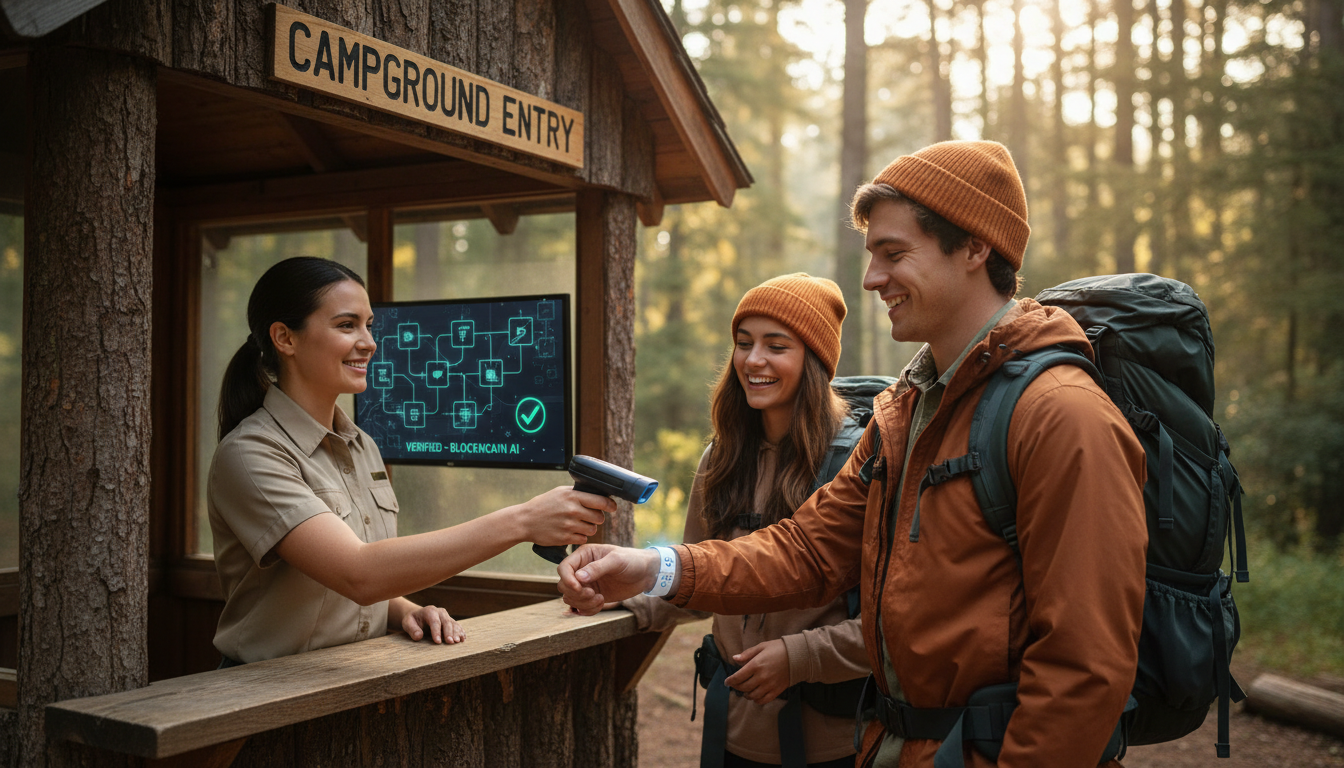
Every Friday you watch the line of RVs snake toward the office—guests growing impatient, staff juggling waiver forms, and the ever-present worry that a fake ID or privacy complaint will land on your desk. What if those headaches vanished in the time it takes to hand over a driver’s license?
Picture an AI kiosk that authenticates passports in under five seconds—even when Wi-Fi drops—and a blockchain “super wallet” that proves a camper’s age, booking, or waiver completion without exposing a single scrap of raw data. Less fraud, shorter lines, happier guests.
Ready to see how this tech leapfrogs budget limits, patchy internet, and regulatory red tape? Keep reading; the next few minutes could redefine check-in forever.
Key Takeaways
– Fast ID check: AI kiosk scans a license or passport in about 5 seconds, even if the internet is slow.
– Shorter lines: Guests move from gate to campsite quickly, so they are happier and staff feel less stress.
– Stops fakes: The system spots fake or expired IDs and keeps under-age visitors from risky activities.
– Protects privacy: A “Super Wallet” only shares simple facts like “age 21+” or “waiver signed,” never the full ID.
– Easy to add: Works with the park tools you already have; start with one scanner and grow later.
– Saves money: Cuts overtime, lowers fraud costs, and may reduce insurance bills.
– Built for outdoors: Hardware resists dust, rain, sun, and power or Wi-Fi dropouts.
– Clear plan: A 90-day roadmap shows how to test, train staff, and roll out to the whole property..
These points form the backbone of a fast, fraud-proof, and guest-friendly arrival experience. Keep them in mind as you explore the deeper dive below, because every section that follows shows exactly how to turn each takeaway into measurable results.
Taken together, they highlight a simple truth: lightning-quick identity verification is no longer futuristic hype—it’s a practical upgrade parks of any size can roll out this season without blowing the budget.
The Weekend Bottleneck Is Costing You More Than Patience
Every idling rig means propane burners running, children asking how much longer, and staff hurrying through manual checks they know aren’t foolproof. Those minutes multiply into lost store revenue because guests bypass the camp shop to reach their site before dark. They also turn into negative reviews that mention “long lines at arrival,” a phrase Google surfaces when travelers compare parks.
Delayed arrivals drain payroll too. When three front-desk employees stay an extra hour on Fridays, you pay overtime while risking burnout and turnover. Meanwhile, forged IDs slip through during the rush, leading to chargebacks or fines when underage visitors rent ATVs or buy beer. Slow and risky is not a sustainable combination.
Why Fake IDs and Privacy Fines Are Growing Threats
Fraudsters no longer rely on cheap laminates; they order high-resolution counterfeits that can fool a quick visual inspection. With more amenities requiring age checks—think e-bike rentals, axe-throwing lanes, or craft-beer tastings—the chance of liability climbs. Even a single incident can spike insurance premiums for years.
At the same time, regulators want proof that you protect guest data. A photocopied driver’s license in an unlocked drawer is indefensible under GDPR-style rules now appearing in several U.S. states. Privacy fines dwarf the cost of new technology, and guests are increasingly privacy-savvy, voting with wallets when they sense sloppy data practices.
The Three Pieces of the Five-Second Puzzle
The first piece is AI-powered document scanning. In a live demo at the V5iD showcase, a kiosk authenticated passports and driver’s licenses in less than five seconds, even when bandwidth dipped below 1 Mbps. The on-device neural network spotted forged holograms and expired documents before guests finished unbuckling from their trucks.
Second comes Self-Sovereign Identity. At HITEC 2025, vendors showed how decentralized identifiers and verifiable credentials let travelers prove who they are without handing over raw data—only cryptographic facts move across the wire (HITEC SSI recap). The result is a tamper-evident audit trail with almost zero breach surface inside your PMS.
The final piece is the guest-controlled Super Wallet. The May 2025 article “From Identity Exposure to Verifiable Trust” explains how visitors share just what you need—age 21+, booking XYZ, waiver signed—while keeping everything else private (Super Wallet concept). Combine the three and you get lightning speed, legal defensibility, and a guest experience that feels futuristic, not invasive.
Plugging New Verification Into the Tools You Already Own
You don’t have to rip out your property-management system or gate controller. Look for platforms that publish open APIs or pre-built connectors so the kiosk pushes verified status straight into your reservation record. One verification event can unlock the front gate, print an age-qualified wristband, and approve a pontoon rental, eliminating repetitive scans.
Map the guest journey on a whiteboard—booking confirmation, arrival gate, camp store, amenity desk. Decide where one scan can authorize multiple actions and build only those touchpoints. A pilot in a single park loop on a slow Tuesday lets you shake out edge cases without a Saturday slog. Keep a barcode fallback on confirmation emails so staff can scan guests through if the tablet or kiosk ever goes offline.
Hardware That Laughs at Dust, Sun, and Spotty Wi-Fi
Outdoor tech has to survive scorching asphalt and surprise downpours. Choose IP65-rated enclosures with sunlight-readable screens so guests aren’t shielding displays with ball caps. A small UPS or solar battery keeps the camera and scanner humming during brief outages; automatic failover avoids the mad scramble for paper forms.
Connectivity nightmares shrink when the kiosk processes AI verification locally and writes to the blockchain once a signal returns. A high-gain antenna or low-earth-orbit satellite puck boosts even remote valleys. Nightly self-test routines ping the camera, scanner, and network card, emailing a fault report before sunrise so maintenance can swap a cable before guests feel the pinch.
Training Humans While Delighting Guests
Front-line employees need muscle memory, not jargon. One afternoon of hands-on drills scanning dummy passports and deliberately forged IDs builds confidence faster than slide decks. When the first fake gets flagged in the real world, celebrate it during shift briefing to reinforce the habit.
Guests crave clarity too. A sign at the entrance reading “One scan, no data stored, faster check-in” converts curiosity into cooperation. Early adopters who download an SSI wallet ahead of arrival breeze through the opt-in lane and rave about it around the communal fire pit. Keep a traditional desk open the first two weeks so tech-hesitant visitors feel respected while staff settle into the new rhythm.
Right-Sizing the Budget From Single Park to Multi-Resort
Start small: one portable scanner tethered to a staff tablet costs less than a weekend of overtime. Cloud identity platforms bill per verification, so a 40-site family campground enjoys the same tech as a 600-site resort without a giant capital hit. Once metrics show minutes saved and chargebacks down, add unmanned kiosks at secondary entrances.
Remember soft savings. Freed from photocopying IDs, staff upsell firewood bundles, kayak rentals, or late-checkout passes. Some insurers shave premiums when you document a robust ID process, turning compliance into a budget ally. Allocate a modest annual reserve for firmware updates; staying current is cheaper than emergency replacements after an unpatched vulnerability.
Compliance Without the Paper Cuts
Verifiable credentials prove age or boating-license status without storing the actual documents, slashing the pile of sensitive data you must protect. Each credential is timestamped and linked to a guest record, giving you a bulletproof audit trail if an incident ever heads to court.
Automated waiver prompts appear the moment an identity is verified, and guests tap-to-sign on the same kiosk. Privacy-by-design means you collect only what you need, store it briefly, and encrypt it at rest, keeping you aligned with GDPR-style laws even if your park sits stateside. Seasonal reviews of your incident-response plan now include immutable logs, which speed regulator conversations compared to rifling through paper folders.
A 90-Day Roadmap to Faster Check-In
Weeks 0–4 focus on vendor selection and an integration sandbox. Spin up a test PMS instance, connect the kiosk, and verify that role-based access hides sensitive fields from staff who don’t need them. Choose your pilot loop—ideally one that sees steady but not peak traffic.
Weeks 5–8 bring hardware installation, staff drills, and guest-facing signage. By week nine you’re soft-launching on weekdays, capturing metrics like average seconds per check-in and failed scan percentage. Months four to six see property-wide rollout, an opt-in SSI wallet lane, and a conversation with your insurer about premium breaks. After six months, explore revenue boosters like automated age-verified craft-beer tastings or night-kayak tours.
Numbers That Prove the Upgrade Pays
Track average check-in time; parks typically drop from three minutes to under thirty seconds. Record the percentage of forged or expired IDs caught; even a handful offsets the tech cost through prevented chargebacks. Calculate labor hours shifted from paperwork to guest engagement—gathering these numbers arms you with tangible ROI for seasonal budgeting.
Guest satisfaction scores rise when the first interaction is seamless. Survey comments often mention “efficient and secure check-in,” a phrase Google rewards in local search snippets. Together, faster throughput, risk reduction, and happier campers build a moat your competitors can’t ignore.
Quick Answers to Common Pushbacks
What if the internet dies? Local AI verification keeps scanning offline and syncs to the blockchain once the signal returns, while a UPS handles brief power blips. Will guests balk at scanning IDs? Privacy-first SSI and a clear sign that no raw data is stored defuse the concern, and early adopters become brand ambassadors. Too pricey for a 60-site park? Start with pay-as-you-go verification, factor in possible insurance discounts, and phase expansion as savings roll in.
Is integration a nightmare? Most kiosks ship with plug-and-play APIs that map to leading property-management systems in under a day, and vendors offer sandbox environments so you can test without touching live data. What about ADA compliance? Touchscreens support wheelchair heights and voice prompts, while staff still have handheld scanners for curbside assistance. Concerned about ongoing support? Quarterly firmware updates arrive over the air, and field-swappable parts mean maintenance crews replace a module in minutes instead of shipping the unit away for weeks.
The next time a line of rigs snakes toward your office, it could be gone before the coffee finishes brewing—if you pair AI, blockchain, and the right rollout plan. That future isn’t years away; it’s a single project cycle waiting for champions in outdoor hospitality. If you’re ready to swap paperwork for verified peace of mind, let Insider Perks guide the journey. Our team blends marketing savvy with AI and automation expertise to help parks like yours deploy secure check-in tech—and then shout its success from every digital mountaintop. Reach out today, and let’s turn five-second identity verification into the story that fills your sites all season long.
Frequently Asked Questions
Q: Do I need to replace my current property-management system or reservation software to use AI and blockchain identity verification?
A: No; most verification vendors expose open APIs or drop-in connectors that let the kiosk or handheld scanner push a “verified” flag, age status, and waiver status straight into the guest record you already maintain, so the new tech simply enhances, rather than disrupts, your existing workflow.
Q: How much does a basic rollout actually cost for a small, 60-site park?
A: A single rugged tablet with an integrated document scanner and on-device AI engine typically leases for under $150 a month, while pay-as-you-go verification charges average $0.40–$0.75 per scan; most parks recoup that in overtime savings and store revenue captured when arrivals move through faster.
Q: What happens if the internet or power goes down right at peak check-in?
A: The AI model that authenticates licenses and passports runs locally on the kiosk, and a small UPS keeps the camera, screen, and scanner alive for 30–60 minutes, so you can still verify guests and simply sync the encrypted blockchain entries once connectivity returns.
Q: Will guests push back on having their ID scanned into a blockchain system?
A: Because Self-Sovereign Identity only transmits cryptographic proofs—never the raw document—most guests appreciate that less personal data is stored, and clear signage explaining “one scan, no data stored” usually turns initial curiosity into praise in post-stay surveys.
Q: How is my liability reduced compared with photocopying IDs or using a manual visual check?
A: The AI engine can spot high-resolution counterfeits and expired documents in seconds, while the immutable blockchain log provides a time-stamped record of every age or waiver verification, giving you defensible evidence if an incident heads to court or an insurer review.
Q: What kind of hardware survives dust, rain, and direct sun at outdoor check-in lanes?
A: Look for IP65-rated enclosures with sunlight-readable touchscreens, solid-state drives, and fan-less cooling; these kiosks are built to operate from –4°F to 122°F and have field-swappable components, so most parks run them season-long with only a quick wipe-down for maintenance.
Q: How long does staff training take before everyone is comfortable?
A: One three-hour hands-on session scanning dummy IDs and walking through common error messages is usually enough for front-desk staff to gain muscle memory, and by week two most teams report faster check-ins than with paper forms.
Q: Can I still accommodate guests who forget their ID or refuse to use the kiosk?
A: Yes; you can keep a traditional desk or smartphone barcode fallback where staff manually verify and note the exception, ensuring no guest is turned away while you transition to primarily digital verification.
Q: Will using blockchain trigger additional regulatory hoops or licensing requirements?
A: No special license is required; the blockchain layer simply provides an auditable, tamper-evident ledger that aligns with GDPR, CCPA, and emerging U.S. privacy laws by minimizing the storage of personal data and documenting consent and disclosures automatically.
Q: How quickly will I see a return on investment?
A: Parks that process 150–200 Friday arrivals often cut total check-in labor by two hours per week and reduce chargebacks or fines linked to fake IDs within the first season, so most operators report positive ROI in under six months.
Q: Can the same verification scan unlock amenities like age-restricted rentals or gated pool access?
A: Absolutely; once the guest’s credential is verified, that single event can trigger wristband printing, gate code activation, or POS age clearance, eliminating repeat checks and letting guests move freely while your system enforces the rules in the background.
Q: How does scaling work if I add a second park or a cluster of resorts later on?
A: Because the identity wallet and blockchain live in the cloud, adding another location is mostly a matter of installing additional kiosks and linking them to the same tenant account, so multi-property groups gain network-wide consistency without duplicating infrastructure.
Q: What ongoing maintenance or updates should I budget for after rollout?
A: Plan for quarterly firmware updates that patch security vulnerabilities and improve document-recognition accuracy, plus an annual hardware inspection; most vendors bundle these updates into the per-scan fee or a modest support subscription.