

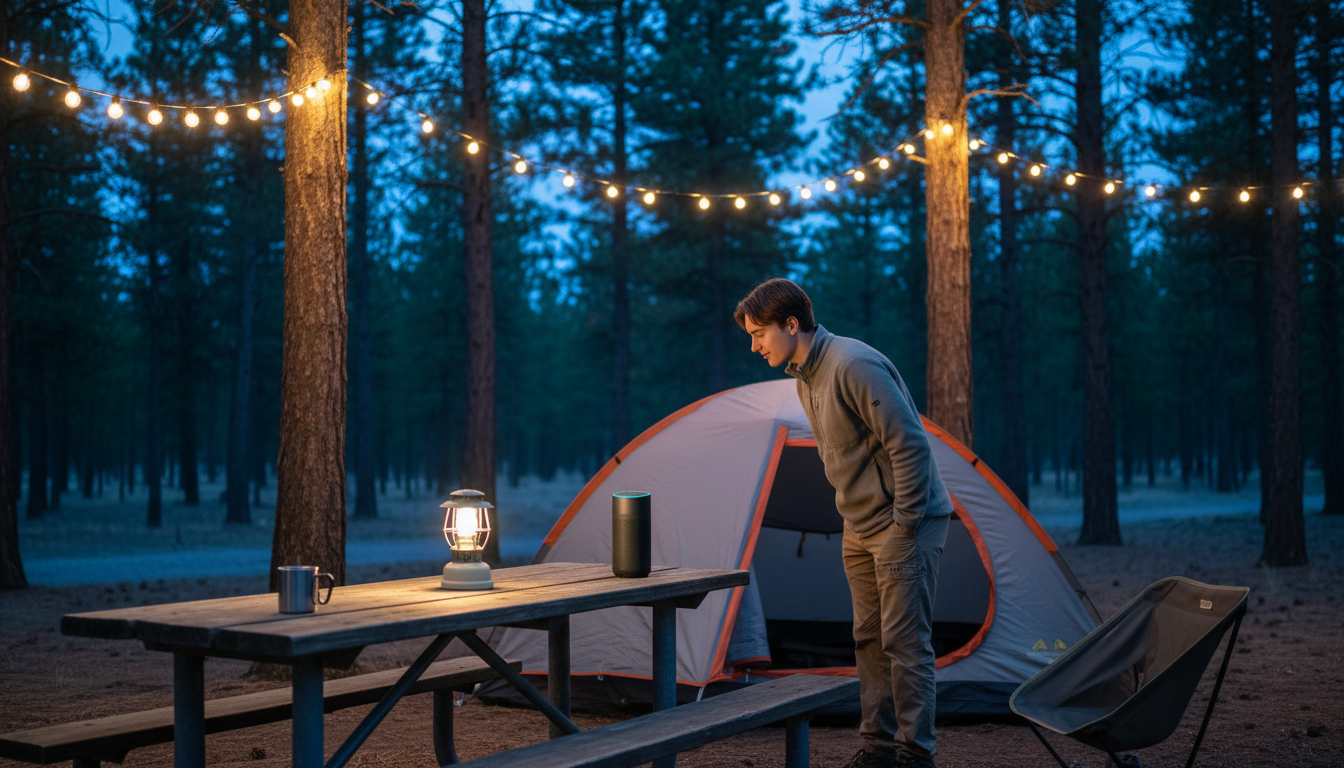
“Alexa, light up Site 17 like a campfire.”
Imagine the pathway LEDs, the awning strip, even the picnic-table lamp all fading to a warm amber before the guest’s marshmallows hit the stick—and your maintenance team didn’t lift a finger.
Voice-activated lighting isn’t sci-fi anymore; it’s a 2025 expectation riding into your park with every Govee table lamp and Matter-ready bulb campers pack. Nail the rollout and you’ll score rave reviews, slash energy costs, and give staff a dashboard that beats racing a golf cart to flip switches.
Ready to turn spoken commands into brighter profits? Keep reading—this guide maps the infrastructure, workflows, and guest-proof tricks that separate “neat gimmick” from “next-level stay.”
Key Takeaways
– Campers like to say things like “Alexa, turn on the light,” so parks now need voice-controlled lighting just like they needed Wi-Fi years ago.
– Use three layers for best results:
• Portable lamps guests bring or rent for tables and tents.
• Fixed smart bulbs along paths, bathhouses, and common areas.
• RV or cabin systems that tie inside and outside lights to awnings, pumps, and more.
– Build solid Wi-Fi and power first; no signal means no voice commands. Keep smart-light traffic on its own network lane.
– Dashboards let staff dim whole loops at once, spot dead bulbs, and save four work hours each week.
– Simple guides—cards, QR codes, short videos—help guests try voice commands fast; still keep regular switches for anyone who needs them.
– Good security is a must: change default passwords, update firmware, and limit how long voice logs are stored.
– Start with a small 60-day test in two zones, learn, then expand across the park.
– Costs run about $50–$90 per bulb and $129 per portable lamp; energy savings plus a $10–$15 “Smart Glamp” upsell can pay back the pilot in one busy season.
– Pick Matter-certified gear today so you can swap or upgrade parts easily in the future.
Why Campers Now Expect to Talk to Their Lights
Gen-Z and millennial travelers arrive with smart speakers in tow, and they’re accustomed to saying “dim the lights” at home. KOA’s 2024 Camping Report shows 68 percent of Gen-Z campers bring at least one voice-compatible device on the road, shifting voice lighting from novelty to baseline amenity—much like Wi-Fi a decade ago. Review sites already flag parks that skip the feature, so the expectation grows louder every season.
Online travel agencies now list “smart campsite” filters, meaning parks without the feature sink further down search results. Operators that adopted automated dim-downs report reclaiming four staff hours per week—time now spent on revenue-building tasks rather than manual switch walks. When convenience, discoverability, and labor savings align, adoption becomes inevitable.
The Three Hardware Layers That Make a Cohesive System
Think of the hardware stack as concentric rings that wrap convenience around your guests. The outer ring is guest-facing—color-changing table lamps and lanterns that create Instagram moments and instant upsell value. The inner rings are park-owned fixtures and RV integrations that quietly handle safety, efficiency, and data without demanding campers learn new tech.
By architecting the layers up front, you avoid patchwork fixes later. Interoperability through Matter keeps each tier speaking the same language, whether the device is a pole-mounted bulb or a battery lamp included in a premium “smart site” bundle. Industry analysts at the smart camping bundle review forecast that modular systems boost average nightly rates by up to 12 percent.
1. Portable guest-side lamps create instant wow without trenching a single cable. The 2025 Govee Table Lamp 2 Pro x Sound by JBL offers 40-hour battery life, full Matter support, and music-synced color scenes, so guests feel like they’ve upgraded to a premium site.
2. Fixed park-owned bulbs protect trails, bathhouses, and communal kitchens from trip hazards and dark-sky complaints. Outdoor-rated, high-CRI LEDs like Mersain’s VoiceSync series screw into existing sockets, answer in under a second, and track kWh at the fixture level.
3. Integrated RV or cabin systems stitch everything together. WFCO’s POWER PRO platform extends voice to awnings, pumps, and interior lights while feeding battery and tank data to maintenance tablets—an operational perk guests never see but rave about online.
Build the Backbone Before the Bulbs
Voice commands die in dead zones, so conduct a site-wide Wi-Fi survey and mark spots where RSSI dips below –67 dBm. Replace or add outdoor-rated Wi-Fi 6 access points powered via PoE, and run extra Cat-6 while trenches are open. Isolate lighting traffic on its own VLAN so TikTok uploads don’t delay a “turn off pathway lights” command during quiet hours.
Storms cut power exactly when guests need light, so back gateways with UPS packs or solar trickle chargers. A 30-minute battery bridge turns potential panic into five-star storytelling. Document uptime metrics in your sustainability report to show prospects you’ve designed resilience into every stay.
Weaving Voice Lighting Into the Staff Rhythm
Choose platforms with bulk actions: dim every loop to 20 percent at 10 p.m. instead of hollering at 60 fixtures. Dashboards that flag offline poles save midnight golf-cart hunts, and role-based permissions stop curious kids from painting the roadway neon pink. A simple color-coded map view lets seasonal staff grasp the system in minutes.
Automate scenes around PMS events. “Check-In Complete” can trigger a welcome glow, while “Site Vacated” shuts lights off and logs kWh savings. Schedule 2 a.m. self-tests so failed bulbs generate work orders before sunrise coffee.
Guest Onboarding and Accessibility: Turning Curiosity Into Delight
Laminated cards or QR tags at each pedestal listing phrases like “Alexa, set Patio Light to Campfire” convert hesitation into first-try success. A 60-second explainer video in the pre-arrival email seeds anticipation. Previewing the feature in marketing emails also increases click-through rates by double digits.
Accessibility still matters. Keep physical switches for speech-impaired guests or low-tech visitors, and publish multilingual cheat sheets. Default warm white at 40 percent prevents unintended raves while meeting dark-sky guidelines.
Turn Efficiency Into a Marketing Story
Astronomical scheduling shuts pathway LEDs off 30 minutes after sunrise and revives them at civil twilight—no staff needed. Occupancy sensors in restrooms shift to a low-glow safety mode after 10 idle minutes, slicing kWh by 25–40 percent. Share those numbers in newsletters and on booking pages to attract eco-minded travelers.
Map the savings back to tangible acts—“Our smart lighting conserved enough energy to charge 2,000 e-bikes last season.” Pair the stat with guest photos under softly lit canopies, and you transform an operational tweak into share-worthy storytelling. The narrative sells itself because conservation and comfort visibly coexist.
Lock Down Security and Privacy First
Change factory passwords, disable unused voice skills, and place hubs behind firewalls. Schedule firmware patches on low-occupancy nights, and auto-delete voice logs after 30 days. Post a clear privacy notice at check-in and provide an opt-out switch for peace of mind.
Layer additional safeguards like VLAN segmentation and MAC whitelisting to corral IoT devices away from payment networks. Regular penetration tests, combined with a public “security.txt” disclosure policy, signal to tech-savvy guests that you take data stewardship seriously.
From Pilot Zone to Park-Wide Rollout
Start focused: two contrasting zones for 60 days. Install backbone first, then a mix of portable lamps and fixed bulbs. Collect SMS feedback, tweak scenes, fix dead zones, and fine-tune onboarding.
When occupancy ebbs, expand in phases that align with existing maintenance schedules. This staged approach avoids guest disruption, and each completed loop creates a live case study you can showcase in social posts and ops meetings. Momentum builds as staff become advocates rather than skeptics.
The Numbers: Cost vs. Payback
Budget $49–$89 per smart bulb, $129 per portable lamp, about $1,200 per gateway cluster, and roughly $2,500 in Wi-Fi upgrades per loop. Automated dimming and a $10–$15 nightly upsell on “Smart Glamp” sites typically recoup pilot costs within a single peak season—plus softer ROI in shorter check-in lines, fewer after-dark calls, and Instagram-worthy guest photos. Energy data logged by fixture can also support utility rebates, trimming capital outlay further.
Factor in depreciation schedules and tax incentives for energy-efficient upgrades. Many park owners reclaim an additional 10-15 percent through accelerated write-offs, making smart lighting one of the fastest-paying improvements you can bulb-swap into existence. Put the math in a one-page brief for stakeholders to accelerate funding approvals.
Stay Future-Ready Without Ripping Everything Out Later
Pick Matter-certified devices now to avoid brand lock-in tomorrow. Keep firmware auto-updates restricted to off-peak hours, and lay conduit that anticipates Wi-Fi 7 or Thread mesh upgrades. Swapping radios is painless when you’re not retrenching asphalt two years down the road.
Future-proofing also means storing configuration files in a vendor-neutral format. If a supplier exits the market, you can import scenes and schedules into a new platform without rewriting every command. Plan for longevity, and your smart-site investment matures instead of aging.
You have the roadmap; now ignite the results. Insider Perks blends hospitality-savvy marketing, AI-driven automation, and campground know-how to turn voice-activated lighting from cool gadgetry into a booked-solid competitive edge—while your crew keeps their eyes on guest smiles, not firmware updates. If you’re ready to hear “Alexa, book us here again!” in next season’s reviews, schedule a quick vision call with Insider Perks and see how effortlessly smart lighting pairs with smarter marketing to illuminate every corner of your business.
Frequently Asked Questions
Q: What exactly is voice-activated campsite lighting?
A: It’s a network of smart, outdoor-rated LED fixtures and portable lamps that respond to spoken commands—usually via Alexa, Google Assistant, or Siri—so guests or staff can turn lights on, off, or to preset scenes without touching a switch.
Q: Do I have to place smart speakers at every site, or can campers use their own devices?
A: Most parks provide one hub per loop or a weatherproof speaker at premium sites, but the system is Matter-based, so guests who bring their own Echo or Nest can pair directly after scanning a QR code, saving you hardware costs.
Q: What kind of Wi-Fi do we need for reliable voice control?
A: Aim for at least –67 dBm signal strength at every pedestal, delivered by outdoor-rated Wi-Fi 6 or mesh access points on a VLAN dedicated to IoT traffic; a slower connection will still carry voice packets, but latency above 300 ms creates command failures.
Q: How weather-tough are these fixtures?
A: Choose bulbs and housings with IP65 or higher ratings, UV-stable gaskets, and operating ranges from –4 °F to 122 °F; properly sealed, they’ll outlast traditional fixtures and most come with three- to five-year warranties.
Q: What happens if the internet or power drops?
A: A small UPS keeps the gateway alive for a few hours, and every site retains a physical switch override, so guests still have light; once connectivity returns, schedules and scenes automatically sync without staff intervention.
Q: How do we prevent kids from turning the whole loop neon pink at midnight?
A: Role-based permissions lock site-level commands to that site’s bulbs, while global scenes (quiet-hour dimming, dark-sky mode) override individual antics; you can also set color limits or brightness caps after 10 p.m.
Q: Is the data collected by microphones stored or shared?
A: Voice assistants convert speech to encrypted text in the cloud, and you can configure logs to auto-delete after 30 days; no audio is stored locally, and a posted privacy notice plus opt-out switch keeps you compliant with most state regulations.
Q: Will smart bulbs violate electrical codes or void insurance?
A: As long as fixtures carry UL-wet or ETL outdoor listings and are installed on circuits that already meet NEC standards, codes and insurers treat them like any other luminaires; always document the listing numbers in your maintenance records.
Q: How steep is the learning curve for staff?
A: Most front-desk or maintenance teams master the dashboard in under an hour, because bulk actions are map-based; the bigger lift is teaching them to mention the feature during check-in so guests actually use it.
Q: Can the lighting platform sync with my PMS or channel manager?
A: Yes, most Matter or MQTT gateways offer webhooks or Zapier connectors, allowing events like “reservation checked in” to trigger a welcome scene or “site status vacated” to shut lights off automatically.
Q: What’s a realistic budget and payback timeline?
A: Expect $49–$89 per bulb, $1,200 per gateway cluster, and roughly $2,500 in Wi-Fi upgrades per loop; electricity savings plus a $10 nightly upsell on premium “Smart Sites” usually recoups the investment within one peak season.
Q: Can we pilot on just a few sites first?
A: Absolutely—Matter makes expansion modular, so you can outfit two contrasting zones for 60 days, gather guest feedback, and then scale during offseason trenching or renovation when labor is already on-site.
Q: Does voice lighting increase light pollution?
A: No, because you can set automatic dimming to 20 percent after quiet hours and cap color temperatures at 3,000 K, which meets most dark-sky guidelines while still giving guests functional illumination.
Q: How often do firmware updates occur and who handles them?
A: Vendors push patches roughly once a quarter; schedule auto-updates between 3 a.m. and 5 a.m. on low-occupancy nights and assign a tech to glance at the update log during the morning walk-through.
Q: Can we create themed scenes for holidays or events?
A: Yes, the dashboard lets you preprogram color palettes—red, white, and blue for July 4th or amber for Halloween—and schedule them park-wide or by loop with a single click, turning décor into a software update instead of a ladder job.