

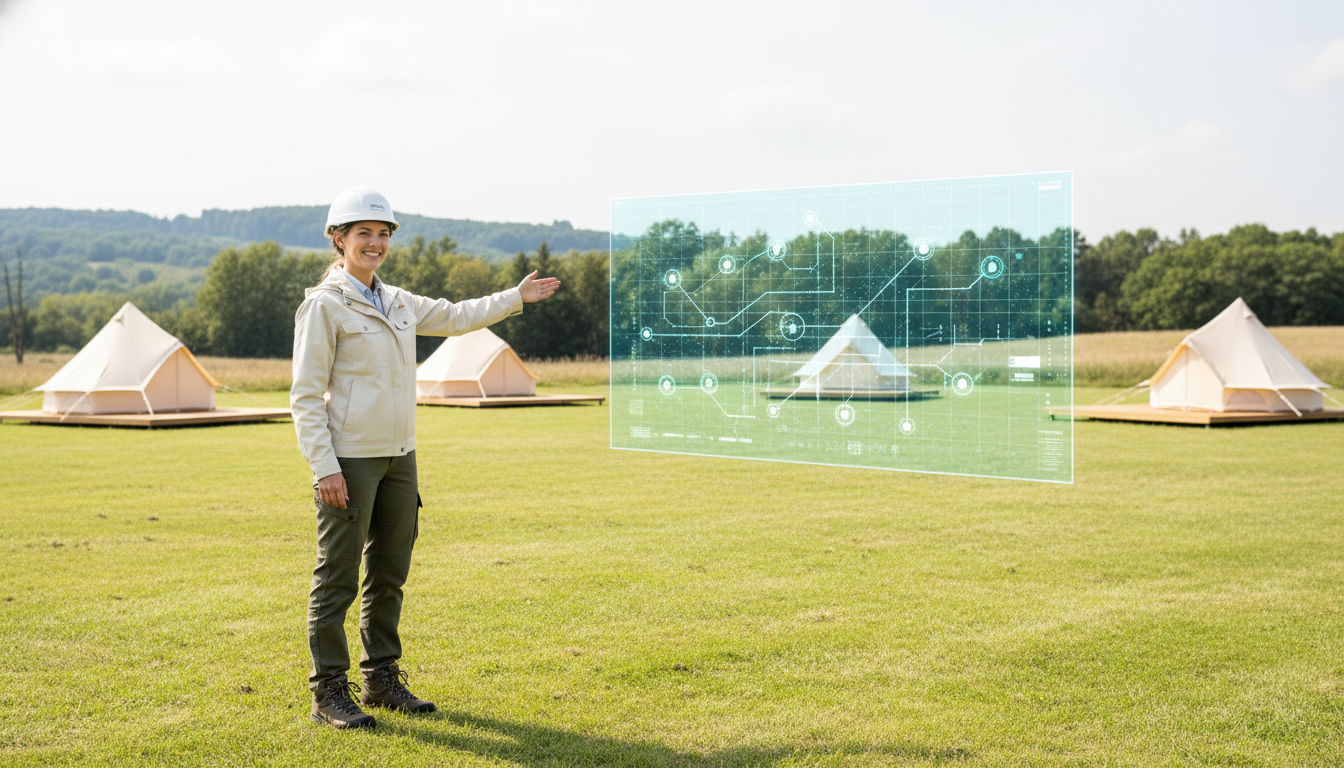
Your next site-expansion meeting could happen inside a 3-D replica of your park—where you drag a yurt 10 feet, watch the fire-lane widen to code, and see propane usage drop before you ever touch the soil. That is exactly how hotels in India and Vietnam are slicing 20–30% off operating costs, and the tools are now priced for campgrounds, RV resorts, and glamping retreats.
Curious how a digital twin can let planners and inspectors “walk” your premium tent circle from their desks, flag ADA grades, or color-code septic alarms in real time? Stay with this post—we’ll show you the quick-start pilot that turns a single bathhouse into a live command center, the guest-facing virtual tour that upsells sunset views, and the maintenance dashboard that stops surprise generator failures. Ready to swap paper maps for an interactive model that pays for itself before high season? Let’s open the gate.
Key Takeaways
– A digital twin is a live 3-D map of your campground that changes as you move things around.
– Parks using twins are cutting 20–30 % of energy and staff costs.
– You can drag tents, cabins, or roads in the model and instantly see fire-lane widths, sight lines, wind flow, and septic spots.
– Inspectors can walk the model online, so permits get approved faster.
– Start small—model one bathhouse or a few premium sites—and pick one staff “twin champion” to keep it updated.
– QR codes on pumps, tanks, and golf carts open repair logs in the twin, stopping surprise breakdowns.
– The twin shows emergency routes and landing zones, helping staff practice for fires or floods.
– Guests can take virtual tours, see exact sunset views, and add paid upgrades, boosting bookings and revenue.
– Dashboards track savings, staffing time, and site demand, giving clear numbers for lenders or owners.
– Keep the model simple at first and update it often; an outdated or over-detailed twin loses its value..
A Living Map, Not a Static Rendering
The phrase digital twin gets tossed around, but in the woods it means a synchronized 3-D model wired to your property-management system, sensor feeds, and GIS layers. Unlike a one-off CAD drawing, the twin breathes: move a cabin icon and utility runs, tree canopies, and reservation data shift with it. Each pixel knows its elevation, its building material, and even its warranty dates.
That living logic solves daily campground riddles. Want to add three safari tents without blocking stargazing views? Drag them in the model and watch sight-line heat maps appear. Ready to upgrade solar inverters? Drop in higher-wattage units and see the kilowatt output curve update. The moment the model stops matching the ground, accuracy alerts remind your “twin champion” to refresh the file, so decisions never rely on stale drawings.
Proof from the Hotel Lobby
Hospitality isn’t guessing anymore. Speakers at the HorecFex Vietnam 2025 report showed operators trimming 20–30 % from energy and staffing budgets after simulating guest flow, climate demands, and equipment cycles inside twins. Every percentage point came with a presentation slide—no hypotheticals, just tracked savings.
One month later, Roseate Hotels in India invited event planners into a virtual ballroom built on the Spalba platform. The walk-through let clients toggle décor, lighting, and seating, locking layouts before a single table rolled out. The hotel now boasts shorter planning cycles and higher client engagement, according to the Roseate Hotels case study. If carpeted ballrooms gain that clarity, imagine what it can do for tent circles, bathhouses, and amphitheaters under the pines.
Drag-and-Drop Site Planning
Outdoor layouts rarely behave once guests arrive. A digital twin lets you rehearse peak-season traffic, flood-season runoff, and midnight flashlight paths without disturbing a pine needle. Shift pathways, widen steps, or angle cabins until the simulated congestion graphs turn green.
The twin also weighs invisible factors. Overlay wind-rose data to orient tent doors away from prevailing gusts. Layer soil-perk rates to drop septic tanks where percolation is perfect. Each adjustment generates an instant cost delta and utility-run distance, giving you quantifiable ROI before you call the dozer.
Permitting in Half the Time
Regulators like clear visuals, and nothing beats a walkable model. Import county parcel layers, topographic contours, and buffer setbacks; the twin highlights violations in red so you fix them before submitting drawings. Invite the planning board to a browser-based tour, letting them measure fire-lane widths, check secondary egress, or verify ADA ramp grades firsthand.
Fire-code layers further streamline approval. Minimum hydrant spacing, fuel-break corridors, and unit-to-unit clearances appear as dynamic zones. Inspectors switch on those overlays, nod once, and stamp faster. Many owners report a single hearing instead of three because everyone looked at the same 3-D evidence.
Turning a Bathhouse into a Command Center
Start small: model one high-impact zone such as the central bathhouse or five premium ridge sites. That pilot keeps software costs low, limits data-entry hours, and builds internal wins staff can rally around. Once confidence rises, the rest of the park feels less daunting.
Appoint a twin champion—your on-site data sheriff. Their calendar includes quarterly refresh sessions to add new decks, rerouted water lines, or tree-growth scans. By saving the model in open formats like IFC, OBJ, or GIS shapefiles, you stay vendor-agnostic and future-proofed if you ever migrate platforms.
Maintenance and Asset Management on One Screen
A clogged filter is cheaper at the first sputter than after the pump seizes. Tag every essential asset—well pumps, solar inverters, golf carts—with QR codes that open its location, service log, and warranty doc inside the twin. Field techs scan, repair, and sign off without hunting for binders in the office.
Live color codes keep priorities obvious. A septic alarm glows red until resolved; propane tanks shift from green to amber when gauges hit 30 %. Managers spot trouble during coffee, reroute staff, and log parts orders before the hardware store closes. End-of-season shutdown becomes a scripted path the twin walks each employee through, reducing forgotten line purges and accidental freeze-ups.
Ready for the Worst-Day Scenario
Wildfire, flash flood, or midnight medical evac—the twin rehearses them all. Load historical wind patterns and forecast models, then test muster points and fuel-break widths. Darken the model to simulate a power outage and run a nighttime evacuation; bottlenecks glow orange so pathways can widen on-screen, not post-incident.
Emergency overlays build muscle memory. Staff click a layer showing helicopter landing zones, utility shut-offs, and nearest hospitals. Quarterly tabletop drills inside the twin keep procedures fresh without pulling guests off-site, shaving both risk and overtime budgets.
Virtual Tours that Sell More Nights
Guests shop with their eyes. Export 360-degree snapshots from sunset-facing sites and drop them into social ads that lead straight to the booking engine. When browsers see the exact view from Site 12, hesitation fades and rates hold firm.
Embed the interactive map on your website so visitors filter by shade, distance to bathhouse, or proximity to the dog park. Toggle paid upgrades—private hot tubs, seasonal décor, ski lockers—and watch add-on revenue climb. Heat-map analytics reveal which virtual angles attract the most clicks, guiding where to build the next premium pad.
Measuring ROI You Can Show the Bank
Numbers close financing. Track layout-approval days, maintenance hours saved, and conversion lift from the virtual map. Operators aiming for the 20 % maintenance-cost cut and 30 % faster staff ramp-up showcased at HorecFex Vietnam have hard data to slide across the lender’s desk.
The same dashboard can merge occupancy, dynamic pricing, and heat-map demand to predict revenue per acre. Tie those forecasts to phased cap-ex schedules and your twin evolves into a living pro-forma, updating itself every quarter. Those rolling metrics give lenders confidence that each expansion phase will self-fund instead of draining reserve accounts.
Pitfalls and Fast Fixes
The most common misstep is over-modeling. Resist the urge to render every picnic table bolt on day one; focus on high-impact utilities and guest-facing assets, then deepen detail as ROI proves itself. Another trap is the orphaned twin: without a champion and refresh ritual, accuracy drifts and staff revert to paper.
Training also matters. Build a 15-minute self-guided walk-through for new hires so the twin becomes daily muscle memory. Finally, invite regulators early; every postponed hearing erodes savings, and a one-hour virtual tour can prevent three weeks of redesign.
Quick-Start Checklist
First, define a clear goal—permitting speed, upsell revenue, or maintenance efficiency—so your pilot has a scoreboard. Second, scan existing topo surveys, parcel lines, and utility maps; clean data on day one beats heroic fixes later. Third, choose a platform that integrates with your PMS and accepts open files, keeping future options open.
Fourth, launch the pilot zone, gather feedback, and iterate twice before scaling across the park. Fifth, schedule quarterly refreshes and publish analytics, reminding the team why accuracy matters. Finally, leverage vendor partnerships for backlinks and visibility—your downloadable checklist or case study can drive both SEO and credibility.
Drag the cabin, drop the fire ring, watch the profit margin shift in real time—then let that same data-rich model power the campaigns that keep every new pad booked solid. Insider Perks can plug your digital twin straight into targeted advertising, AI-driven rate management, and automated guest journeys, so the layout you perfect on-screen translates into fuller calendars and leaner ops on the ground. Ready to see how a living map becomes a living revenue stream? Connect with Insider Perks today and make your next site expansion a sure thing before the first stake hits the soil.
Frequently Asked Questions
Q: What makes a digital twin different from a normal 3-D rendering of my park?
A: A rendering is a static picture, while a digital twin is a live, data-connected replica that knows elevations, utility locations, occupancy, and maintenance schedules, so when you drag a yurt or change a septic line the model instantly recalculates costs, code setbacks, and guest-flow metrics.
Q: How much does it typically cost to launch a starter twin for a small campground?
A: Most owners begin with a pilot zone and spend $3,000–$7,000 on software, lidar or drone scans, and onboarding, then scale across the property once the savings on permitting time and maintenance labor start offsetting that investment.
Q: What files or data do I need on hand before I call a vendor?
A: Current topo surveys, parcel boundaries, utility maps, and a property-management-system export of site numbers and amenities give the vendor enough to stitch an accurate base layer without repeated site visits.
Q: How long does the first model take to build?
A: A focused pilot like one bathhouse or premium ridge loop can be scanned, modeled, and online in two to four weeks, after which cloning the workflow across the rest of the park is largely drag-and-drop.
Q: Will my existing PMS or channel manager integrate with a twin platform?
A: Most leading twin vendors offer open APIs that sync availability, rates, and guest preferences so the same data driving reservations also powers the model’s occupancy heat maps and revenue forecasts.
Q: Do I need powerful computers or VR headsets for staff to use it?
A: No; modern twins stream through a browser, so planners can fly around the map on an everyday laptop and inspectors or guests can view tours on a tablet or phone without extra hardware.
Q: How often must the model be updated to stay accurate?
A: Appointing a “twin champion” to spend a few hours each quarter logging new decks, rerouted utilities, or tree growth keeps the model aligned with reality and prevents staff from drifting back to paper maps.
Q: Is guest or operational data secure inside a twin?
A: Reputable platforms encrypt data in transit and at rest, offer role-based access so guests only see marketing layers, and comply with PCI and GDPR standards, keeping reservation and payment information siloed from public-facing views.
Q: Can a twin really shorten my permitting timeline?
A: Owners report that letting county officials walk a browser-based model with fire-lane widths, ADA grades, and hydrant spacing highlighted in real time often reduces hearings from three to one because objections are resolved on the spot.
Q: How does the twin translate into more bookings or higher rates?
A: Exporting 360-degree views and embedding an interactive map on your website lets shoppers filter by sunset angle or distance to the dog park, which both shortens decision time and nudges guests toward premium sites, raising per-night revenue.
Q: What return on investment should I expect and when?
A: Operators who combine layout simulations, predictive maintenance alerts, and virtual tours typically see a 5–10 % lift in ADR and a 15–25 % drop in unplanned maintenance within the first high season, meaning most pilots pay for themselves in under a year.
Q: What happens if I change software vendors down the road?
A: As long as your twin is saved in open formats like IFC, OBJ, or GIS shapefiles, you can migrate to a new platform without re-surveying the property, protecting the time and capital already invested.