

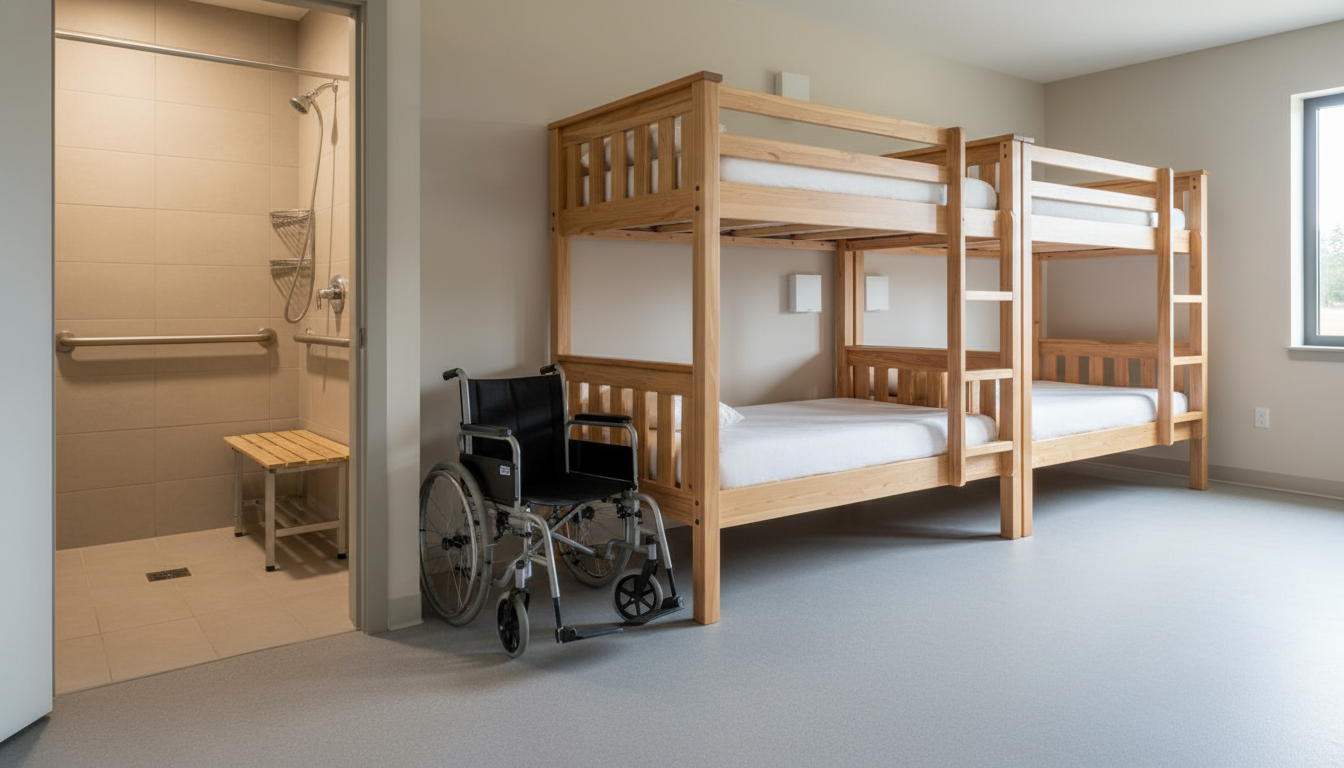
Picture your busiest summer weekend: every cabin is full, the camp store is buzzing—then a multigenerational family rolls up and asks, “Do you have a bunkhouse with a true roll-in shower?” Say yes, and you capture a loyal guest segment that spends 30% more per trip and tells every adaptive-sports forum you’re the place to stay. Say no, and they book down the road—taking their whole travel party with them.
From moisture-proof modular showers that install in a day to reservation filters that flag accessible units before the phone even rings, universal-design bunkhouses aren’t a feel-good upgrade; they’re a revenue engine hiding in plain sight. Ready to see how turnkey ADA cabins, shared bathhouse strategies, and staff protocols can turn compliance into competitive edge? Keep reading—your next five-star review might roll right in on four wheels.
Key Takeaways
Inclusive design turns what looks like a niche amenity into a high-yield booking magnet, but only when every touchpoint—construction, housekeeping, and marketing—works in sync. The following points distill the playbook you can act on this season, protecting you from five-figure lawsuits while unlocking a guest segment that books early, stays longer, and spreads the word faster than any banner ad.
Bookmark this list for your next budget meeting; each bullet represents a proven tactic, not theory. Nail even half of them and you’ll see higher occupancy and stronger reviews before your next seasonal ramp-up.
– Roll-in shower cabins attract bigger travel groups who spend more money
– ADA access now helps avoid lawsuits that can cost tens of thousands of dollars
– Decide early: one shared bathhouse or separate ADA cabins for each group
– Use ready-made, waterproof shower kits and good drains to keep floors dry
– Build smooth, wide, well-lit paths from parking spots to cabin doors
– Train housekeeping to reset grab bars, shower seats, and keep floor space clear
– Show accessible units online with filters, photos, and simple floor plans
– Add easy-use features like lever handles and low light switches so everyone benefits
– Start with one ADA unit, track bookings, then copy the winning model
Why Roll-In Showers Are the New Must-Have Amenity
More than one in four U.S. adults now lives with a disability, and many travel with family or friends who would otherwise book multiple rooms. When your campground offers roll-in shower bunkhouses, you unlock that entire group’s booking power, elevating average party size and length of stay. Properties that list accessible lodging online consistently report 80–90 percent occupancy for those units, even in shoulder seasons.
The numbers stack up on the liability side, too. ADA lawsuits for lodging facilities typically settle between $16,000 and $45,000, plus legal fees—an expense that dwarfs the incremental cost of building right the first time. Meanwhile, positive accessibility reviews carry outsized SEO clout; they use keyword-rich language (“wheelchair-accessible cabin,” “roll-in shower”) that algorithms surface to fellow travelers searching the same phrases.
Shared Bathhouse or Self-Contained Cabin? Pick Your Model Early
A central, fully accessible bathhouse lets you keep construction costs consolidated while delivering luxurious comfort. The approach works at Evergreen Lodge glamping, where upscale canvas tents feed into a bathhouse fitted with roll-in showers and family-sized changing rooms. Guests get the sensory magic of sleeping under canvas without giving up a safe, curb-free washdown. For management, one maintenance hub means faster inspections, lower plumbing redundancy, and easier moisture control—exhaust fans and dehumidification are centralized rather than sprinkled across dozens of units.
Operators chasing premium nightly rates often choose self-contained ADA cabins. Vacavia ADA cabin modules arrive with 36-inch doorways, roll-under sinks, and a transfer-style shower already welded in place. Because the structure ships finished, you avoid weather delays and slash onsite build time by roughly 60 percent compared with stick-built cottages. Many owners start with one pilot unit, monitor booking velocity and guest feedback, then duplicate the module once the data proves ROI.
Building for Dry Floors and Decades of Use
Moisture is enemy number one for any shower, but roll-in designs raise the stakes: if water escapes, wheel traffic tracks it through the bunkhouse and into adjoining floors. Stop the problem at the source by specifying non-porous wall panels—solid-surface or fiberglass—and pairing them with a factory-welded shower pan that denies water the tiniest entry point. A quarter-inch-per-foot slope aimed at a linear trench drain keeps water in the wet zone without an obstructive curb.
Think beyond the stall itself. Extend a waterproof membrane at least three feet past the shower footprint so errant spray can’t wick into subflooring. Back all fasteners and grab-bar mounts with stainless or other corrosion-proof hardware; humidity chews through mild steel in a season. Finally, install a quiet, continuous-run exhaust fan or passive stack to sweep out steam and mildew before they bloom into costly remediation jobs.
Paving the Way: Site Circulation That Works for Everyone
An ADA-ready bunkhouse fails if guests can’t reach it comfortably from their vehicle. Provide at least one firm, slip-resistant route—packed stone fines, asphalt, or concrete—measuring 36 inches wide and never steeper than a 1:20 slope. Place accessible parking as close as geometry allows, aligning paths so travelers never cross active traffic lanes without a marked crossing.
Wayfinding matters after sunset, too. Mount directional signs at seated-eye height using high-contrast lettering and simple pictograms. Low-glare, shielded fixtures illuminate routes without blinding campers, while beveled transitions smooth any grade changes over half an inch. These touches don’t just help wheelchair users; parents with strollers and older guests with canes rave about them in online reviews.
Housekeeping Moves That Protect Compliance
A pristine shower means little if a housekeeper rolls the folding seat up against the wall or parks the handheld wand out of reach. Train staff to reset grab bars, chairs, and wands to default positions every turnover. Add an accessibility checklist to standard room-turn sheets—lever handles must rotate freely, floor space must be clear, transfer areas unobstructed.
Keep downtime near zero by stocking spare suction cups, O-rings, and shower-seat feet in the maintenance closet. When a small part fails during peak season you can swap it instantly rather than sidelining a high-earning unit. Document wheelchair-related scuffs and dents separately from general wear; that line item gives finance teams the data to forecast replacement parts vital to compliance.
Make Accessibility Clickable and Bookable
Guests using mobility aids often plan travel weeks in advance to verify lodging fit, and they loathe phone tag. Add a dedicated filter or icon for roll-in-shower units on your booking engine so they can self-select with confidence. Publish floor plans and door-clearance diagrams on your website—these assets build trust and cut last-minute cancellations that wreck occupancy forecasts.
Staff language matters. Ban fuzzy descriptors like “partially accessible” and make sure agents can explain features plainly: “Yes, the shower is curb-free and has a folding seat 17 to 19 inches high.” Consider a flexible cancellation policy for accessible cabins; health variables sometimes trigger sudden changes, and leniency earns repeat business and glowing testimonials.
Universal Design Touches That Future-Proof You
Accessibility extends beyond wheelchairs. Install light switches, thermostats, and key hooks at 48 inches so both seated and standing guests reach them effortlessly. Swap all knobs for lever handles; they aid travelers with arthritis and parents juggling toddlers. Use contrasting colors between walls, floors, and fixtures so guests with low vision perceive edges clearly, reducing slips.
Safety signals are another win. Visual and tactile fire-alarm indicators alert guests with hearing impairments, while at least one lower bunk—17 to 19 inches high—helps seniors and anyone recovering from injury. These universal-design tweaks cost pennies in the build phase yet broaden your market to multigenerational families and aging adventure seekers.
Phased Roll-Out Strategy When Budgets Are Tight
Start small and let data guide the journey. Many operators install a single Vacavia module or retrofit one bath stall with a Barrier Free stall to gauge demand. Track metrics: occupancy rate, ADR lift, guest satisfaction scores. When the first season closes—and spreadsheets show payback well under two years—duplicate the unit for predictable costs and timelines.
Bundle upgrades for extra efficiency. While trenching the path to your new ADA cabin, lay conduit for future EV chargers or Wi-Fi access points. That foresight prevents repeat excavation and positions the park for the next tech wave. Accessibility, sustainability, and connectivity make a compelling trio in marketing copy and, more importantly, in guest experience.
Action Checklist to Start Today
Begin by auditing your current inventory: measure door widths, inspect bathroom slopes, and photograph any curbs that break continuity. Prioritize the lowest-hanging fixes—lever handles, relocated light switches, fresh signage—before diving into larger capital projects. Small wins build momentum and show investors tangible progress.
Next, set a deadline for your pilot ADA cabin or shower retrofit and assign a cross-functional team spanning maintenance, marketing, and guest services. Give them authority to gather guest feedback, track ADR differentials, and recommend scale-up. By locking in ownership and timelines, you transform accessibility from an aspirational ideal into a line-item deliverable.
Build the bunkhouse that welcomes everyone, then broadcast that welcome so loudly no traveler has to wonder if you’re ready for them. Insider Perks turns those curb-free showers into headline amenities—optimizing your website filters, automating follow-ups for adaptive sports groups, and targeting ads where accessible-travel planners actually scroll. Ready to keep the bookings rolling in as smoothly as your new shower floors? Connect with the Insider Perks team today and turn universal design into universally booked.
Frequently Asked Questions
Before you start demolition or draft a budget request, scan the questions below. They surface the real-world details owners wrestle with daily, from code minimums to marketing tactics, so you can act with confidence and avoid costly rework.
Q: What exactly makes a shower “roll-in” instead of simply “accessible”?
A: A true roll-in shower has no curb or lip whatsoever, at least 60 by 30 inches of clear floor space inside the stall, grab-bar backing on three sides, and controls plus a handheld wand operable from a seated position; if any of those elements is missing it’s considered a transfer shower and will disappoint wheelchair users and expose you to ADA claims.
Q: How many roll-in units does my park need to satisfy ADA rules?
A: Under the 2010 ADA Standards you must offer at least one fully accessible lodging unit for the first 25 cabins or rooms and one additional accessible unit for each additional 25, so a 60-unit property needs three, but demand often outpaces that minimum so owners commonly build 5–10 percent of inventory as roll-in to avoid chronic sell-outs.
Q: What’s the average cost premium for a bunkhouse with a factory-built roll-in shower?
A: Operators report spending $6,000 to $12,000 more per cabin than a standard bath layout, largely for the pan, reinforced walls, wider doors, and slope work, yet the units typically command $20 to $40 higher nightly rates and achieve 10 to 15 percent higher annual occupancy, paying back the delta in 18 to 24 months.
Q: Can I retrofit an existing cabin or is new construction the only practical route?
A: Most wood-frame cabins built in the last 20 years can be retrofit by removing the curb, lowering drains, widening the bathroom door to 36 inches, and adding blocking for grab bars; a modular stall can slide through the wall once framing is opened, turning an underperforming cabin into an ADA star in about a week of downtime.
Q: Do roll-in showers create chronic moisture problems in bunkhouses?
A: Not if they’re specified with a pre-slope pan, trench drain, continuous waterproof membrane extending at least three feet beyond the stall, and a dedicated 80 CFM or better exhaust fan that runs on a humidity sensor; those details keep water in the wet zone and vapor out of your subfloor, eliminating the rot many owners fear.
Q: How do I stop non-disabled guests from blocking availability in my accessible cabins?
A: The ADA forbids screening callers about disability status, but you can list the accessible units under a dedicated booking category, display floor plans that clearly highlight the roll-in features, and instruct staff to offer standard cabins first; guests who don’t need the features usually self-select out when the layout is transparent.
Q: What staff training is essential to keep a roll-in bunkhouse compliant?
A: Housekeepers must reset the folding seat to the down position, return the handheld wand to 48 inches, verify grab-bar tightness, keep the 30-by-48-inch transfer space clear, and note any seal or suction-cup wear so maintenance can swap parts before the next arrival, preserving both safety and online review scores.
Q: Will adding just one accessible unit really move my revenue needle?
A: Yes, because travelers with mobility needs often book in multigenerational groups and will choose the park that lets the whole family stay together; owners routinely see the accessible cabin trigger three to five additional standard site or cabin bookings during the same dates, amplifying revenue far beyond the single unit’s ADR.
Q: Modular ADA cabins arrive finished—does that limit my ability to brand the interior?
A: Factory modules ship with structural and plumbing elements locked in, but finishes like wall color, millwork, bedding, fixtures, and exterior cladding remain customizable, so you can align the cabin with your existing décor package while still benefiting from the time savings and code compliance the module guarantees.
Q: How long does it take to install a prefabricated roll-in shower in a shared bathhouse?
A: Once the rough plumbing and electrical stubs are in place, a two-person crew can crane or slide the one-piece stall into position, bolt it to the blocking, and seal seams in a single workday, allowing tile or wall panels to be finished the next day and the bathhouse to reopen within the same week.
Q: Are insurers offering any incentives for universal-design bunkhouses?
A: Many carriers now apply a small premium reduction or deductible credit when you document ADA-conforming features because the units reduce slip-and-fall exposure and lawsuit risk, so furnishing your underwriter with spec sheets and photos of the roll-in showers can shave points off your annual liability bill.
Q: What online content converts the most accessible-travel browsers into bookings?
A: Floor-plan PDFs with measured clearances, short video walk-throughs showing a wheelchair turning into the shower, and a booking-engine filter labeled “Roll-In Shower Cabin” consistently outperform generic accessibility blurbs, because they replace guesswork with proof and let guests finalize plans without phone tag.